


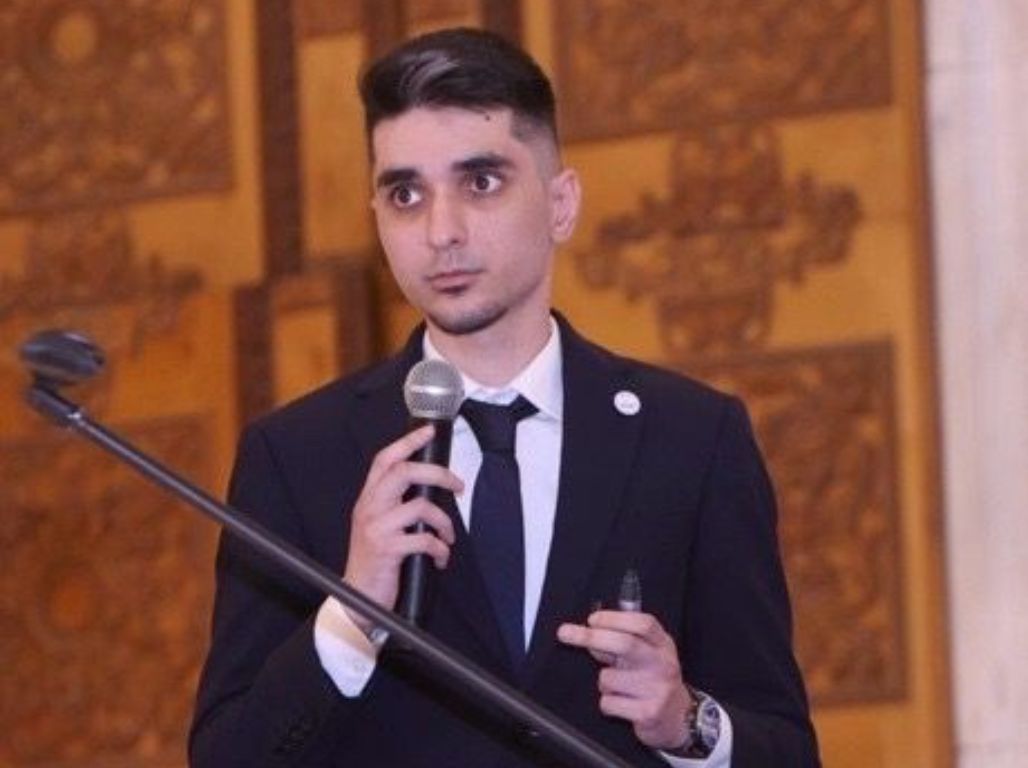
An interview with Andrei Petrușcă about professional growth, difficult decisions, communication in sensitive contexts, and how consistent involvement builds trust, communities, and lasting direction.
Andrei Petrușcă has been the Marketing & Public Relations Manager of the Romanian Chess Federation since September 2025, where he coordinates the communication and promotion strategy of one of Romania’s most important sports federations. A graduate of the Master’s program in Brand Management and Corporate Communication (SNSPA), Andrei has experience in branding, institutional communication, and leadership within the NGO and sports sectors. Throughout his career, he has coordinated national projects, communication campaigns, and multidisciplinary teams, contributing both to the increased visibility of Romanian chess and to student representation through the roles he held during his academic journey. His work combines brand strategy with public communication and community development.
C&B: If we were to look at your career as a narrative thread, what were the key moments that defined you?
Andrei Petrușcă:
If I look at my journey as a narrative thread, I believe the moments that defined me were not necessarily the most “spectacular” from the outside, but rather those in which I chose to remain consistently involved, even when it was uncomfortable or when it was not clear that anything concrete would follow.
A first key moment was my entry into the student associative environment. That was where I first understood what real leadership means: not positions, not titles, but responsibility toward people. As Director of the IT Department, then Director of the Marketing Department, and eventually President of a student league (the League of Students in Political and Administrative Sciences within SNSPA), I learned how to coordinate teams, manage pressure, and make decisions that do not please everyone, but must be fair and fully assumed. It was the environment that shaped me the most, both as a person and as a leader.
A second important moment was discovering design and communication as strategic tools, not just creative ones. From my first graphic design projects for events and organizations, I came to understand how image, messaging, and brand consistency can build trust, communities, and relevance. This is where my professional direction took shape: communication as a form of impact.
The Master’s program in Brand Management and Corporate Communication was another turning point (marking my transition from Political Science to Communication and Public Relations), as it provided the theoretical and strategic framework needed to structure my accumulated practical experience. I began to view branding, communication, and PR as business processes, with clear objectives, performance indicators, and public accountability.
The most recent defining moment was taking on the role of Marketing & Public Relations Manager at the Romanian Chess Federation. Here, everything I had built so far came together: leadership, communication, working with young people, sport, and institutional responsibility. It is a role that challenges me daily and confirms that long-term involvement, even when it does not seem immediately “profitable,” creates real opportunities.
Overall, the common thread connecting all these stages is the desire to build something meaningful alongside people, and the belief that leadership and communication can change not only an organization’s image, but also mindsets.
C&B: What has been the most difficult moment in your journey so far, and how did you overcome it?
Andrei Petrușcă:
The most difficult moment in my journey was undoubtedly the period when, as a student representative and president of a student organization, I had to become a public voice in an extremely sensitive context marked by serious abuse allegations and intense media exposure (the Alfred Bulai and Marius Pieleanu scandal regarding abuses against SNSPA female students).
It was a time when pressure came not only from the outside, but also from a deep sense of responsibility toward students. We were talking about real people, about victims who had the courage to speak up, in a climate where fear, stigmatization, and silence had long been normalized. As a student leader, I did not have the luxury of withdrawing or avoiding a position. I had to be balanced, firm, and above all, human.
The challenge was maintaining a responsible discourse that supported victims without turning the situation into conflict or public spectacle. That was when I learned what crisis communication truly means: every word matters, every message can have a real impact on people. It required a great deal of accountability, constant dialogue with students, the institution, and the press, as well as emotional strength to move forward, even when reactions were not always favorable.
I overcame that moment through consistency and solidarity—by ensuring that student voices were not lost and by continuing to demand clear measures, real reporting mechanisms, and a safe academic environment. That period shaped me deeply and taught me that authentic leadership does not mean being comfortable or popular, but assuming responsibility when it is hardest.
Looking back, it was a moment that matured me both professionally and personally and confirmed that a collective voice, supported with responsibility and empathy, can create real change.
C&B: Is there a dream or ambition that has always guided you, regardless of obstacles?
Andrei Petrușcă:
Yes, I believe the ambition that has consistently guided me is the desire to leave something behind—not necessarily something visible or spectacular, but something that matters to people and remains functional even after I am no longer there.
I have always believed that every action, no matter how small it may seem, matters if it is done with purpose and responsibility. A well-completed project, a correct decision in a difficult moment, a timely message, or a community that functions better thanks to constant involvement—all of these add up and build something much bigger than it appears at first glance.
In everything I have done—whether in student organizations, communication, design, or more recently within a national institution—I have been guided by the idea of continuity. I have never been interested only in immediate results, but in whether things can continue, whether those who come after me have a better, clearer, and safer framework in which to grow.
I believe true ambition is not about being noticed, but about building structures, mindsets, and communities that endure. And if, in the end, someone can say that things are a bit better organized, more honest, or cleaner because you were there, then I believe you have fulfilled your role.
C&B: What were you like at the beginning of your journey, and how do you feel you have transformed?
Andrei Petrușcă:
At the beginning, I was a very involved young person, but with many questions about the meaning of what I was doing. I had energy, a desire to change things, and a strong willingness to stay involved, even when I was told that “it’s not worth it” or that I was “wasting my time.” I didn’t have certainties, but I believed that sincere involvement could not be wrong.
Over time—through my master’s studies, years of student representation, and projects carried through to completion—I transformed from someone who acted mainly on instinct and enthusiasm into someone who better understands responsibility, impact, and the consequences of each decision. I learned to see the bigger picture, manage pressure, communicate more clearly, and remain consistent even when it would have been much easier to give up.
Looking back, I realize that all the late nights, seemingly impossible projects, and moments when I chose to stay mattered not only professionally, but also personally. They shaped me, gave me confidence, and helped me understand that involvement is not only about doing something for others, but also about building yourself.
Today, I feel more grounded, more accountable, and more aware of my role. I still have the same desire to do things better, but with greater clarity, structure, and patience. If at the beginning I was guided mainly by energy, now I am guided by meaning. And the most important transformation is understanding that leaders are not born, but formed through work, consistency, and the ability to remain true to their values, even when the road is difficult.
C&B: If we spoke with your collaborators, what do you think they would say about you?
Andrei Petrușcă:
I believe they would say that I am someone they can rely on—that I take responsibility, see things through to the end, and do not disappear when difficulties arise. I have always tried to be present not only in good moments, but especially when pressure increases and things become complicated.
They might also say that I am demanding, including with myself, but fair. I like to work in an organized way, with clear objectives, and I strongly believe in open communication. I prefer to discuss things directly, explain why certain decisions are made, and build solutions together rather than impose directions without dialogue.
At the same time, I hope they would say that I believe in people, especially young people. I have always tried to create contexts in which those around me can grow, take on roles, and express their viewpoints. For me, real collaboration means trust, not control.
In short, I believe they would describe me as a committed leader, results-oriented, but mindful that performance is built with and for people.
C&B: What is the most important decision you have made that changed your trajectory?
Andrei Petrușcă:
The most important decision that changed my trajectory was gradually assuming the role of student representative, culminating in the decision to become president of a student league. From the beginning, I operated from a very clear conviction: correct and effective representation is possible only when you truly listen to those you represent.
When I ran for the Faculty Council and University Senate, it was not out of a desire for visibility, but from the need to be a real channel between students and the decisions that directly affected them. The experience gained as a volunteer, marketing director, and later association president helped me understand that a leader’s role is not to speak the most, but to listen, synthesize, and responsibly carry forward the voice of an entire community.
The decision to become president came at a personally difficult time, when I questioned my own abilities. It was a breaking point: either I stopped, or I moved forward with even greater accountability. I chose to continue because I felt I could not abandon the people who trusted me or the promise I made to myself—to remain the same person and not disappoint.
This decision forced me to clarify my values and deeply understand that a position does not define a person; rather, the person gives meaning to the position. Leadership, for me, became about consistency, honesty, and the ability to turn dialogue into action.
Looking back, it was the moment when I moved from involvement to full accountability, shaping the way I view responsibility, trust, and representation to this day.
C&B: How did you build your leadership style or decision-making approach? Was it natural or learned?
Andrei Petrușcă:
My leadership style was built almost entirely through experience and through the people around me. It was not something planned or taken from a manual, but a continuous learning process made up of assumed decisions, mistakes, adjustments, and a great deal of dialogue. From the start, I understood that I cannot lead if I do not listen, and that I cannot make good decisions without truly understanding the context and the needs of those involved.
The “Future Leader” award I received at the 2025 Student Gala was a confirmation of this journey, not a destination. For me, that recognition reflected how I chose to build my leadership—close to people, based on collaboration, and on the ability to turn ideas into concrete projects. I learned that leadership does not mean having all the answers, but creating a framework in which others can find them together.
My decisions have always been influenced by context and by feedback from those around me. I was fortunate to work with people who challenged me, supported me, and helped me grow. From every project and every team, I learned something new, refining my style—to be firm when necessary, but open, empathetic, and willing to adjust direction.
Today, my decision-making process feels much more grounded and conscious. It is not about control, but trust; not about position, but responsibility. If I were to summarize, I would say my leadership is entirely learned—built over time, through people, experiences, and a constant desire to do things better.
C&B: What does a typical day look like for you now, and which moments bring you the greatest satisfaction?
Andrei Petrușcă:
A typical day usually begins with an overview of the things that need to move forward. Whether it involves institutional communication, campaigns, events, or team coordination, I like to have clarity on priorities before entering the rhythm of the day. I work in a dynamic environment where things can change quickly, so adaptability is part of the daily routine.
A large part of my day is dedicated to coordination and communication—discussions with colleagues, collaborations with partners, managing public messages, and making decisions related to image, content, and strategy. I try to be present in all key stages without losing sight of the overall direction and medium- to long-term objectives.
The moments that bring me the greatest satisfaction are those when I see things gaining meaning and continuity—when a campaign is well received, an event is properly communicated, or when I notice a team functioning better because there is trust and clarity. But perhaps most of all, I am motivated by moments when I know my work helps build a community and creates real opportunities for young people.
At the end of the day, satisfaction comes from the feeling that I contributed, even in a seemingly small way, to something that continues forward. For me, this is what makes the difference between a busy day and a truly meaningful one.
C&B: What values or principles guide you in what you do, and how do you apply them daily?
Andrei Petrușcă:
The values that guide me are, essentially, responsibility, honesty, and respect for people. Regardless of the context in which I have worked, I have tried not to lose sight of the fact that my decisions have a real impact on those around me, and that leadership means, above all, accountability.
Responsibility is reflected in how I keep my promises and see things through to completion. I prefer to say less and do more, because I know trust is built through consistency, not declared intentions. In every project or role I take on, I try to be present and involved, even when pressure is high.
Honesty is another essential principle. I believe in clear and direct communication, both within teams and in relationships with partners or communities I represent. I say things as they are, without embellishment, because only then can correct decisions be made and real solutions built.
Lastly, respect for people guides how I work every day. I try to listen, understand different perspectives, and create contexts in which everyone feels valued. Whether we are talking about colleagues, collaborators, or young people at the beginning of their journey, I believe performance emerges where there is trust and safety.
Applying these principles is a constant exercise, not a permanent state. But it is precisely this day-to-day consistency that gives meaning to my work and the direction I follow.
C&B: If you were to share a message with those who follow your example, what would it be?
Andrei Petrușcă:
My message would be simple: get involved and be patient with your own journey. Nothing that truly matters is built overnight, and the path is never linear. There will be moments when you are questioned, when you are told “it’s not worth it” or that you are “wasting your time.” If what you are doing makes sense to you and to those around you, keep going.
Do not wait until you have all the answers or feel “ready.” Leadership, confidence, and clarity are formed through experience, mistakes, and accountability. People do not follow perfection, but authenticity and consistency.
And perhaps most importantly, do not forget that every action, no matter how small it may seem, matters. A gesture, a correct decision, or sincere involvement can change the direction of a community or a person. If, in the end, you leave things a little better than you found them, then you have done exactly what needed to be done.
Leaders are not born; they are formed. And the journey always begins with the courage to stay.
Andrei Petrușcă’s story is one of consistency, commitment, and the ability to turn communication into a real instrument of change and continuity.

 UK
UK
 IT
IT
 ES
ES
 DE
DE
 FR
FR
 RO
RO
 PT
PT
 HU
HU


