


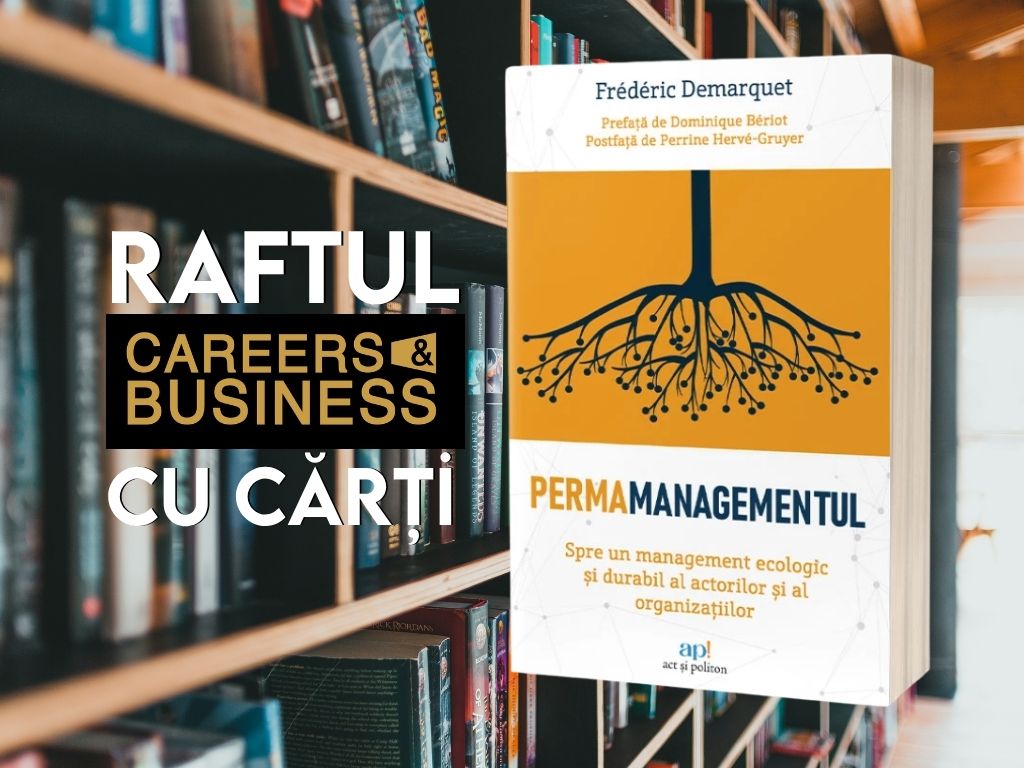
Permamanagement proposes a new model of sustainable leadership, in which organizational performance is achieved without exhausting employees, through balance, regeneration, and respect for people.
Nowadays, employees are increasingly subjected to growing pressure to perform at work. Unfortunately, many end up experiencing burnout, and quiet quitting has become a widespread phenomenon.
The book Permamanagement: Toward an Ecological and Sustainable Management of Individuals and Organizations by Frédéric Demarquet, recently published by ap! (ACT and Politon), proposes a shift inspired by agriculture, more specifically, by permaculture. This concept treats the soil with care in order to produce healthier resources for plants. Demarquet argues that, much like in permaculture, organizations must create fertile ground, namely their employees, that should be nurtured rather than intensively exploited, helping them grow instead. His concept places human resources at its core, viewing them as a living ecosystem that requires the right conditions for development and less pressure.
Exclusive excerpt
In permaculture, yields are much higher than in traditional agriculture. The main reason is respect for the ecosystem created by the permaculturist. To achieve this, they first provide the soil with what it needs in terms of nutrients, but in a natural way, always guided by the principle of observation. They replicate what exists in rich natural ecosystems. For example, they create a sowing substrate from chopped young branches and cut grass, which they add to the soil; they use mulch to preserve coolness in summer and warmth in winter, ensuring the multiplication of microorganisms; they use plant waste to make compost; they abandon monoculture, which depletes the soil; they do not plow, in order to respect the life of the soil… In this way, they harness, support, and encourage natural forces while simultaneously generating ongoing regeneration that prevents the “burnout” of the soil and all the living beings within it. Soil can only produce if life pulses within it. Without this life, it becomes depleted and dies. It loses its ability to produce anything, and it will take many years for it to regenerate and become productive again.
If we view people as the soil of organizations, we cannot help but ask questions about the ecology of individuals and groups. What makes people feel well, and be physically, emotionally, mentally, and behaviorally healthy? Do we truly take the time to observe organizations where everything seems to function smoothly, teams that deliver results without becoming exhausted? If we consider certain types of behavior as symptoms, at what point can we conclude that an individual or a group is not well?
When productivity and quality decline, many organizations tend to solve the problem by reproducing what largely caused it in the first place. They push the logic as far as possible, until reaching a breaking point, whether individual or collective. Burnout is not far behind, and, just like with soil, the years needed for reconstruction begin to accumulate.
As a result, other people are brought in and the same scenario is repeated. Some will certainly be more resilient than others, but no one is immune to risk. Moreover, many individuals, especially from younger generations, no longer wish to live through such situations. Recruitment becomes an obstacle course for many organizations, and training for certain professions turns into a complex challenge.
Speaking about ecology when referring to people, individuals, and organizations may seem confusing. However, a human being is, in itself, a complex system composed of multiple physiological, cognitive, and emotional interactions, which connect with other human systems through behaviors driven by a certain energy and which generate information. Thus, groups, teams, departments, and organizations are formed, ever-larger systems made up of smaller subsystems. We can therefore speak of “human ecosystems,” which in turn interact with inert systems and other living systems. The ecology of a system that includes the human element, such as an organization, can be measured by the ability of each individual and collective to fulfill their mission continuously, without disrupting individual or group balance beyond what can be sustained in terms of physical, emotional, and energetic expenditure.
This means that individuals must be able to regenerate sufficiently so as not to reach points of degradation that harm both individual and collective health, leading to an inability to fully carry out their missions and functions. Ideally, the efforts required and invested should themselves create opportunities for regeneration, forming a continuous virtuous cycle. Just as permaculture fosters the perpetual regeneration of soils, permamanagement aims to implement mechanisms that allow people to reach this point of balance between ensuring their well-being and maintaining their ability to produce. The closer a system gets to this functional homeostatic target, the more it nourishes its own ecology. True and optimal performance, within a sustainable and ethical framework, cannot be achieved by weakening an ecosystem and destroying its ecology. Once again, it is easier to replace a person than to replace the soil, but to what extent, and for how long?
An exhausted employee is no longer able to be creative, to grow, or to innovate. Permamanagement recognizes the valuable contribution of employees and does not ask organizations to give up performance, but rather to treat human resources with greater respect, to create a balance in which people give their best because they are cared for, appreciated, and able to develop within a healthy environment.
Permamanagement is not just an innovative concept, but an invitation to fundamentally rethink how we define performance in organizations. Instead of a culture based on pressure and the rapid consumption of human resources, it proposes a sustainable model in which people are supported to grow, regenerate, and contribute over the long term.
ap! (ACT and Politon) is one of the most important players in the Romanian book market. Specializing in high-quality nonfiction, the publishing house has brought to the local market a number of globally renowned authors such as Tim Ferriss, Robin Sharma, Tony Robbins, Wayne Dyer, Steve Harvey, Gino Wickman, and many others. At the same time, ap! (ACT and Politon) is the Romanian publisher under whose imprint the largest number of audiobooks have been released locally. Launched in 2014, the publisher has introduced over 300 audiobook titles in Romania, many of them bestsellers that have traveled the world and changed thousands of lives.
ap! (ACT and Politon) believes in continuous development and brings Romanian readers titles that cover a wide range of topics, including personal and professional development, business, entrepreneurship, spirituality, and wellbeing. The publisher’s titles are available both in traditional print format and as eBooks, MP3s, or audiobooks, allowing readers to enjoy them at any moment in their lives.

 UK
UK
 IT
IT
 ES
ES
 DE
DE
 FR
FR
 RO
RO
 PT
PT
 HU
HU


