


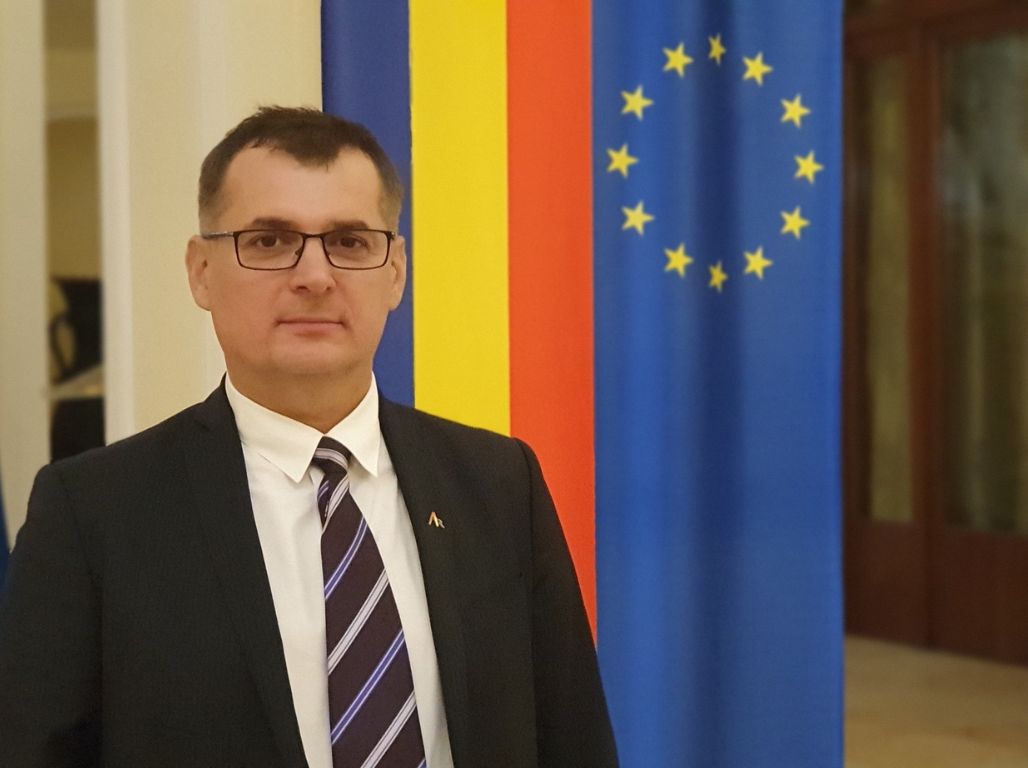
Interview with Dan Nuțiu, President of AIR, on Romanian investments in the Republic of Moldova, business opportunities, market barriers, labor market dynamics, and the role of the private sector in strengthening bilateral economic relations.
With over 25 years of experience in leading commercial and management teams, Dan Nuțiu is a professional who has built real bridges between strategy and results, with a constant focus on developing businesses in cross-border contexts. Today, as President of the Association of Investors from Romania in the Republic of Moldova (AIR), he plays a key role in supporting Romanian and European companies seeking to enter or expand in the Moldovan market, facilitating connections, partnerships, and clear growth trajectories. Find out more about his journey and market perspective in the interview below.
C&B: What was the real context that led to the establishment of AIR, and what specific market problem were you aiming to solve from the very beginning?
Dan Nuțiu: The context behind AIR’s establishment was, first and foremost, one of recognition. At that time, the Romanian capital already had a significant presence in the Republic of Moldova, but this impact was neither sufficiently visible nor aggregated into a coherent voice. Companies were present and active, but they operated more individually, without a common framework for representation and support. AIR emerged as a natural step in the maturation of this presence.
C&B: Can you give a concrete example of a situation where AIR influenced an investment or an important decision in the Republic of Moldova?
Dan Nuțiu: In several cases, AIR’s involvement made the difference between intention and a concrete investment decision. We contributed by validating market opportunities, connecting investors with local partners, and facilitating institutional dialogue when blockages or uncertainties arose.
I believe the most important impact is not tied to a single project but to the fact that we have significantly reduced investors’ perceived risk. This is reflected in the numbers: around 20 companies have entered the market with direct or indirect support from AIR, generating investments of tens of millions of euros.
Ultimately, our role is exactly this: to turn interest into decisions and decisions into real investments.
C&B: What has concretely changed in recent years that has made the Republic of Moldova more attractive to Romanian investors?
Dan Nuțiu: Several essential things have changed—and, importantly, they have changed at the same time.
First, the Republic of Moldova’s strategic direction is much clearer today. The European path is no longer just a political message; it is beginning to translate into concrete reforms, greater predictability, and alignment with European standards.
Second, the economic relationship with Romania has matured. We are no longer talking only about cultural proximity, but about real interconnection—in energy, infrastructure, and banking—which significantly reduces perceived risks for investors.
Another important element is the shift in mindset among companies. The Republic of Moldova is no longer seen merely as a small market, but as a strategic opportunity—either as a testing ground or as a gateway into the region.
All these elements together have transformed Moldova from an “opportunity market” into one where investments can be planned for the medium and long term.
C&B: Has the war in Ukraine been more of a risk factor or a catalyst for Romanian investments in the Republic of Moldova?
Dan Nuțiu: It has clearly been both—initially a risk factor, later a catalyst. In the early phase, the reaction was one of caution. Any conflict in close proximity generates uncertainty, and some companies postponed decisions or entered a waiting mode.
However, in the medium term, the effect reversed. The war accelerated the strategic repositioning of many companies in the region, and the Republic of Moldova began to be perceived differently—not just as a local market, but as part of a broader context of operational security and diversification.
I would say that the risk has not disappeared, but it is now better understood and better managed. For investors with a structured approach, the current context has even opened up new opportunities.
C&B: How do you see the positioning of the Republic of Moldova: a consumer market or a regional hub—and in which sectors is this positioning becoming real, not just theoretical?
Dan Nuțiu: I don’t think Moldova can be viewed solely as a consumer market anymore—its size is limited. But precisely this limitation has driven a smart repositioning.
In reality, Moldova is beginning to function as a regional hub. We see this becoming tangible in several key sectors:
In industry and manufacturing, especially in free economic zones, companies use Moldova as a competitive production base for exports to the EU.
In IT and services, there is already a well-developed and regionally competitive ecosystem.
In energy, interconnections with Romania are turning Moldova into a strategic point in the regional architecture.
I would say Moldova becomes relevant not by size but by positioning.
C&B: Free economic zones and tax incentives are often cited as a competitive advantage. In practice, how effective are they for investors?
Dan Nuțiu: For investors who were already operating in free economic zones before 2024, the advantages are indeed significant—especially on the fiscal side, where real benefits can influence long-term competitiveness.
However, for new investments, the regime is different. Today, the main benefits are more operational: VAT exemptions for certain flows and logistical facilities, such as on-site customs control, which simplifies and accelerates processes.
This means we can no longer speak about a major tax advantage for all investors, but rather about an operational efficiency advantage.
In practice, free economic zones remain relevant, but they are no longer a sufficient argument on their own.
C&B: What are 2–3 concrete barriers for investors that would disappear if legislative harmonization between Romania and the Republic of Moldova were complete?
Dan Nuțiu: If legislative harmonization were complete, the impact would be very concrete, not just theoretical.
First, a large part of administrative friction would disappear—differences in procedures, documentation, and interpretation that currently force companies to “relearn” the market. A business model validated in Romania could be replicated much faster in Moldova.
Second, there would be greater legal predictability. Even though the direction is European, there are still uncertainties in how legislation is applied, which increase compliance costs and decision-making time.
And very importantly, cross-border operations would be significantly simplified—from taxation to the movement of goods and services. For many companies, Romania and Moldova would begin to function almost like a single extended market rather than two separate ones.
In essence, harmonization is not just about legislative alignment, but about reducing the cost of doing business.
C&B: What is the most common mistake Romanian investors make when entering the Moldovan market?
Dan Nuțiu: The most common mistake is treating the Republic of Moldova as a simple extension of Romania.
Cultural and linguistic proximity creates a false sense of familiarity, and many companies assume that what works in Romania will automatically work here. In reality, there are important differences: market structure, purchasing power, and the dynamics of business relationships.
Perhaps most importantly, the time needed to build is often underestimated. Moldova is a market where relationships and trust matter greatly, and results do not come instantly.
In essence, the issue is not market complexity, but approach. Those who come prepared and with realistic expectations usually achieve good results.
C&B: What does the labor market in the Republic of Moldova look like in reality for an investor: deficit, opportunity, or competitive advantage?
Dan Nuțiu: In reality, it is a combination of deficit and opportunity—rarely a competitive advantage in itself.
There is undoubtedly a labor shortage, especially in certain sectors and at certain skill levels. The emigration of recent years is felt, and for investors, this means pressure on recruitment and retention.
At the same time, there is a clear opportunity: the workforce in Moldova is well-trained, adaptable, and in many cases highly competitive in terms of cost-quality ratio. This is particularly visible in IT, services, and certain industrial sectors.
I would say the labor market is no longer an “entry argument,” but it can become a differentiator for those who manage it properly.
C&B: Do you believe the private sector is more effective than the political sphere in strengthening Romania–Republic of Moldova bilateral relations?
Dan Nuțiu: I don’t think it’s a matter of being “more effective,” but of having different roles.
The political sphere creates the framework—through agreements, strategic direction, and institutional openness. Without this framework, the relationship cannot evolve sustainably.
The private sector, on the other hand, gives substance to this relationship. Investments, concrete projects, and commercial partnerships are what build the real connection between the two economies day by day.
From our experience, the private sector has the advantage of speed and pragmatism. It can react faster, identify opportunities, and turn them into tangible results. But real impact appears when the two work together. The political framework opens doors, and the private sector turns them into projects.
In essence, the Romania–Moldova relationship is strengthened neither solely by political decisions nor by private initiative, but by a balance between the two.
C&B: How can companies from the two countries join forces to enter third markets with greater competitive strength?
Dan Nuțiu: I believe this is one of the biggest opportunities that is still insufficiently exploited.
We have talked a lot about the internationalization of companies from Romania and the Republic of Moldova, but the next step is not to go separately, but together.
In practice, this means building complementary partnerships: Romanian companies with financial capacity and market access, alongside Moldovan companies with operational flexibility, competitive costs, and execution capability.
Another important element is creating joint offerings—not just exporting products, but delivering integrated solutions that can compete in larger markets.
There is also a need for greater coordination: joint participation in international fairs, joint economic missions, and, ideally, projects designed from the start with third markets in mind, not just the local market.
In essence, the real advantage appears when the two ecosystems complement rather than duplicate each other.
If done consistently, Romania and the Republic of Moldova can become far more relevant together on external markets than separately.
C&B: What role does AIR aim to take in the next stage of Moldova’s economic development and European integration?
Dan Nuțiu: AIR aims to take on a much more active role than the traditional one of representation. We are entering a stage where European integration is no longer just an objective, but a concrete process with direct impact on the business environment. In this context, AIR aims to act as a working partner—for both companies and institutions.
On one hand, we want to support companies in adapting to the standards and opportunities of the European single market—not only in terms of compliance, but also competitiveness.
At the same time, we will continue working to attract investment and strengthen the presence of Romanian capital in Moldova, but in a more structured way, with a focus on strategic sectors.
Ultimately, our goal is to contribute to transforming Moldova into a competitive and compatible economy within the European market, with the business environment as an active participant in this process, not just a beneficiary.
C&B: What is a concrete AIR project in the next 12 months that could generate a visible impact in the Moldovan business environment?
Dan Nuțiu: A concrete project we are preparing for the next 12 months is the “AIR Caravan – Republic of Moldova, a destination for investment and partnerships.”
This initiative will be carried out in collaboration with the Investment Agency and under the patronage of the Ministry of Economic Development and Digitalization, with a very clear objective: to bring the Republic of Moldova closer to Romanian investors—not just as a message, but as a concrete opportunity.
In practice, we will organize a series of events across several cities in Romania, where we will present investment opportunities, priority sectors, and concrete examples of companies already successfully operating in Moldova. The impact we aim for is very concrete: generating qualified interest and turning it into real investment and partnership projects.
In essence, we want to move the conversation from potential to decision.
The interview highlights the Republic of Moldova’s growing relevance as an investment destination, as well as the importance of a strategic and well-informed approach. In this context, AIR plays a key role in connecting opportunities with concrete decisions, contributing to the strengthening of economic ties between Romania and the Republic of Moldova.

 UK
UK
 IT
IT
 ES
ES
 DE
DE
 FR
FR
 RO
RO
 PT
PT
 HU
HU


