


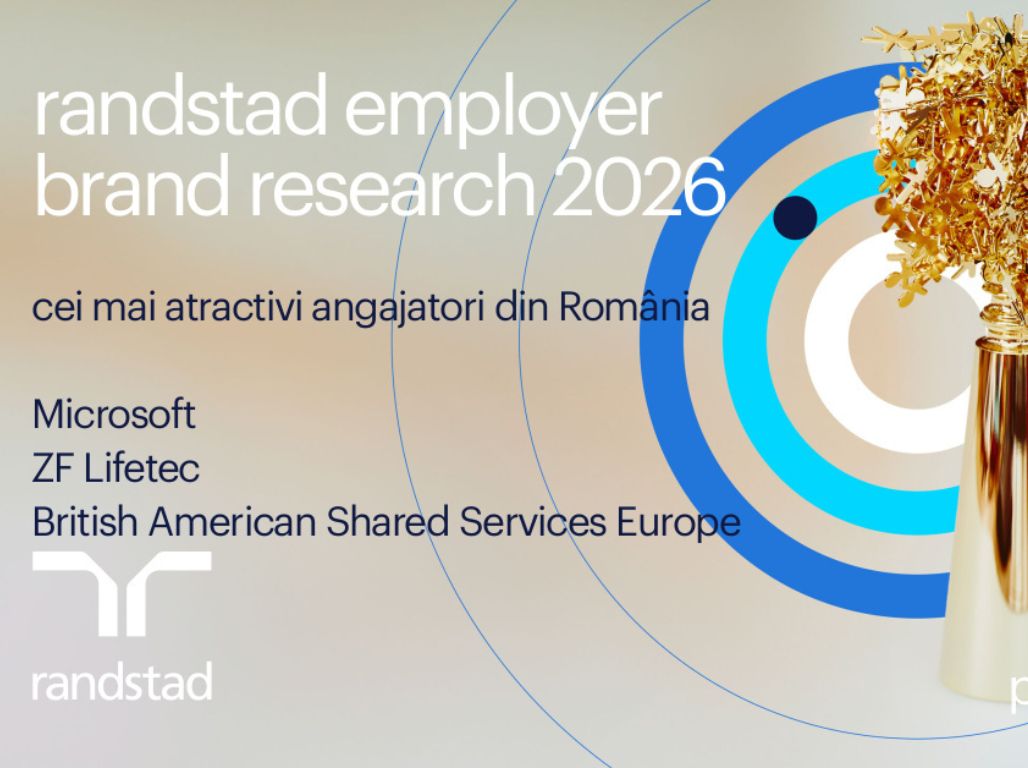
The Randstad Employer Brand Research 2026 shows that salary remains the main priority for Romanian employees, while more than a quarter are looking for a new job out of fear of losing their current one.
Salary continues to be the main reason Romanians choose or leave a workplace, according to the latest Randstad Romania Employer Brand Research 2026. The study reveals that only 51% of Romanian employees believe they are paid enough, significantly below the European average of 58%. At the same time, 28% of respondents say they intend to change jobs in the first half of 2026, while many are already looking for alternatives because they fear losing their current position.
According to the research, salary is the main criterion for choosing an employer for 67% of Romanians, and its importance increases with age and professional experience. While salary is a priority for 64% of Generation Z respondents, the percentage rises to 71% among more experienced employees.
“Salary remains an essential factor for talent, but it does not work in isolation: organizational culture and employee experience are becoming complementary elements that strengthen the employer value proposition and support long-term retention,” said Dagmara Chudzińska-Matysiak, Country Manager of Randstad Romania.
Microsoft Remains Romania’s Most Attractive Employer
The ranking of Romania’s most attractive employers is once again led by Microsoft in 2026, with the company being appreciated for its cutting-edge technology and strong market reputation. ZF Lifetec (TRW) and British American Shared Services Europe complete the podium.
Other companies highly appreciated by Romanian employees include Ford Otosa, Makita, Gedeon Richter, Digi, Banca Transilvania, eMAG, and OMV Petrom. According to the study, employees are attracted not only by competitive salaries but also by strong leadership, stability, and an excellent reputation.
Fear of Layoffs Is Pushing Employees to Look for New Jobs
One of the study’s most important findings is the gap between employees’ intention to change jobs and actual mobility in the labor market. Although 28% of respondents say they plan to change jobs in 2026, the number of those who actually did so in the second half of last year was much lower.
The main reasons employees want to leave their current workplace include:
- insufficient compensation (49%);
- lack of professional growth opportunities (37%);
- the desire for a better work-life balance (30%);
- fear of losing their current job (26%);
- the feeling that their work is not rewarded fairly (26%).
Major Differences Between Generations
The study also highlights important generational differences within the workforce. Generation Z places greater emphasis on flexibility, equal opportunities, and professional development, while also being the most active generation in changing jobs. Millennials prioritize security and stability, while Generation X employees are the most concerned about salary levels and the risk of losing their jobs.
At the same time, employees in digital roles value flexibility and work-life balance more, whereas those in operational roles focus primarily on job security and stable income.
What Romanians Expect from the Ideal Employer
According to the research, the ideal employer profile is primarily defined by salary and benefits, followed by job security, equal opportunities, a pleasant work atmosphere, and career growth opportunities. However, when evaluating their current employer, Romanians appreciate stability and easy access to the workplace the most, revealing a clear gap between expectations and reality in the labor market.
The findings of the Randstad Romania Employer Brand Research 2026 confirm that the Romanian labor market is going through a period of uncertainty, in which employees are increasingly seeking financial stability, job security, and clear career development opportunities. For companies, the challenge is no longer limited to offering competitive salaries, but also to building a credible organizational culture capable of inspiring trust and long-term employee retention.

 UK
UK
 IT
IT
 ES
ES
 DE
DE
 FR
FR
 RO
RO
 PT
PT
 HU
HU


