


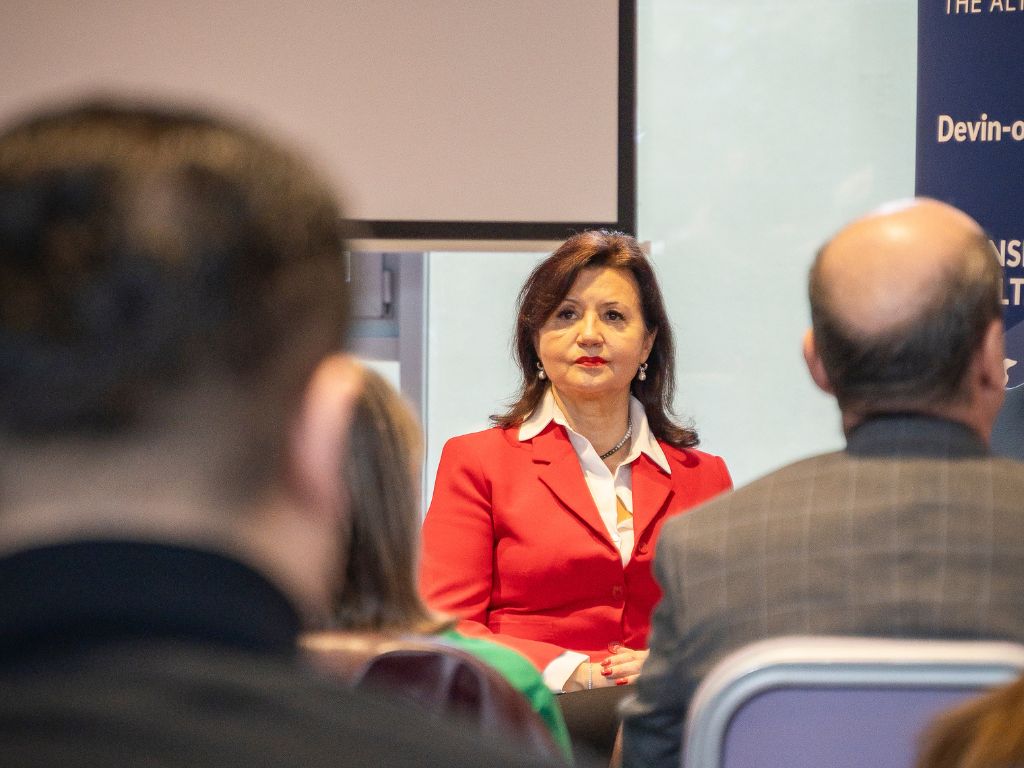
Discover the story of Cristina Filip, founder of Be Connected, on leadership, organizational development, employee retention, systemic constellations, and the balance between performance, people, and transformation in business.
Cristina Filip is an entrepreneur and organizational development consultant, the founder of Be Connected, with over 15 years of business experience and more than 17 years in the corporate environment, where she supports leaders and organizations in identifying blockages within their internal systems, aligning people, processes, and leadership, and building engaged teams and sustainable performance. At the same time, as a family and systemic constellations facilitator, she integrates into her work a profound perspective on the invisible dynamics that influence decisions, relationships, and results, working with people and organizations at a systemic level to bring clarity, stability, and direction where things seem blocked.
C&B: If we were to look at the narrative thread of your career, what were the key moments that defined you?
Cristina Filip: The narrative thread of my career is built around several moments that, looking back, fundamentally changed the way I understand performance, decision-making, and people.
One defining moment was joining a multinational organization where entrepreneurship was not just a concept, but a value lived every day. It was both a business school and a life school, where I learned what real responsibility means, how to make decisions under pressure, and the impact leadership has on people and results.
The second moment was the transition to entrepreneurship and the founding of Be Connected. Moving from the role of HR and Training Director, as part of the board, to becoming an entrepreneur meant stepping out of a system that supports and validates you into a space where you are the one creating direction, structure, and trust. It was a profound stage of professional and personal maturation.
However, the moment that radically changed my perspective was the loss of my husband. It opened another dimension of understanding — beyond logic and control — and brought me into contact with the world of family constellations, a space where I began to understand how deeply our choices and direction are influenced by invisible dynamics.
Discovering systemic constellations was the next natural step, where I realized that the same principles governing family systems are also present in organizations: in relationships, positioning, decisions, and results.
Today, what defines my work is the integration of these two worlds — the organizational one, connected to people, processes, and performance, and the deeply human one, connected to the relationship with the self. I believe true potential emerges when these two dimensions are no longer separated.
This perspective is also the foundation of my book, Când viața se rescrie – Relații transformate prin constelații familiale, in which I explore, through real experiences and personal reflections, how profound change begins from within and is then reflected in all areas of life and business.
C&B: What has been the most difficult moment in your journey so far, and how did you overcome it?
Cristina Filip: For me, the most difficult moment was losing my husband during a period when I was simultaneously responsible for leading two businesses. It was a context where it was no longer only about business decisions, but about finding the inner resources to move forward during a time of profound personal instability.
During that period, I discovered family constellations, and later chose to deepen this direction through facilitator training. It was a turning point because I started finding answers I had been searching for in business, but could not access solely through logic or analysis.
The clarity I gained through this experience helped me not only navigate that moment, but also rebuild the way I view decisions, relationships, and leadership.
The people around me — my community, family, and friends — also played an essential role, offering real support not only emotionally, but also through their presence and grounding in reality.
Looking back, it was one of the most difficult periods, but also one that profoundly changed my direction and the way I work today with people and organizations.
C&B: When did you realize this project could become a scalable business?
Cristina Filip: The moment I realized this project could become a scalable business was when I deeply understood the mechanisms behind blockages — not only at an individual level, but also within organizations.
Until that point, I had been working more intuitively, based on experience. But when I started seeing recurring patterns — in decisions, relationships, and team dynamics — and understanding what generated them and how they could be transformed, it became clear that this was not only about isolated interventions, but about a model that could be replicated and scaled.
That was when I realized I could take this approach further — not only to individuals, but also to entrepreneurs, leaders, and organizations facing similar blockages, even if they appeared in different forms.
For me, scalability did not come only from structure or products, but from the clarity of the method and the fact that the results are relevant across various contexts — from personal life to strategic business decisions.
C&B: What personally motivated you to pursue the learning & organizational development field?
Cristina Filip: For me, choosing the learning and organizational development field was not a calculated decision, but rather a natural direction.
I have always been drawn to the idea of development — real growth, not only in terms of results, but also at the human level. I was constantly interested in how I could use more of what I enjoy and what feels meaningful to me. And the answer came simply: by working with people and contributing to their growth.
Over time, I realized that beyond strategies, processes, or information, what truly makes the difference in an organization is its people — the way they think, relate, make decisions, and manage pressure. That is where blockages appear, but also where potential exists.
My motivation comes from the desire to create spaces where people can see more clearly, understand what blocks them, and make more conscious choices — both for themselves and for the organizations they are part of.
C&B: If we met your team or collaborators, what do you think they would say about you?
Cristina Filip: I believe that if you asked the people I work with, they would first talk about connection — about the way I manage to create a space where they feel seen and understood.
They would say that I offer guidance and support, but without imposing directions, instead helping them find their own answers. That I pay attention to people, nuances, and to what is not said directly, yet still influences relationships and decisions.
They would probably also mention the energy I bring — positive, yet grounded in reality — and my ability to mobilize people, becoming a sort of engine in achieving goals, especially when things seem blocked.
And perhaps most importantly, that I work “together with them,” in an authentic partnership where growth is built step by step.
C&B: What is the most important decision you have made that changed your trajectory?
Cristina Filip: I do not believe there was a single decision that was “the most important” and completely changed my trajectory.
Rather, my journey has been built through a series of choices and events that, put together, guided me toward where I am today. There were many turning points — some conscious, others shaped by circumstances I could not control — but each contributed to greater clarity and the next step forward.
Looking back, I realize the common thread was not one singular decision, but the willingness to listen to myself, adapt, and move forward even when I did not have all the answers.
All these “small” decisions actually built the big change.
C&B: How did you build your leadership style and your way of making decisions? Was it a natural or learned process?
Cristina Filip: When I look back at my first leadership role and the journey that followed, I can say that my leadership style and the way I make decisions were not fixed or something I was simply “given,” but rather an ongoing process of development.
They were built over time, through direct experience, different contexts, and the people I worked with. Every situation — especially the difficult or high-stakes ones — challenged me to adapt my approach, better understand relationship dynamics, and recognize the impact decisions have on teams and results.
To a large extent, it was a learned process, but one deeply grounded in practice. Not only from theory, but from reality: from understanding what works, what does not, and from the ability to constantly reflect and adjust.
Today, I would say my leadership style is based on connection, clarity, and responsibility — and my decisions come from a balance between analysis, intuition, and a deep understanding of the human context behind every situation.
C&B: What are the most common mistakes organizations make when trying to motivate employees?
Cristina Filip: One of the most common mistakes organizations make is believing motivation can be “solved” mechanically — through salary increases or benefit packages — and that this will automatically lead to engagement, satisfaction, and performance.
In reality, things are far more nuanced.
Salaries and benefits are essential for market alignment and competitiveness. But they are not enough to build an environment where people truly want to stay and perform. Real motivation comes from a much more complex mix: the quality of relationships, leadership style, sense of meaning, recognition, and psychological safety.
Another mistake is implementing initiatives without truly understanding the organization’s reality. My recommendation is simple: do not offer solutions before measuring. Understand where you are, what people feel, and what they want. An employee opinion survey can be a valuable starting point.
But equally important is what happens afterward. Very often, organizations collect feedback but fail to act concretely, which leads to even greater frustration and mistrust.
And perhaps most importantly, the impact of toxic relationships is often ignored. Sometimes, changing a manager or removing destructive behavior can completely transform the atmosphere and restore people’s energy, joy, and willingness to engage.
Motivation is not a button you press. It is the result of a system of relationships, decisions, and contexts that you create day by day.
C&B: What does a typical day look like for you now, and which moments bring you the greatest satisfaction?
Cristina Filip: My days never look the same — and I think that is exactly what makes them alive. I work with a variety of contexts, people, and challenges, and the rhythm comes from this diversity: client meetings, work sessions, workshop preparation, or moments of reflection and structuring.
Still, there is a common thread that gives meaning to every day.
The greatest moments of satisfaction appear when, while working with clients, that “aha” moment happens. When I hear: “I never thought this could be what was blocking me.” That is the moment when something becomes visible and clear, and the perspective shifts.
Equally valuable are the moments when I see people succeed in removing blockages — whether related to difficult decisions, relationships, or professional contexts. That is where not only clarity appears, but also energy, courage, and direction.
For me, satisfaction comes from these real transformations, from the changes I see in people and in the way they choose to move forward.
C&B: What values or principles guide you in what you do, and how do you apply them daily?
Cristina Filip: The values and principles that guide me are not just things I believe in, but things I live every day in everything I do.
Authentic connection with people
For me, relationships are the foundation. I create spaces where people can truly see themselves beyond roles or titles. In every interaction, I choose to be present, attentive, and open.
Clarity beyond appearances
I do not stop at what is visible or logical. I look deeper, where the real blockages exist. I enjoy guiding conversations to the point where clarity appears and things begin to make sense.
Personal responsibility
I believe every person has the resources needed to find their own answers. My role is to create the context and guide, not to provide ready-made solutions. I encourage ownership and conscious choices.
Growth through awareness
I do not believe only in “doing more,” but in understanding better. Real and sustainable change comes from that understanding. That is what I pursue in everything I do.
Authenticity and coherence
For me, it is important that there is alignment between what I say and what I do. People feel this coherence, and trust is built from there.
I apply these values daily through the way I work with people, through the questions I ask, the space I create, and the decisions I make.
C&B: How did the idea behind Be Connected emerge, and what real problem did you want to solve in the market?
Cristina Filip: Be Connected emerged from a real need I observed while working with organizations, leaders, and teams: although strategies, processes, and investments in people exist, retention and engagement remain constant challenges.
I wanted to create more than traditional consulting and organizational or personal development services. I wanted to create a framework where we could go beyond the surface — to the place where the blockages affecting performance, relationships, and decisions are actually formed.
Studies and direct experience confirmed for me that motivation and retention are not only about benefits or isolated initiatives. That is why I built initiatives such as Engage, Retain & Grow – Executive Event and programs dedicated to the organizational environment, approaching employee engagement in an integrated way: leadership, relationships, organizational culture, and the invisible mechanisms influencing behavior.
At the same time, the workshops — both organizational and individual — complement this approach. They add an experiential dimension, where people not only understand, but concretely see what blocks them and can create real change.
The problem I wanted to solve is not the lack of information, but the lack of clarity and connection. Because most of the time, organizations know what they should do, but fail to truly change how people function internally.
Be Connected is the answer to this need: an approach that connects strategy with the human reality inside organizations and creates contexts in which people can become more engaged, stay longer, and perform — not out of obligation, but out of meaning and alignment.
C&B: How have companies’ needs changed in recent years?
Cristina Filip: Looking at the evolution of recent years, I believe companies’ needs have changed not only in depth, but also in pace — much faster than they were used to.
In the past, the focus was on processes, efficiency, and results. Today, these remain important, but they are complemented by two major pressures: people and technology, especially AI.
On one hand, companies increasingly feel the challenges related to retention and engagement. It is no longer enough to offer stability or benefits. People are looking for meaning, autonomy, healthy relationships, and leadership that truly sees and understands them. This creates a real need to build organizational cultures where people choose to stay, not simply remain.
On the other hand, AI is fundamentally changing the way we work. It automates processes and increases efficiency, but at the same time places pressure on roles, competencies, and the way leaders make decisions. Companies no longer need only people who execute, but people who think, adapt, and can work in a constantly changing environment.
And here an interesting tension appears: the more technology advances, the more important the human component becomes. Relationships, trust, clarity in decisions, and the ability to navigate uncertainty cannot be automated.
At the same time, leaders face increasingly complex decisions: how to integrate AI without losing people, how to increase performance without creating burnout, and how to remain relevant in a constantly changing context.
That is why I believe companies today have a dual need: to keep pace with technology while not losing sight of what is essential — people and the way they function together.
Ultimately, the difference will not be made by whoever adopts AI the fastest, but by whoever manages to create a real balance between technological performance and human maturity within organizations.
C&B: How was the Engage, Retain & Grow event born, and what role does it play in your ecosystem?
Cristina Filip: The Engage, Retain & Grow event did not emerge as an isolated initiative, but as part of a broader ecosystem we built around a very clear organizational need: how do we truly create engagement, retention, and sustainable performance?
Everything started with the analysis and deep understanding of the phenomenon — through a study dedicated to retention and engagement, where we examined not only the data, but also the business impact and the practices that genuinely work. This study highlighted one essential thing: the difference is not made by isolated initiatives, but by the coherence between leadership, culture, and the way people experience the organization day by day.
Based on these insights, Engage, Retain & Grow – Executive Event was created as a space where leaders can understand these dynamics, see concrete examples, and have relevant conversations that go beyond theory.
However, the event is only one part of the ecosystem.
We also built the “Engage, Retain & Grow” program, structured into eight modules, which takes things further — from awareness into implementation. It is a framework in which organizations can work practically on their own realities: from leadership and relationships to the mechanisms influencing engagement and retention.
The role of the event within this ecosystem is one of opening and clarification. It is the place where the right questions emerge, where leaders begin to see what is not working and where the actual blockages exist.
Then, through the program and subsequent interventions, this process continues and transforms into concrete actions and real change.
In essence, Engage, Retain & Grow is not just an event, but an integrated system — from understanding (study), to awareness (event), to transformation (program) — built to respond to a real challenge in today’s business environment.
Through her expertise in leadership, organizational development, and systemic constellations, Cristina Filip offers an integrated perspective on how organizations can build employee retention, engagement, and sustainable performance.

 UK
UK
 IT
IT
 ES
ES
 DE
DE
 FR
FR
 RO
RO
 PT
PT
 HU
HU


