


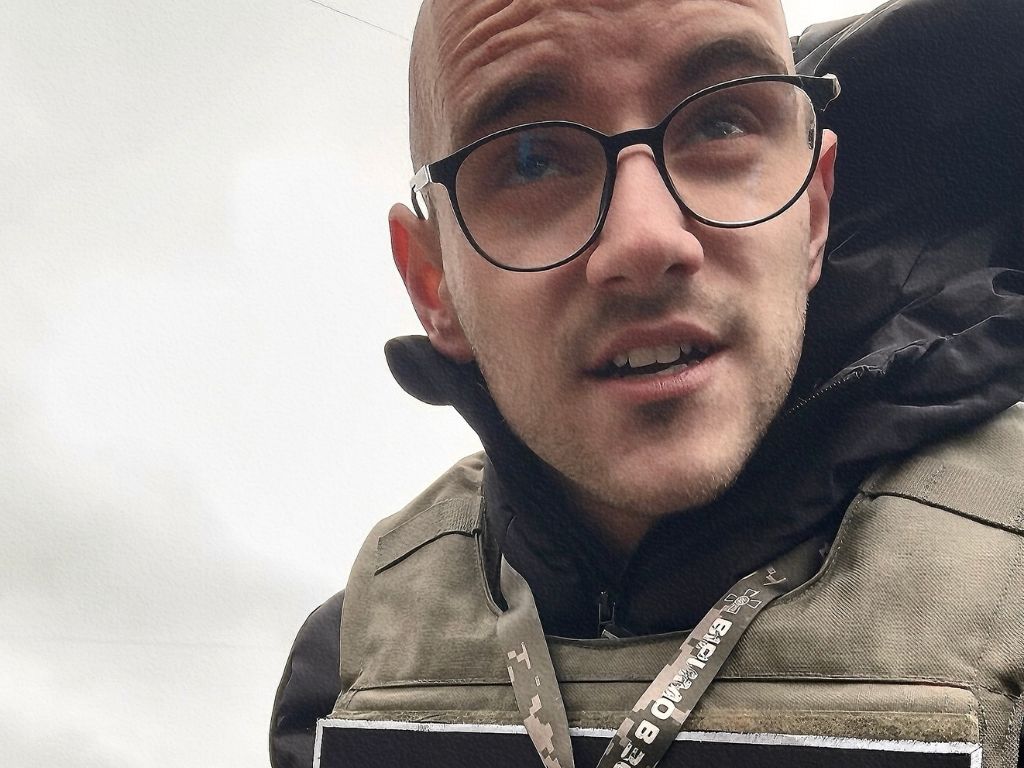
Alex Craiu, a Veridica journalist and war correspondent in Ukraine, reflects on the decisions that shaped his career, life in a country at war, and the human lessons learned on the ground.
Alex Craiu is a Veridica journalist and war correspondent in Ukraine. He has been living full-time in Ukraine since September 2023 — he previously lived in Zaporizhzhia and is now based in Kyiv. He collaborates with multiple national television stations in Romania and has weekly appearances on the program “Frontul” on TVR Info. In parallel, he documents Ukraine and other places informally on social media under the suggestive name “Nu Vrei Aici” (“You Don’t Want to Be Here”), as the topics are of interest to people who, generally, would not want to travel to the places where Alex produces his reports. Alex is a graduate of film school in Leeds (United Kingdom) and Sacramento (California, USA), specializing in video documentary. In 2017, he completed an internship with the BBC.
C&B: If we were to look at a narrative thread of your career, what were the key moments that defined you?
Alex Craiu: The start of my collaboration with Veridica was a key moment. I had no experience as a journalist, but after a conversation one morning with Marian Voicu and Cătălin Gomboș, it was clear that we had to work together. It was the perfect platform where I could showcase my work, and I was the right person — I had already been in Ukraine for a few months and was going to stay indefinitely as a field reporter.
In the past, I made many efforts to build a loyal audience that would read my blog, then watch my vlogs, and eventually at least follow my social media pages. I went through all those phases, without success. I was making almost the same type of content that I make now. But something was missing: the niche. A precise one. “Vlogs in Romanian” was not a niche, nor were “Vlogs from Ukraine.” But the combination of the two filled a gap. And from there, all my previous projects started to work: not only did people read and watch my video content, but my social media audience grew significantly. And the bonus was the collaboration with Veridica, where I feel I can practice my profession ethically and cleanly.
C&B: What has been the most difficult moment so far in your journey, and how did you overcome it?
Alex Craiu: The decision to stay in Ukraine was difficult. It wasn’t a decision I made overnight. It was a decision I made every day, week, or month in which I extended my stay. Each time, I knew that professionally I needed to be there, but on a personal level I did not resonate with Ukraine. It’s a different culture, and from that stem all kinds of barriers — linguistic, cultural, social, adaptive, and so on. Of course, that’s normal — I can’t imagine that other war correspondents in the Middle East resonate better with their temporary base; on the contrary, it’s probably even more difficult for them. When your life and health are potentially the things you are sacrificing, a fundamental dilemma arises, at least for me. In theory, at least, nothing is more important than those two. Physical and psychological imbalances appear after a prolonged time in a country at war, where everything becomes about work. The reason I stayed is that, so far at least, I have managed to somehow navigate through these obstacles. My resources are not unlimited, but they are renewable. I have to be careful not to consume them all before the next recharge.
C&B: Is there a dream or ambition that has always guided you, regardless of obstacles?
Alex Craiu: I am usually not satisfied with an answer like “it can’t be done.” Obviously, I don’t take that into any absurd or extreme territory. Not everything is possible, and it’s absurd not to understand that. Maturity can be both a friend and an adversary. On one hand, it teaches you that in real life some things cannot be achieved and that you need to manage that, preferably without existential crises. On the other hand, it can limit you when you accept too quickly that you can’t or shouldn’t do a certain thing.
I was born in Turda and grew up in a rural area nearby. Dreams weren’t big back then, and life was slow. The kind of environment where survival itself is an achievement. My favorite toy as a child was a mirror; I imagined that, through the different visual perspectives I saw in it, I could capture frames as I would with a video camera. I made my own shows with scripts and everything. It was a toy too atypical for a child, and that explains why I wasn’t encouraged to go down this path. But I kept that dream and didn’t let go of it until I was old enough to do something concrete to follow this professional path. “Maturity” could have marked the moment when I gave up on this dream, believing it was something too grand for me, or, on the contrary, it could be the point from which I could explore that path even further. If I hadn’t chosen the latter, this interview wouldn’t exist 🙂
C&B: What determined you to become a war correspondent and work on the front line, in such a serious conflict context?
Alex Craiu: Several factors, but curiosity had a significant weight. I didn’t make content that bored me just hoping to attract numbers; I always explored subjects that interested me, that sparked this curiosity. Out of personal curiosity, I first came to Ukraine in 2022 and started filming vlogs, and out of personal curiosity, the materials I was making moved to the next level — one where, through a more official, journalistic approach, I explored certain topics in depth.
In addition, I return to the importance of the niche I chose, because that also determined me to continue; there were no Romanian journalists living full-time in Ukraine. Some of my colleagues produced very good material, but they came and went. I stayed. It was a kind of discovery in which I found my place very well. From there came my success, until people started to know me and my audience became loyal. The thought that I hadn’t taken advantage of this opportunity would have troubled me. And that feeling of success, of personal achievement, is addictive. Otherwise, I never sought to be on the side of conflicts and had no expertise in the military field. I never intended to become a war correspondent, but I wanted to do something significant, at this level.
C&B: If we were to meet your team or collaborators, what do you think they would say about you?
Alex Craiu: I can guess, based on the feedback I receive. Most often, I’ve been told that I’m very brave for doing what I do. In reality, by nature, I am clinically anxious. I’m a hypochondriac, stressed, often in fight or flight mode.
If they were completely honest, they would also tell you that I am very impatient. When I have to film something or publish something, I tend to rush things, feeling that they will lose their relevance or that I will lose interest in them. That’s a flaw, just like impulsiveness is.
The people I work with are satisfied with my work and sometimes even praise it, but something tells me that if they witnessed the process by which I reach that result, they might not be as confident in me. Professionally, I am not surrounded by people who praise me often. The people I work with at Veridica, for example, having extensive experience in the field, understand that solid material is the standard we should be working at anyway, so there isn’t much room for praise (obviously, except when a particular piece far exceeds expectations, which happens occasionally).
In general, other collaborations occasionally come with the “mirage of war correspondence,” and that brings me compliments that I don’t know how to manage very well; half of them are just personal observations, not virtues in the true sense of the word, and the other half sometimes fill me with positivity and other times make me wonder whether these people are mistaken.
Impostor syndrome, perhaps? I think each of us is an impostor at some point. After you realize that, you have to decide what to do next.
C&B: What is the most important decision you have made that changed your trajectory?
Alex Craiu: I think that often a decision that, in isolation, seems insignificant becomes the most important decision in a certain context because everything else stems from it. Chain reactions, direct and indirect consequences, the way life events are sometimes interconnected. Causality, determinism, but sometimes coincidences as well. That’s how I explain things; I don’t believe in destiny or supernatural interventions.
In my adolescence, I moved to England with my parents, as part of a family decision. Considering the importance of the decisions I made many years later (probably the decision to become a war correspondent itself), that decision may not have seemed the most important at first glance. But with that move, the paradigm in which I began to think changed, along with my studies, experiences, and so on. And all of that brought me to this point. Of course, you can reduce this logic to absurdity, but I prefer to be reasonable and say that, in reality, the decision to go to university, the decision to leave the UK after finishing my studies, the decision to do things in parallel with university were factors that helped me. I have the impression that I still haven’t been faced with the most important decision of my life. But since I don’t have a crystal ball or superpowers, I have no idea whether that’s true or not.
C&B: How do you prepare before going into a conflict zone — practically, psychologically, logistically?
Alex Craiu: Some people are helped by preparing as much as they can, by feeling that they have as much control as possible. That sometimes reduces anxiety and unforeseen situations. But in a country at war, everything is unforeseen anyway. In my case, being impulsive, I don’t prepare too much and prefer to do things as soon as possible. Moreover, preparation and anticipation amplify anxiety. When you prepare for an event for a long time, you are struck by its importance and by the entire buildup of emotions, and that doesn’t help some people.
When traveling to risk zones, resources are important. Good sleep, a good physical and psychological state contribute to a better “baggage” you take with you. But enough with the abstract part. Let’s move on to something more practical:
Your passport always with you, as well as your press accreditation — there are military checkpoints you must pass. Supplies — water, food. A full fuel tank. Offline maps because the signal is unstable. You learn to take physical landmarks in places you don’t know; satellites are sometimes jammed and you can’t rely on GPS.
Psychologically, you look for things that bring you comfort. You listen to something familiar or, on the contrary, to stupid music, something that doesn’t match the situation you’re in. I was the one driving toward territories within artillery range, villages deep in the Zaporizhzhia region, blasting Aurel Tămaș through the speakers. A ridiculous juxtaposition. Either the anxiety gives in, or you give in and turn off the music. The goal is to reduce the likelihood that you have to physically stop because of a panic attack. The thought of the return journey is comforting. When you come back along a road you’ve already traveled, things suddenly seem better. You promise yourself you won’t venture like this again next time. But the circle has to be completed, otherwise I wouldn’t be here anymore 🙂
C&B: What was the first moment or scene that profoundly marked you since you began this mission?
Alex Craiu: I remember my “baptism” in the winter of 2023. The first massive air attack I witnessed. I was somewhere in western Kyiv, near one of the airports. The area was frequently attacked, and that evening drones and missiles were hitting the capital hard. I was standing by my window on the 13th floor, filming everything, even though I knew I couldn’t publish those images without providing strategic information to the enemy, thus endangering Ukraine’s security. The less you know, the less fear there is. When you don’t yet have the psychological burden of multiple attacks you’ve experienced, there are fewer tragic associations in your mind. At first, explosions sound like fireworks. After a while, fireworks sound like explosions. I have no idea whether there is some psychological preparation protocol that someone intending to work in conflict zones should follow. Maybe it’s included in the war correspondent course I never took. I think it’s useful, but I’ll be a bit annoying now and say that, more important than taking a course you may never use (many who take such courses never reach combat zones) is learning certain things on the go, even if you feel like an impostor at first.
C&B: What does a typical day look like for you now, and what moments of the day bring you the greatest satisfaction?
Alex Craiu: In the end-of-year months, with the deterioration of the situation in Ukraine (intensified attacks, power outages, low temperatures), my satisfaction was limited strictly to professional results and to the thought that, at some point, I would take a well-deserved break from Ukraine and leave for those few weeks a year that I can afford outside the war.
A typical day is strangely typical. In Ukraine, no one recognizes me on the street. I camouflage myself well; it’s not very obvious that I’m a foreigner, and that helps me not draw attention on days when I don’t want to seem like an alien on a mission. I go to shops, for walks, and my work schedule is flexible at best, chaotic at worst. I film, edit, write when needed, and schedule everything else around that. I cook less lately due to time constraints and power outages. Everyday life sometimes interferes with my work as a war correspondent because I don’t have personal assistants, I don’t stay in hotels, and I don’t have special privileges. At the end of the day, like everyone else, I’m just someone trying to live and do something else alongside that.
C&B: What is the most powerful human lesson you have learned while reporting from conflict zones?
Alex Craiu: That everything that is built can also be destroyed. Everything that is gained can be lost. Losing close people is, by far, the greatest loss. I’m not bringing anything new here, but when you truly understand this, it’s a reality that hits differently.
I’ve had people in front of my camera crying as they told me about children who died, life partners, parents who were killed in bombings. Others suffered before they died. I’ve met people who never found the answers they were looking for: relatives who went to war and never returned home; neither alive nor dead. “Missing in action” often means “dead, but impossible to confirm or recover the body from the front.” It’s a pain I don’t fully understand because I haven’t had that personal experience, but I understand it better since living in Ukraine.
Many Ukrainians now understand that material things are less valuable than they thought before. However, you might be surprised — some still haven’t understood that. There are still cases of corruption where people seek to appropriate various benefits despite knowing very well how easily you can lose everything in a second. Perhaps these people don’t think deeply enough, or perhaps, on the contrary, it’s a coping mechanism for them.
C&B: What criteria do you use when deciding what to transmit and what not to, for the safety of those involved?
Alex Craiu: Ethical, moral, and deontological journalistic principles also apply to war correspondence. But beyond them, there is the context of martial law and an additional set of rules that journalists must consider.
From embargoes (you are not allowed to speak publicly about an important event you participated in until several hours later, so as not to endanger the safety of those involved) to attention to detail to avoid leaking strategic information, you must treat what you publish with maximum responsibility, whether you work for a large publication or the opposite.
A war correspondent must always establish a strong trust agreement with the people who facilitate their work. Soldiers, police officers, civilians, other journalists. When you work with sensitive information that, if it falls into the wrong hands, can endanger national security, you must choose carefully the people you collaborate with and trust. But paranoia is also an extreme that should be avoided.
You can’t do this job alone. You must learn how to convince others that you are trustworthy. Call it “war networking,” if you like. You must keep your honor and earn the respect of those you work with. You must be correct, honest, but at the same time never betray anyone’s confidentiality. Mistakes are rarely forgiven and even more rarely forgotten.
Inevitably, you will learn secrets, perhaps even state secrets or classified information. You become an important person for those who want to obtain that information; therefore, responsibility increases, and suddenly you realize that you could have been a simple, armchair journalist, rewriting information from major agencies between two overpriced coffees. But you chose real, field work. The paradigm here is completely different.
C&B: Looking back at everything you’ve reported and experienced, what message would you convey to the world about the people and places you encountered during this difficult mission?
Alex Craiu: I believe that most people need something that takes them out of their comfort zone, an experience that changes the paradigm in which they think. Looking at people’s reactions, I’ve concluded that not all those who appreciate my work have had such an experience, but all those who discredit me have not truly left their comfort zone. From that position, it’s difficult to understand complex issues that extend far beyond familiar horizons.
In general, I’ve learned that the only things you truly need to do in life are to survive, to live, to maintain your physical health and, necessarily, your mental health. Everything else is a bonus, something that may be important to do but not absolutely necessary. Your job can change at some point. One day, you can lose your house and car or, on the contrary, buy a better one that satisfies you more. The only “thing” you will have for life is yourself. Perhaps truisms like these are born from some people’s personal experiences, completely irrelevant to others, so I’ll stop here. The conclusions are still being updated as my work in Ukraine continues. There will be a moment when I will change the path I started in 2023, when I moved to Ukraine. Every chapter has an ending, and in that spirit, I hope that in this mission as a war correspondent, I have less ahead of me than behind me.
Alex Craiu’s story is not about spectacular heroism, but about choices made and remade every day in a reality where comfort, safety, and certainty no longer exist.

 UK
UK
 IT
IT
 ES
ES
 DE
DE
 FR
FR
 RO
RO
 PT
PT
 HU
HU


