


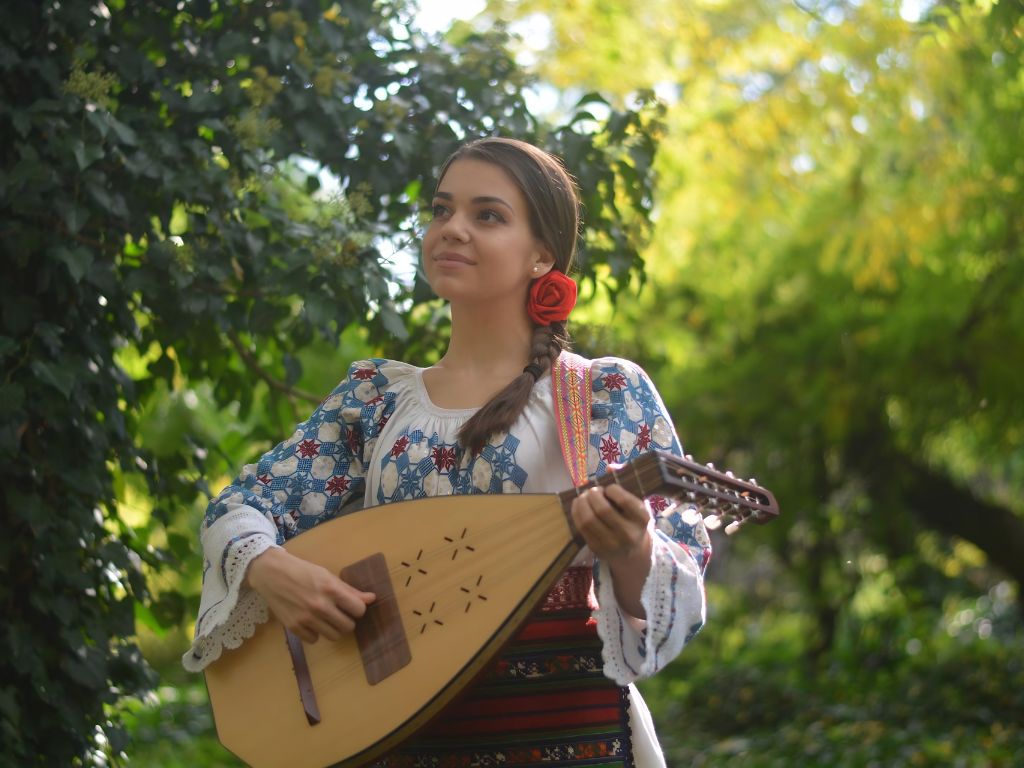
Interview about romanian folk music, cobza, and modern fusion: the journey of an artist and how she carries Romanian folklore forward.
Maria Chivu is an educator and musician, a graduate of the Faculty of Music, trained in vocal performance and cobza; she is involved in numerous artistic projects, founder of the vocal group Jianca, collaborator of producer David Ciente, and part of the concept Lăutăresele, initiated by Șaraimanic.
C&B: How did your relationship with folk music begin, and where did your love for the cobza come from?
Maria Chivu: My relationship with folklore began in childhood. Romanian folk music was present in my home at every celebration and in every important moment. I grew up with its sound and, without realizing it, it became part of how I feel the world. My love for the cobza came as a natural discovery: I was drawn to its vibration and its history. When I first held a cobza, I felt I had found an instrument that represents me and allows me to carry forward an extremely valuable tradition. Since then, folk music and the cobza have been not just passions, but an essential part of my artistic identity.
C&B: What has been the most difficult moment in your journey so far, and how did you overcome it?
Maria Chivu: The most difficult moment in my journey was when I had to find a balance between all the projects I was involved in and my inner rhythm, between what I had to do and what I truly wanted to do. There were periods when I felt overwhelmed, but over time I learned to choose what is best for me. When I feel that I am drifting away from myself, I go back home, to Ostroveni, the place where I grew up and where people still live by their own rhythm, in peace and simplicity. There I remember that life is not just a constant rush, as it often seems nowadays, but that sometimes it is good, healthy, and even necessary to take a break. Other times, I gather my thoughts by sewing traditional blouses; it connects me with tradition and brings back my patience. This is how I manage to find myself again and move forward, more at peace and more confident in my path.
C&B: Is there a dream or ambition that has always guided you, regardless of obstacles?
Maria Chivu: Yes, I have always had a dream that guided me. I like to listen to my intuition, and it has always led me toward music. When I sing, I find peace; I feel that I am settling into my place, that I am fulfilling my purpose on this earth. I feel that this is the gift I have received and that I must carry forward to people. God chose this path for me, from the gift He gave me to the people He placed along my way. I simply try to do everything I can in this direction—to grow, to learn, and to honor the gift I have received through every song I offer.
C&B: What did the decision to participate in Vedeta Populară mean to you, and why did you feel it was the right moment?
Maria Chivu: My first participation in Vedeta Populară came following a proposal that deeply honored me: maestro Tudor Gheorghe encouraged me to enter the competition. I accepted the challenge with emotion and gratitude, and that journey took me all the way to the final. It was an experience that gave me confidence and helped me better understand who I am as an artist.
My second participation was different, because it came from my own desire. I felt the need to push my limits, to show how I feel and carry forward folklore, and to work with professionals, because I like to take things seriously. For me, the competition was a conscious challenge, a path I wanted to see through to the end. And I did. After enjoying every stage, every rehearsal, and all the emotion of the competition, I was awarded the Vedeta Populară trophy. It was a unique moment, a validation, and one of the most beautiful memories I have ever experienced.
C&B: How did you experience the Vedeta Populară competition, and what impressed you most during that journey?
Maria Chivu: The experience at Vedeta Populară was, for me, an intense process of working with myself. An essential support throughout this journey was Professor Cristian Mihăescu, who guided me with patience and professionalism. I spent entire days studying, searching for the right repertoire, working on every detail of the pieces, and learning how to manage my emotions so they wouldn’t overwhelm me. All this preparation helped me experience the competition with joy. Backstage, before going on stage, I had a mix of emotions and thoughts that unsettled me, but the moment I stepped into the stage lights, everything simplified. I remembered my beginnings, the moments when I sang simply because I loved it, and I entered that same state of sincerity. On stage, it was just me, the orchestra, and that special energy created when music comes alive. I felt it lifting me, placing me where I belong.
After each performance, knowing I had given everything I could in that moment, I waited calmly for the jury’s reaction. From one stage to the next, I learned, adjusted, and grew.
C&B: What is the most important decision you have made that changed your trajectory?
Maria Chivu: I believe the most important decision that changed my trajectory was participating in Vedeta Populară. It was the moment when I managed to prove to myself that this is my path. Until then, I had many questions, many possible directions, and I didn’t know exactly where to go. Before entering the competition, I told myself something very simple: if I manage to at least reach the final, then it means this is the path I should choose and that it is worth dedicating all my time to music. It was my way of asking for a sign, a confirmation.
And that sign came. Because nowhere do I feel better than when I make music, when I connect with people through what I sing, and when I can share my passion with those who receive it. Winning the competition was a strong, clear confirmation that I am exactly where I need to be. That decision changed my life. It brought clarity, direction, and helped me understand that when you listen to your soul, the path opens before you.
C&B: What does winning season 8 mean to you, and how has this success changed your artistic perspective?
Maria Chivu: This achievement was not an endpoint, but a beginning. It showed me that I must move forward with more courage, but also with a deeper awareness of the responsibility I have: to carry folklore forward in my own way, with respect, care, and all the seriousness it deserves.
C&B: How do you manage to combine traditional authenticity with modern influences in the way you sing or interpret?
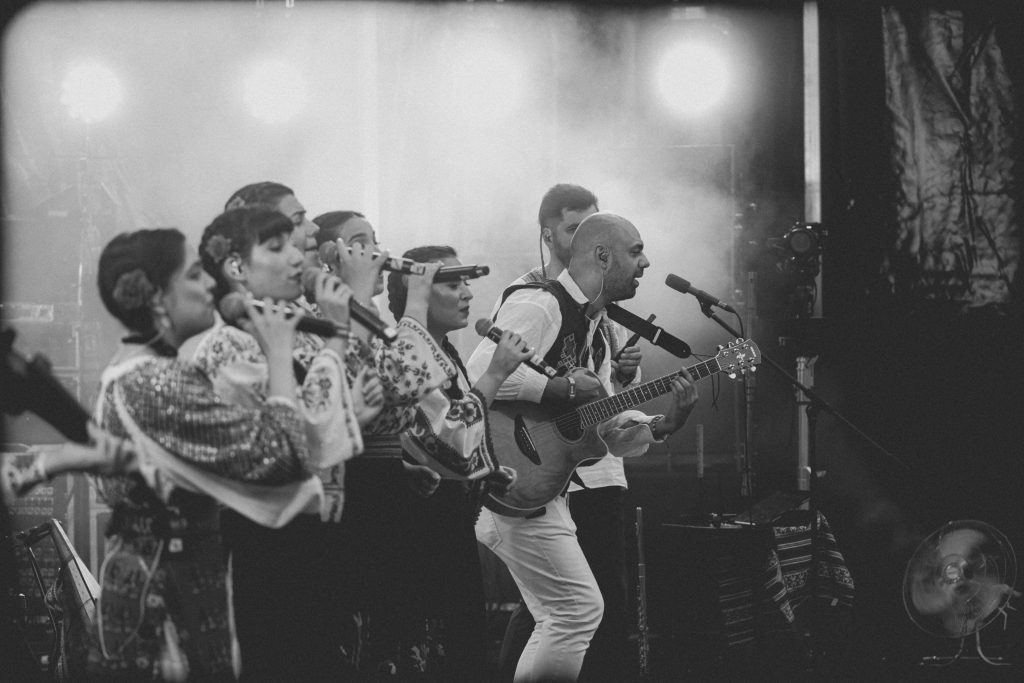
Maria Chivu: The blend between traditional and modern came at the initiative of David Ciente to work together. He wanted to bring folklore closer to younger audiences, and to try to bring together the world I come from with the one he comes from. I remain anchored in the authenticity of folklore, while he brings a contemporary perspective that highlights what is already there. Together, we founded the vocal group Jianca, which also aims to promote authentic Romanian folklore.
C&B: What does a typical day look like for you now, and which moments of the day bring you the greatest satisfaction?
Maria Chivu: For me, no two days are alike. My schedule is always full and very diverse, because I try to take care of all aspects of my career. There are days when I start with study and rehearsals, others when I have meetings, discussions, phone calls, emails, and organizational work for shows, events, or contracts. I also have moments when I withdraw to create: I compose, look for new ideas, browse books, enrich my repertoire, or go to libraries. Other times, I go out into the field, to villages, to search for old songs and stories from local people—an aspect of my work that inspires me immensely. At the same time, I try to stay active online, where many of us spend our time. For me, it is important to remain present in this space, because it allows me to stay close to people even when I am not on stage. I post fragments from rehearsals, backstage moments, personal thoughts, or projects I am working on, and this direct interaction helps me better understand what the audience wants and how they resonate with what I do.
I am also involved in my family’s tradition: I sew traditional blouses that I later wear on stage, and I help my mother in her small workshop, where she weaves Oltenian carpets on a loom. I truly enjoy working together with her, because she was the first to see, even when I was very young, that my path is music. There are also days dedicated to the studio, where I record or work on new projects. And beyond everything related to my career, it is important for me to take care of my home, to be a good homemaker, to cook, keep things in order, and maintain a healthy body and mind through sports.
C&B: Do you have plans to explore related genres or fusions between folk music and other styles?
Maria Chivu: I have long had thoughts and desires regarding collaborations in this direction. It seems the universe worked in my favor, because this idea came back to me through the proposal from David Ciente. That is how a project was born that opened folklore to a wide audience, from whom we received wonderful feedback.
C&B: How did your collaborations with the Jianca group and David Ciente come about, and what experiences have these projects brought you?
Maria Chivu: My collaboration with David Ciente began as a simple experiment, without a clear plan in that direction. We wanted to see what could emerge from the meeting between folklore and contemporary sounds, and the result surprised both of us. It gave us the confidence to continue and develop the project, and from there came the idea of forming a group of girls that we could train together. It was a beautiful challenge that helped me divide my time between multiple projects, discover myself in new roles, and build a wonderful collective where sincere friendships were formed.
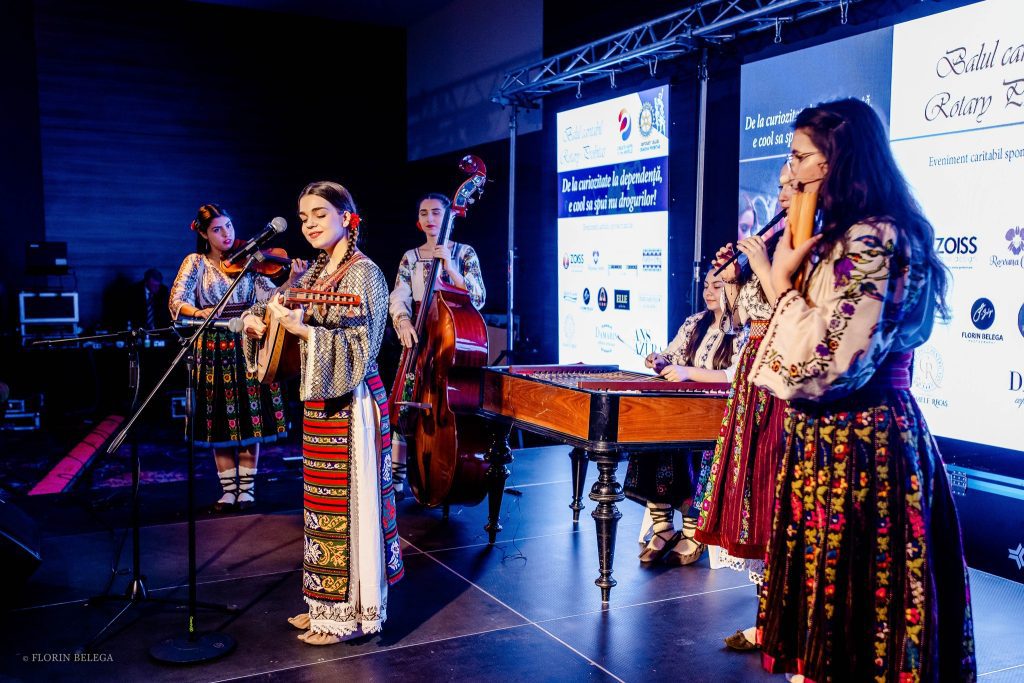
The collaboration with Jianca came from the desire to create something authentic and coherent together, based on respect for tradition and a shared energy that united us from the beginning. Today, we perform in two different formats: alongside David Ciente, with the fusion of folklore and contemporary sounds, which attracts a wide audience—and in the traditional format, accompanied by an authentic taraf, for those who love the roots and purity of folklore.
This diversity fulfills me and helps me grow, because each project shows me the richness of music and the many ways I can share it with people.
C&B: How does your style evolve from one project to another, and how do you adapt your repertoire for a broad audience?
Maria Chivu: When I talk to event organizers, I quickly understand what type of repertoire fits best, depending on the theme of the festival, the space where it takes place, and the expected audience. In this way, I choose the right direction: either the traditional version, alongside a taraf, or the concept developed together with David Ciente, where we reinterpret folklore in a contemporary light.
These are two distinct projects, united by the desire to promote folklore, but addressed to different audiences. What makes me happy is that people have understood that these two directions naturally coexist in my artistic journey and complement each other, without excluding one another.
Maria Chivu’s story is one of balance between roots and evolution, between tradition and the present. Through every project and every stage appearance, she embraces the role of carrying Romanian folklore forward with respect, authenticity, and personal sensitivity.

 UK
UK
 IT
IT
 ES
ES
 DE
DE
 FR
FR
 RO
RO
 PT
PT
 HU
HU


