


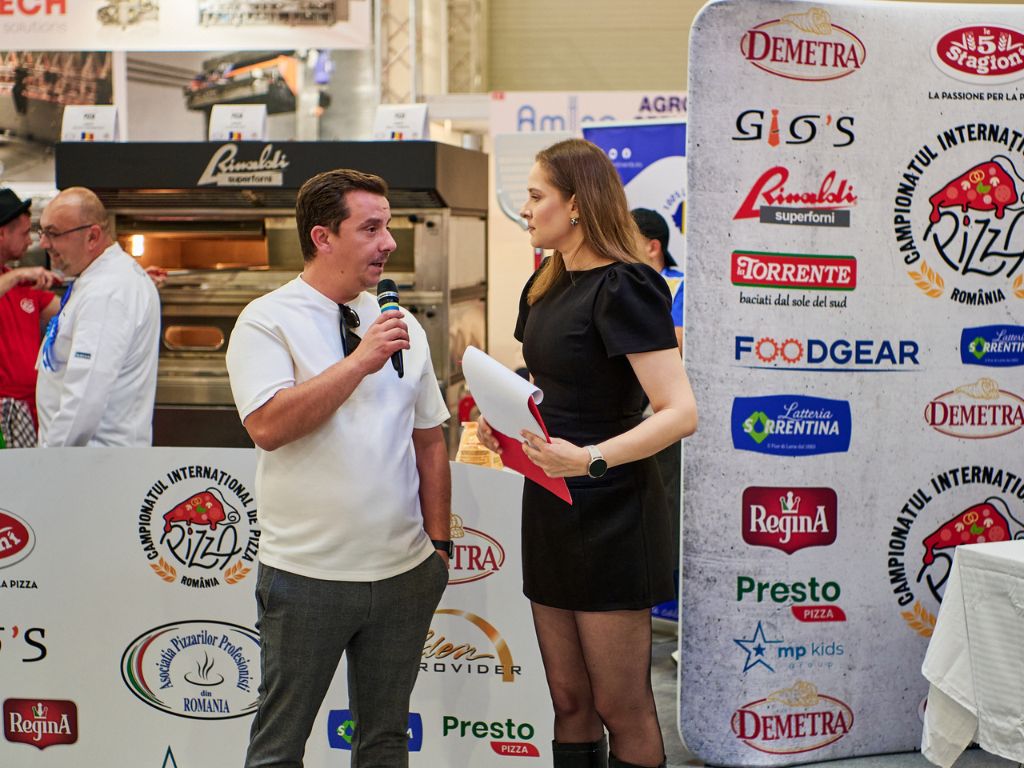
Valeriu Ogica, Co-founder of Food Gear Romania, shares insights into his HoReCa journey, key entrepreneurial decisions, equipment strategy and why functional, well-supported solutions matter most in a fast-paced hospitality industry.
Valeriu Ogica is the Owner and Co-founder of Food Gear Romania, a company specialized in the complete setup of HoReCa spaces, the distribution of professional equipment and, perhaps most importantly, their servicing. Food Gear is not just about selling equipment, but about end-to-end solutions designed for restaurants, cafés, hotels and any business that lives by the intense rhythm of the hospitality industry.
With over 12 years of experience in the HoReCa field, Valeriu has gone through several stages of the industry and has led different departments over time, which has given him a comprehensive perspective on how a HoReCa business actually works—from operations and technical aspects to strategy and partner relationships. He does not speak from theory, but from direct, hands-on experience, gained “in the field,” where equipment must function flawlessly and solutions need to be fast and efficient.
For more than 5 years he has been an entrepreneur, a period during which he built Food Gear Romania with a practical approach focused on the real needs of clients. From the very beginning, the emphasis was placed on quality, reliability and a team capable of intervening quickly when things cannot wait—an essential aspect in an industry where every hour of downtime means losses.
His style is relaxed yet extremely professional, based on open communication and long-term partnerships. Valeriu believes in simple, well-thought-out solutions, in correctly chosen equipment and in service done on time. For him, success in HoReCa is not just about machinery, but about how it is integrated and supported over the long term.
Today, through Food Gear Romania, Valeriu Ogica continues to be a trusted partner for HoReCa entrepreneurs, offering them not only equipment and service, but the reassurance that they have someone by their side who understands the industry from the inside.
C&B: If we were to look at the narrative thread of your career, what were the key moments that defined you?
Valeriu Ogica: My first contact with the HoReCa industry was in the accessories area—pans, knives, utensils and everything related to the basic outfitting of a kitchen. That was the stage when I began to truly understand what HoReCa means and to familiarize myself with the dynamics of this field. That’s when I realized how much details matter and how important it is for every single piece, no matter how small, to do its job perfectly.
Later on, I moved to what I call the “real HoReCa,” namely professional kitchen equipment. This is where things became much more complex and technical, and that helped me deepen my knowledge of the field significantly. I began to understand the workflows in a professional kitchen, the pressure under which people work, and the real impact equipment has on the functioning of a business.
At this stage, I evolved toward an intrapreneurial role, getting involved not only in sales, but also in designing solutions, strategies and project development. From there, the step toward entrepreneurship came naturally.
All the experiences I accumulated, both in accessories and in professional equipment, eventually led me to the decision to found Food Gear Romania. It was the result of a journey built step by step, on practical experience and on the desire to offer real solutions for the HoReCa industry.
C&B: What was the most difficult moment so far in your journey, and how did you overcome it?
Valeriu Ogica: The most difficult moment was right before opening Food Gear Romania. Even though I had experience in the field, I felt that I couldn’t find the “perfect formula.” I was trying to align everything, but nothing seemed to come together exactly the way I wanted, which inevitably led to moments of doubt. I even started to question whether I could truly succeed in the HoReCa equipment industry.
The turning point came through my partner, Mihai. He was the one who helped me regain clarity and channel my energy in the right direction. Instead of chasing perfection, we started building something concrete, based on the experience we had accumulated and on what we knew was missing from the market.
Together we laid the foundations of Food Gear Romania, and that moment of uncertainty actually turned into a catalyst. Looking back, I believe that was the biggest challenge, but also one of the most valuable lessons: sometimes you don’t need the perfect formula, but the right people by your side and the courage to take the step forward.
C&B: Is there a dream or an ambition that has always guided you, regardless of obstacles?
Valeriu Ogica: Yes, there is, and it’s a principle I’ve consistently followed. I understood fairly early on that perfection does not exist and, more importantly, it doesn’t need to. What truly matters instead is that things are functional and solve the client’s real problem.
This mindset helped me enormously, especially in moments when I tended to overanalyze or wait for ideal conditions. In HoReCa, you don’t have time for perfection—you need solutions that work here and now. That was also the foundation I started from: to offer clear, applicable and efficient solutions, even if they are not “perfect” on paper.
Paradoxically, this very approach gave me a strong boost. It helped me move forward, make faster decisions and build a business that responds concretely to clients’ needs, not to theoretical standards. For me, that has been and remains the main ambition: to deliver real value, not perfect promises.
C&B: What were you like at the beginning of your journey, and how do you feel you’ve transformed up to now?
Valeriu Ogica: At the beginning, everything was quite ambiguous. I had a lot of energy and drive, but I didn’t fully understand why things lacked consistency. There were good periods followed by less good ones, which created frustration and many questions. I felt we were doing things right, but the results were not always predictable.
Today, the feeling is completely different. From the outside, it may seem like things are happening “just like that,” naturally. In reality, I know very well that nothing is accidental. Everything that happens now is the result of consistently investing in relationships with clients, being proactive and making no compromises when it comes to quality.
The transformation came with maturity—both personal and professional. I learned to build for the long term, not on quick fixes. And the fact that many clients and partners recommend us and choose to work with us again is the clearest confirmation that we are heading in the right direction.
C&B: If we were to meet your team or collaborators, what do you think they would say about you?
Valeriu Ogica: I would honestly recommend that you ask them directly. I think they could say it much better than I ever could.
What I can say is that I have always tried to keep my team and collaborators close. For me, things are very clear: you cannot build anything solid on your own. No matter how much experience you have, without a good team and trustworthy collaborators, you won’t get very far.
I try to build relationships based on respect, communication and real involvement. I strongly believe in the idea of partnership, not only within the team, but also with the people we collaborate with. At the end of the day, success is not individual; it is the result of work done together.
C&B: What is the most important decision you have made that changed your trajectory?
Valeriu Ogica: Professionally, without a doubt, the most important decision was to open Food Gear Romania. It was the moment when I moved from accumulated experience and ideas to full ownership. It meant risk, responsibility and a lot of work, but also the clarity that I am on the right path and that I can build something of my own, based on the values I believe in.
On a personal level, the most important decision was having our second child. It’s a decision that completely changes your perspective on time, priorities and the balance between professional and personal life. It made me more responsible, more organized and, paradoxically, more efficient in business as well.
Taken together, these two decisions helped me grow both as an entrepreneur and as a person. They redefined my direction and taught me that truly important things are built with patience, accountability and a lot of commitment.
C&B: What are the most important criteria a HoReCa entrepreneur should consider when choosing equipment?
Valeriu Ogica: The most important criterion is for the entrepreneur to choose equipment based on their real, current needs, not on what they think they might do five years from now. This is one of the most common mistakes I see in the industry: investments that are too large, made too early, based on scenarios that don’t yet exist.
I especially encourage entrepreneurs opening their first location to be cautious. They should choose equipment suited to their current concept, current menu and real customer flow. At the beginning, it is essential to invest only in what is strictly necessary, and then add or upgrade gradually as the business grows. Little by little, not everything at once.
There is a temptation to “make everything perfect” from the start, but many forget that until you reach profitability, you need a solid budget to support the business. In HoReCa, the reality is clear: a business needs, on average, 6–8 months to break even, and only then does it start to grow, step by step.
Equipment should support the business, not weigh it down financially. A well-thought-out initial investment offers flexibility, stability and a real chance to build healthily over the long term.
C&B: What differentiates Food Gear from other HoReCa equipment suppliers?
Valeriu Ogica: I could answer in just a few words, because that’s exactly how our clients define us as well: reliability, promptness, proactivity and, perhaps most importantly, being human in our relationships.
We take things seriously, respect deadlines and react quickly when a problem arises, because we know very well how critical time is in HoReCa. At the same time, we don’t wait for problems to appear before acting—we try to be proactive and come up with solutions before situations become complicated.
And the “human” aspect is something you can’t fake. We speak openly with clients, explain things exactly as they are, even when that means telling them they don’t need a certain piece of equipment or that there is a more suitable option for them. From their feedback, this is one of the reasons they choose to work with us and keep coming back.
C&B: What does a typical day look like for you now, and which moments bring you the greatest satisfaction?
Valeriu Ogica: No two days are the same, and I think that is actually the beauty of entrepreneurship. Every day brings different challenges, meetings, decisions or unforeseen situations, and it’s precisely this variety that makes the work more interesting and motivating.
My satisfaction at the end of the day comes from managing to tick off as many of the objectives I set as possible. No matter how small or large they are, each achieved objective gives me energy and confidence that we are moving in the right direction, both as a business and as a team.
C&B: What values or principles guide you in what you do, and how do you apply them day by day?
Valeriu Ogica: I always start from the premise that all people are good, until they show me otherwise. It’s a principle that guides both my professional and personal relationships.
This principle underpins the way I approach customer care, which is one of the most important pillars of Food Gear Romania. I believe that respect, patience and open communication with clients and partners are not just simple procedures, but the essence of a relationship built on trust. I apply this principle every day by speaking honestly with clients, understanding their real needs and offering solutions that are truly useful to them, without compromises and without empty promises.
C&B: How did Food Gear come about, and what need in the HoReCa industry did you identify as insufficiently covered at the time of launch?
Valeriu Ogica: Food Gear emerged from my and my partner’s desire to bring a breath of fresh air to this industry. We wanted to do things differently and respond to needs that we noticed the market was not addressing properly.
At the time of launch, we identified that in HoReCa, responsiveness to requests for quotes and prompt communication were weak. Clients were waiting days for responses or facing a lack of a truly human approach. We quickly discovered that simply answering the phone, listening to the client and helping them sincerely is hugely appreciated and builds long-term trust.
Thus, we built Food Gear Romania on the idea that promptness, professionalism and a human approach are just as important as the equipment we offer. This was our differentiator from the very beginning.
C&B: What trends do you see in the HoReCa industry that will directly influence equipment demand in the coming years?
Valeriu Ogica: At Food Gear, we constantly participate in international HoReCa equipment trade fairs, but many of the trends we identify right here in Romania, through daily interaction with our clients and collaborators.
What is clearly noticeable is that people have started to increasingly appreciate quality. Demand for products such as pizza, bread or top-quality coffee is continuously growing, and clients prefer quality over quantity.
This shift is directly reflected in the equipment needed: restaurants and cafés are no longer just looking for large machines that produce volume, but for high-performance, precise and reliable equipment capable of supporting superior-quality products. In the coming years, I believe this trend will continue and will influence all investments in professional kitchens and in the service area.
Valeriu Ogica’s journey is built on hands-on experience, conscious decision-making and a deep understanding of the HoReCa industry. Through Food Gear Romania, he proves that long-term success is not driven by perfect theories, but by practical solutions, human relationships and the ability to consistently deliver real value.

 UK
UK
 IT
IT
 ES
ES
 DE
DE
 FR
FR
 RO
RO
 PT
PT
 HU
HU


