


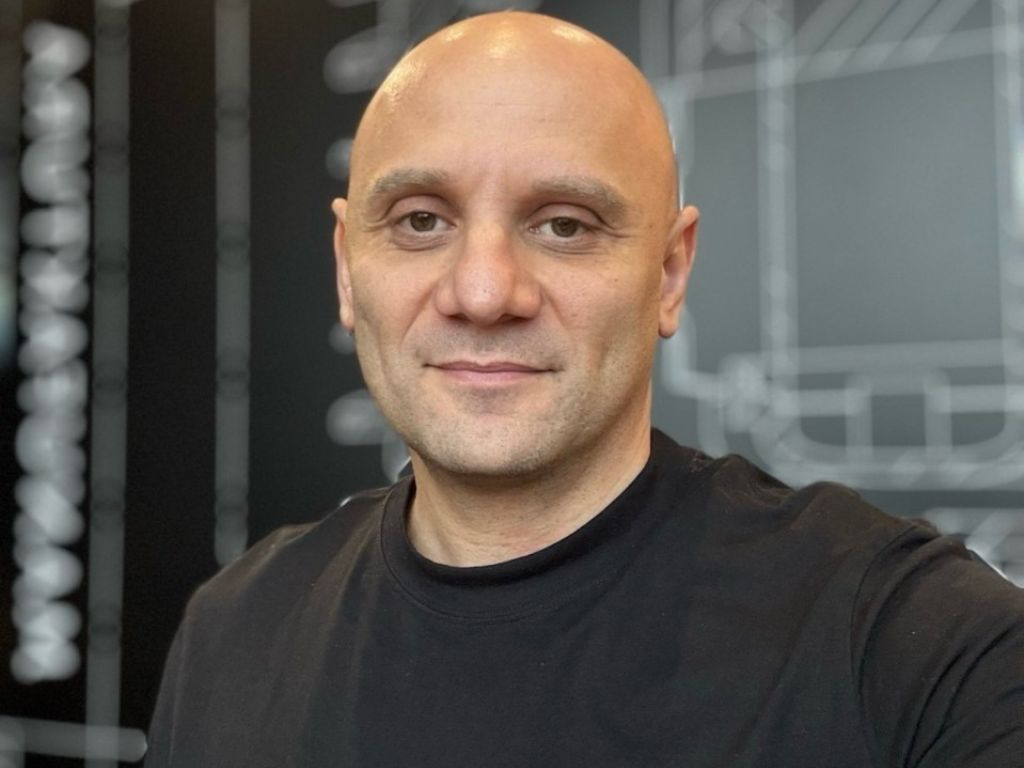
Dragos Müller, founder of Magic Salons, talks us about business, adaptability, AI, leadership, and transforming the beauty industry into a modern technological ecosystem.
Dragos Müller is the founder of Magic, a Romanian ecosystem built around the beauty industry, including a premium salon network, an academy, its own app, internal ERP/CRM systems, and an increasingly strong technological development direction through MagicOS.
C&B: How would you describe yourself in a single sentence to capture the attention of someone who doesn’t know you?
Dragoș: I’m passionate about business development, I like unconventional routes, and I strongly believe that results don’t come only from hard work, consistency, and persistence, but especially from having the courage to change direction when the classic path no longer works.
C&B: Looking back, what is the “red thread” that has guided your professional journey?
Dragoș: The desire to reach the stars. It may sound artistic, but when I look back, I realize I never had a perfectly written plan on paper. What pushed me to run a business from the age of 16 was the desire to continuously grow, create impact, and build something bigger than the environment I was in.
I started without too much theory, straight into practice. I chose business over traditional education, and that gave me time to make mistakes, learn from them, and constantly test things. The red thread was, I think, this permanent need for movement: not staying in the same form for too long.
C&B: What was a difficult moment or failure that truly changed you?
Dragoș: In the fall of 2007, I fulfilled a dream: I opened a tanning studio. At the time, the plan was to create a business that would require neither my physical nor mental presence. I strongly believed I would open center after center. Clearly, that was not the case.
I had major leasing contracts for tanning equipment and other expenses that were nowhere near covered by revenue. I reached a point where I could no longer pay. At the same time, however, I transformed that location into a mini beauty salon. That pivot turned out to be a success and eventually led to more than 20 locations, millions of euros in annual revenue, and hundreds of artists working behind the chair.
The negative impact of that near-bankruptcy was smaller than the positive impact of the adaptation that followed. If I spoke only about the difficult moment without explaining how I turned it into an advantage, it wouldn’t be fair. In my case, every major failure became a launch ramp that propelled me to the next level.
C&B: What is a bold or counterintuitive decision that significantly influenced your trajectory?
Dragoș: Every major shift in my journey can be called a courageous decision. Change itself requires courage.
I moved from a retail business in construction to a tanning studio, then to beauty salons, then to a marketing agency, and today I increasingly find myself in a technology company. Adaptability does not come naturally. Continuous adaptability requires action, risk, and sometimes the decision to let go of an identity that once worked but no longer moves you forward.
C&B: How have you changed over time as a leader and professional?
Dragoș: The change happened step by step. An apple didn’t fall on my head and suddenly give me a revelation. I learned how to work in a team, and that was the key.
Alone, you can’t do much. If you don’t know how to create perspectives for others so people align around a common direction, it becomes very difficult to build something meaningful.
I talk a lot, I know how to listen, but speaking helps me provide clarity to the people I work with. In business, the gift of communication can be an advantage if you are well informed and clear-minded.
The concrete answer is this: before starting a new business model, I usually changed myself first. A new business direction overlaps with a personal transformation, not the other way around. We change the business; rarely does the business change us.
C&B: What do you think people who work directly with you say about you beyond the public image?
Dragoș: I think they would say that I am both difficult and valuable at the same time. As much as I am criticized, I am also loved or respected, especially within the close group, the company board.
I fought hard to build a free culture where people can say what they think. We compliment each other, disagree, challenge one another, and reconcile often. We function like a united family where free expression truly belongs.
I don’t believe in a culture where everyone smiles nicely but nobody tells the truth. I prefer a living team that can disagree in a healthy way rather than a polite team that hides problems under the rug.
C&B: What truly differentiates you in the way you build or lead?
Dragoș: I don’t have up-to-date information on how others run their companies, so it’s difficult to make a direct comparison. What I can say is that I have allowed time in the team’s life so people can actually see opportunities.
I don’t believe in operating permanently with the RPM needle in the red zone. I believe the team needs time, freedom of thought, room for reflection, and constant communication.
For me, the fact that meeting rooms are occupied does not mean wasted time. On the contrary: the more people talk, the more clarity increases. And clarity, inside a company, is sometimes more valuable than speed.
C&B: How has the current context — technology, AI, economy, the way of working — changed you?
Dragoș: I hope as many people as possible read this answer. Maybe not everyone has heard of Peter Steinberger, the creator of OpenClaw, an open-source project in the AI agents space. If you own a business or want to build one, I believe you need to use AI, but not just in the sense of occasionally writing prompts in ChatGPT.
The next step is for you and ideally as much of your team as possible to learn how to orchestrate AI agents working in parallel. The difference between a person who does not use an LLM at all and one who uses it intensively is important. But the difference between someone who uses an LLM intensively and someone who can orchestrate an entire suite of agents is much greater.
I can say I’m lucky because I have Isac beside me, a true IT enthusiast, not just a practitioner. He comes from the viral video industry, and through my constant pushing and challenging, he transitioned into technology. Today, he no longer sees things except through systems, agents, automations, and tasks running simultaneously, even while we sleep.
Our current project is for part of the company’s people to learn how to orchestrate dozens of agents in parallel. I believe this is where the market will split: between companies that merely “use AI” and companies that actually reorganize work around AI.
C&B: Is there a habit or routine that significantly influenced your performance?
Dragoș: I don’t have a fixed set of routines. I do what I feel and what I believe brings value at that specific moment.
I’m the kind of person who can say one thing today and do something else tomorrow. Many people have told me over time that I say one thing and do another. But I strongly believe in adapting to context. Since everything around us is alive, our decisions, actions, and plans must constantly change as well.
For me, the most important routine is not being dependent on routine. I’m not saying it’s the right model for everyone, but it worked for me.
C&B: What principles guide your important decisions?
Dragoș: I know it sounds controversial, but I even change or adapt my principles. Maybe it’s not good for everyone, but this has been my path, and since I was asked, I decided to tell the truth.
I have always guided myself by the principles I considered right at that moment. The only thing is that they changed. They were not always the same.
Still, if I had to extract something constant, I would say I make important decisions based on three questions: what can I continue building from this, what do I risk if I stay still, and how much living energy does this direction create in me and in the team?
C&B: How do you see the evolution of your field over the next 3–5 years?
Dragoș: The term “field,” together with a 3–5 year horizon, no longer sounds safe at all. Industries merge, divide, and constantly change.
Beauty will no longer be just beauty. It will become technology, data, apps, experience, loyalty, content, community, and automation. Likewise, IT will no longer be just IT, but will enter all industries that until yesterday seemed traditional.
I don’t know if I can say I have a fixed vision for a single industry. Rather, I see a fusion between salons, technology, education, AI, data, and customer experience. Whoever treats an industry as something static will lose. Whoever understands that the industry is transforming into a living organism will have the advantage.
C&B: What role do you aim to have in this evolution?
Dragoș: I aim to build bridges between industries that normally don’t sit at the same table: beauty, technology, education, data, AI, and real operations.
Magic started as a service business, but today I increasingly see it as a living laboratory. We have salons, people, clients, data, apps, internal systems, and the ability to quickly test ideas in reality, not just in presentations.
The role I want to play is to take this experience further: to transform a traditional business into a scalable technological ecosystem. I’m not interested only in opening more locations. I’m interested in building a model that can be understood, replicated, measured, and continuously improved.
C&B: What real advice would you give to someone who wants to build something relevant today?
Dragoș: The first piece of advice: don’t fall too much in love with the first version of your idea. The initial idea is rarely the final form. Many times, the real business appears only after the first version breaks apart.
The second piece of advice: test in the market as fast as possible. Not with perfection, not with beautiful presentations, but with reality. See whether someone pays, comes back, recommends you, or gets involved.
The third piece of advice: learn AI as quickly as possible. Not as a text-writing tool, but as a new work infrastructure. Those who do not learn this now will, within a few years, compete with people and companies producing ten times more with the same team.
And maybe the most uncomfortable advice: accept that hard work alone is no longer enough. You can work enormously in the wrong direction and still fail elegantly.
C&B: What is an uncomfortable truth about your field that few people talk about?
Dragoș: An uncomfortable truth is that in many service businesses, the difference between success and failure is not only the quality of the service, but the system behind it.
You can have talented people, beautiful locations, and satisfied clients, but if you don’t have control over costs, retention, bookings, recurrence, payroll, feedback, operational flow, and data, the business may look good from the outside while being fragile inside.
In beauty, many people romanticize talent. Talent matters enormously, but without a system, talent becomes difficult to scale. And without data, decisions become impressions. That is a major issue in many companies: they are run on feelings, not on measured reality.
From premium salons to technology systems and AI, Dragos Müller outlines a new direction for the beauty industry, built on innovation and the creation of sustainable ecosystems.

 UK
UK
 IT
IT
 ES
ES
 DE
DE
 FR
FR
 RO
RO
 PT
PT
 HU
HU


