


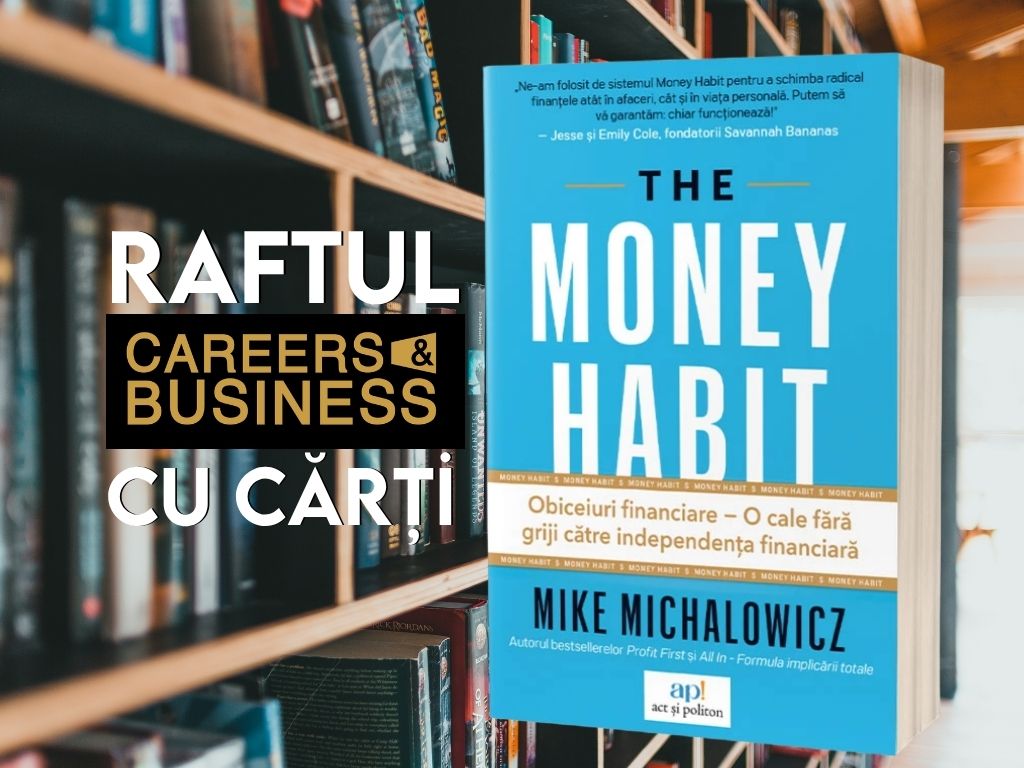
Discover how financial discipline and smart habits can help you achieve long-term stability and financial independence without relying on luck or quick wins.
Excerpt from Money Habit: Financial Habits – A Worry-Free Path to Financial Independence
Money Habit: Financial Habits – A Worry-Free Path to Financial Independence by Mike Michalowicz, recently published by ap! (ACT and Politon), is a book that aims to change the way financial security is perceived, as well as the way readers think about luck when it comes to money. In the exclusive excerpt below, published for Careers&Business, the author explains that financial stability is the result of healthy decisions and habits, and that it can be achieved over time through disciplined choices.
Exclusive excerpt:
I dedicate this book to your wallet.
Applying the Money Habit system, my wife and I had set aside $50,000 for each of our three children’s weddings. And because Tyler and Cora spent only $14,000 on their big day, we gave them a check for the remaining balance from the wedding fund ($36,000) to use however they wished — as an emergency fund, a down payment on a house, or for any other dream they wanted to pursue.
A few weeks later, I had to encourage Cora to deposit the check into her account; she had kept it aside because she wasn’t sure her bank would even accept such a large amount. She had never seen that much money before, and I had never given away such a large sum. Ten years earlier, I would never have been able to write that check. We might have given them a nice wedding gift — perhaps a reasonably priced dinner set or a pasta maker. But paying for the wedding? A full $50,000? The thought that we could help our children in such a way would never even have crossed our minds, unless we had won the lottery.
After convincing Cora to deposit the money, something became clear to me: we really had won the lottery.
And so have you.
You just may not realize it yet.
People dream of checks filled with zeros. Some play the lottery hoping to hit the jackpot. Others keep an eye on the will of a wealthy, elderly uncle in poor health. Why? Because they want financial security and a life free of worries, and money falling from the sky seems like the fastest path to get there. And understandably so.
But the odds of winning the lottery are incredibly small. More precisely, incredibly, incredibly small. Even if luck happens to be on your side, typical jackpot prizes range from one to three million dollars, usually awarded through state lotteries or more common secondary prizes. The chances of winning more than a million dollars? Roughly one in 12.5 million. Those are terrible odds.
To put that into perspective: if you played the lottery every single day for 23,942 years — yes, that is not a typo — you would only have a 50% chance of winning. At two dollars per ticket, you would spend $730 a year. Over 24,000 years, you would have paid $17.5 million just for the chance to maybe win $2 million. In other words, the lottery empties your pockets and steals your time. Don’t play its game. And hoping that a rich uncle will leave you his fortune instead of giving it to the 25-year-old he recently “fell in love with,” while perhaps slightly more likely, is still entirely out of your control.
You don’t need to rely on impossible odds or place your hopes in someone else’s decisions, because you have already won. And I mean that seriously.
Let me explain. What would you do if you won $2 million in the lottery today? That would certainly be an amazing day. The lottery gives you two options: receive the money in monthly installments over 30 years or take the cash upfront — about $1 million immediately. Let’s say you choose the installment plan so you don’t blow through the money all at once.
Now, what if you realized that you have already won exactly that amount — perhaps even more? And that you wisely chose a structured payment plan that naturally puts healthy limits on your spending?
On average, an American or a European earns around $2 million (or euros) in salary throughout their lifetime. So your main concern should not be how to make more money right now, but how to manage more effectively the money already flowing into your life, starting today.
You have probably heard that most lottery winners lose everything within a few years and end up more miserable than before they became rich. A famous example is Jack Whittaker, who won more than $300 million in the Powerball lottery and whose story has been told endlessly. What began as “the happiest day of his life” spiraled into lawsuits, gambling addiction, the loss of family members to drugs, the destruction of his uninsured home in a fire, and total financial ruin. Still, he is the exception.
What you may not know is that the theory claiming lottery winnings make people unhappy has been disproven. Research has shown that lottery winners are generally quite happy — when they manage their winnings wisely. This perspective also explains Whittaker’s case. Although he was already a multimillionaire before the record-breaking win, it was not the money that destroyed him, but the way he handled it. Shortly after winning, he bought a Lamborghini and drove around his neighborhood throwing money out the window. Not long after, thieves stole over $500,000 in cash that he inexplicably kept in the car, inside a silver suitcase, while he was visiting a strip club. When asked why he made such reckless decisions, his answer was: “Because I can.”
Financial success has nothing to do with what you can do — it has everything to do with what you should do.
That brings me back to the moment we gave money to our son and his wife. You might assume that the $50,000 we saved for our children’s weddings was possible because of my income. That is only part of the story. The real reason we managed to save that money was because we created a system that helped me manage my income and automatically save for fifteen years for their weddings. The system assigned a purpose to every dollar, ensuring that every aspect of life — including Tyler and Cora’s wedding — was taken into account. The Money Habit system guided me toward what I needed to do and, most importantly, it handled the discipline for me.
The odds of winning the lottery are tiny, but the odds of a wedding happening in your family are quite high. If you have children, chances are they will eventually get married, so I choose to bet on those probabilities. And when it comes to managing money, if you bet on life’s likely events, you will gain far more in the long run.
“Money Habit” delivers an essential message: financial security does not happen overnight and does not depend on luck, but on the consistent choices we make every day. Through discipline, planning, and healthy financial habits, anyone can gradually build financial balance and the freedom to support the goals that matter most in life.
ap! (ACT and Politon) is one of the leading players in Romania’s publishing market. Specializing in high-quality nonfiction, the publishing house has introduced Romanian readers to internationally acclaimed authors such as Tim Ferriss, Robin Sharma, Tony Robbins, Wayne Dyer, Steve Harvey, Gino Wickman, and many others. At the same time, ap! (ACT and Politon) is the Romanian publishing house under which the largest number of audiobooks has been released locally. Since its launch in 2014, the publisher has brought more than 300 audiobook titles to Romania, many of them international bestsellers that have transformed thousands of lives.
ap! (ACT and Politon) believes in continuous development and offers Romanian readers titles covering a wide range of subjects, including personal and professional development, business, entrepreneurship, spirituality, and wellbeing. The publisher’s titles are available in print, eBook, MP3, and audiobook formats, allowing readers to enjoy learning and reading at any moment in their lives.

 UK
UK
 IT
IT
 ES
ES
 DE
DE
 FR
FR
 RO
RO
 PT
PT
 HU
HU


