


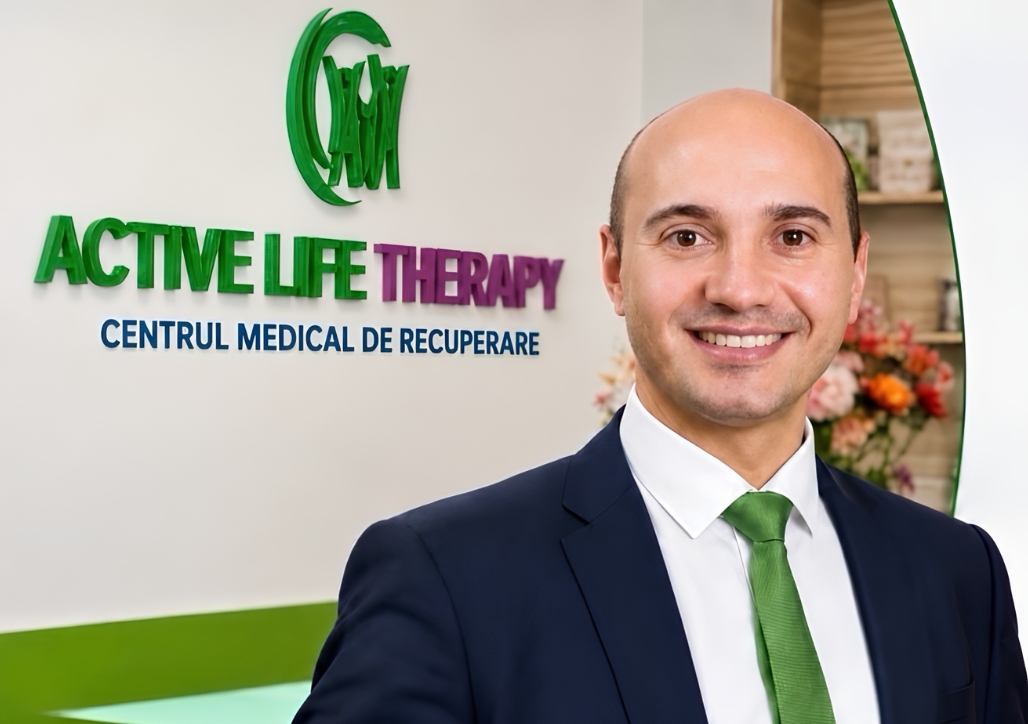
Discover the story of Marius Viorel Dincă, founder of Active Life Therapy, as he shares insights on preventive healthcare, medical rehabilitation, ergonomics, leadership, and building an integrated healthcare model that focuses on treating the root cause—not just the symptoms.
Marius Viorel Dincă is the founder of Active Life Therapy, specializing in osteopathic manual therapy and postural ergonomics for both children and adults through an integrative approach focused on identifying and treating the root cause of pain, not just its symptoms. He is dedicated to developing personalized recovery plans by combining manual therapy, therapeutic exercise, and patient education to achieve lasting results.
C&B: How would you describe yourself in a single sentence to capture the attention of someone who doesn’t know you?
Marius: I am Marius Viorel Dincă—an entrepreneur and therapist who doesn’t just treat people’s pain but builds systems that enable more and more people to live, work, and perform without pain.
I have dedicated more than two decades to creating solutions that bring health closer to people—in clinics, companies, schools, and everyday life.
C&B: Looking back, what is the “common thread” that has guided your professional journey?
Marius: Looking back, I realize that the common thread throughout my entire professional journey has been my desire to help people regain their freedom of movement and live without pain. My goal has always been to identify the root cause of pain rather than simply treating its effects.
In 2005, I opened my first therapeutic massage center. Every day, I helped people get rid of pain, but I kept noticing the same pattern: after a few days or a week, many of them would return with the very same problems. They would tell me they simply didn’t have time to take care of their health.
A few years earlier, in 2002, I had attended a Shiatsu course led by an American trainer, where I discovered a completely different approach. In many companies in the United States, employee health was viewed as an investment rather than a reaction to pain.
That was when I asked myself a simple question: if people don’t have time to come to us, why shouldn’t we go to them?
That’s how I began offering therapeutic massage directly in the workplace, at a time when the concept of organizational wellness was almost unheard of in Romania. It was a bold step and one of the first initiatives of its kind on the market.
However, after a few months, I noticed something even more important. Although therapy helped, the tension kept returning. I realized I was treating the effect, not the cause.
That naturally led me to the next step: focusing on prevention. We introduced postural assessments, workplace ergonomics, mobility and stretching exercises, education on proper posture, and healthy workplace habits. Back in 2005, these concepts were virtually unknown in Romania.
From that moment until today, the common thread of my work has remained the same: not to stop at treating pain but to help people understand why it occurs and how it can be prevented. Today, I pursue the same mission through Active Life Therapy, only on a much larger scale—in clinics, companies, schools, and the community.
Whenever a patient leaves pain-free, a child corrects their posture, an employee avoids a work-related condition, or an entire team begins to see health differently, I feel that my work has meaning. That is the guiding thread that has shaped my journey and continues to inspire me.
C&B: What was a difficult moment or failure that truly changed you?
Marius: I believe the most difficult period of my professional life was the pandemic.
At that time, I was developing wellness and ergonomics programs for companies while simultaneously building Active Life Therapy, our medical rehabilitation center. In just a matter of days, almost everything I had built came to a halt. Corporate wellness programs were suspended, and the center’s activity was significantly reduced.
Beyond the financial impact, the greatest pressure came from the responsibility I felt toward my team. Behind every employee was a family that depended on that job. There were moments when I sincerely wondered whether it would be wiser to close everything down and start over in a completely different field.
But every time I thought about the patients I had helped over the years and the people who still needed us, I realized I couldn’t give up so easily.
I chose to look for solutions instead of excuses. I reorganized our operations, reduced expenses, adapted our services, and continued investing in our team’s development, even during a period when the future seemed incredibly uncertain. At the same time, my family, my faith, and prayer gave me the peace and strength to keep moving forward when, from a rational perspective, it seemed there were no solutions left.
Looking back, the pandemic was not only the greatest professional challenge I had ever faced—it was also the experience that transformed me the most as a leader. It taught me that an entrepreneur is not defined by the periods when everything goes well, but by the way they lead their people when everything seems to be falling apart.
Today, I am grateful that I did not give up. Had I done so, Active Life Therapy would no longer exist, and the thousands of patients we have helped since the pandemic would never have walked through our doors.
The pandemic took away almost everything I had built until then, but it also reaffirmed why I had started this journey in the first place. When your purpose is greater than your obstacles, you find the strength to keep moving forward.
C&B: What is one bold (or counterintuitive) decision that significantly influenced your journey?
Marius: One of the boldest decisions I have ever made was investing in prevention at a time when almost everyone else was investing solely in treatment.
I chose to develop health programs for companies and promote ergonomics, posture, and health education, even though the Romanian market was not yet ready for these concepts. Many believed it was too early and that organizations would not recognize the value of such programs.
Over time, this vision expanded to include schools and kindergartens. I wanted to teach children, from a very young age, what a healthy posture means—a posture that not only protects their spine and overall health but also gives them greater self-confidence. I believe health education begins with the habits we develop during childhood.
Looking back, that decision transformed my professional journey and laid the foundation for the vision I continue to develop today through Active Life Therapy: building a culture of prevention in which people learn to take care of their health before pain appears.
C&B: How have you changed over time as a leader and professional?
Marius: I believe the greatest change I’ve experienced as a leader has been learning how to work with people.
Back in 2005, when I hired my first colleagues, I personally trained each of them. I taught them massage techniques, how to communicate with patients, and how to represent the company in its relationships with corporate clients. Because of that, whenever someone left—or we had to part ways—I felt as though a piece of my work and my heart was leaving with them.
Over time, I came to understand that this is simply part of every organization’s journey. A leader’s role is not to keep everyone at any cost, but to create an environment where people grow while ensuring the organization’s mission continues.
Wanting to become a better leader, I attended a business academy, where I learned how to recruit, lead teams, develop systems, and transform an idea into a thriving organization.
Today, my mission is greater than building a clinic. I want to develop healthcare systems that help people preserve their energy, mobility, and health over the long term, while also training professionals who, in turn, will improve the lives of others. I believe a leader’s true success is measured not only by what they build, but by the people they inspire and the impact those people create.
C&B: What do you think the people who work closely with you would say about you—beyond your public image?
Marius: I believe the people who work directly with me would first say that I am deeply committed and that I genuinely care about people. I try to help them grow professionally, give them confidence, and explain not only what we do, but also why we do it.
They would probably also say that I have high standards. I want every patient to receive the same level of care and quality that I would want for my own family. Sometimes that means I am demanding and expect a great deal from my team—but first and foremost, I expect it from myself.
One piece of feedback I have received over the years is that I inspire people to believe more in themselves and strive for continuous growth. At the same time, I have learned that not everyone develops at the same pace and that leadership is also about patience, listening, and adaptability—not just goals and results.
If I had to summarize what I hope people say about me in a single sentence, it would be: “He is someone who believes in people and challenges them to become the best version of themselves.”
C&B: What truly differentiates the way you build and lead?
Marius: I believe what sets me apart is the way I see people. I don’t just see a painful knee, a herniated disc, or a frozen shoulder. I strive to understand the whole person.
Over the years, I have learned that many health conditions have multiple causes. Sometimes they are biomechanical, related to posture or ergonomics. Other times they are influenced by stress, emotions, lifestyle, or the personal challenges someone is facing.
That is why I believe in an integrated approach. I collaborate with physicians and psychologists, and whenever patients wish, I also encourage them to seek spiritual support through their faith alongside a priest. Not because any single specialist has all the answers, but because true health is about balance between the body, mind, and soul.
This philosophy is the foundation of every project I develop—from medical rehabilitation and ergonomics to health education in companies, schools, and kindergartens. I believe we can truly change people’s lives only when we see them as whole human beings, not merely through the lens of their symptoms.
We have successfully built an integrative healthcare model in which physicians, physiotherapists, psychologists, ergonomics specialists, laboratory medicine professionals, radiologists, and, when patients desire it, spiritual guidance from a priest all work together for the well-being of the individual.
C&B: How has today’s context—technology, AI, and the economy—changed the way you work?
Marius: The current landscape has made me realize that technology and artificial intelligence will not replace the human relationship in healthcare, but they will profoundly transform the way we work.
In recent years, I have begun using AI to develop procedures, educational materials, communication campaigns, growth strategies, and internal systems much more efficiently. This allows our team to dedicate more time to what technology can never replace: the relationship with the patient, empathy, and the therapeutic process itself.
At the same time, the economic climate has made me far more attentive to efficiency, process development, and investments that create long-term value.
I believe the future belongs to organizations that successfully combine technology with the human touch. For me, AI is not a replacement for the therapist; it is a tool that helps professionals become better prepared, more organized, and more effective. And the time we gain can be invested where it matters most—in people.
C&B: Is there a habit or routine that has significantly influenced your performance?
Marius: One habit that has profoundly shaped my professional journey is beginning every important decision with a moment of silence, reflection, and prayer. It helps me avoid impulsive reactions and approach situations with greater clarity and balance.
At the same time, I have made continuous learning a lifelong habit. For more than 20 years, I have consistently invested in courses, books, conferences, and conversations with specialists from various fields. I believe a professional stops growing the moment they stop learning.
Perhaps the most important habit, however, is listening. I try to understand not only where my patients feel pain, but also how they live, how they work, and what challenges they face. Very often, the answers are found not only in the body, but also in lifestyle, emotions, and the environment in which people live and work.
These habits have helped me make better decisions, build relationships based on trust, and develop a healthcare approach that views the person as a whole.
I never settle for the first answer. I constantly ask myself: “What is the real cause?” This way of thinking has shaped not only my profession but also the way I lead people and develop my organization.
C&B: What principles guide your most important decisions?
Marius: I strive to make important decisions by starting with one simple question: “Is this decision truly in people’s best interest, and will it still create value years from now?”
I have learned not to be guided solely by short-term gains. I prefer building things that create trust and deliver lasting results, even if they require more time, greater effort, or larger investments.
One example that truly tested these principles was the pandemic. There were moments when the easiest solution would have been to close the business and walk away. Instead, I chose to move forward, support my team, and continue investing in everything we had built. It wasn’t an easy decision, but it was one that aligned with my values.
Before making major decisions, I take the time to analyze the situation, listen to the people around me, and pray. I believe a leader needs not only competence but also the wisdom to make decisions that genuinely help people and stand the test of time.
C&B: How do you see your industry evolving over the next three to five years?
Marius: I believe the medicine of the future will not be defined by how well we treat disease, but by how effectively we prevent it. I also believe that the next three to five years will fundamentally transform the fields of medical rehabilitation and preventive healthcare.
We will see an increasing integration of technology and artificial intelligence into assessment, monitoring, and the organization of medical care. However, I do not believe technology will replace the therapist. Empathy, communication, and human connection will remain essential.
At the same time, we will continue to see more people suffering from conditions caused by sedentary lifestyles, stress, and excessive screen time. This is already evident among both adults and children. That is why I believe prevention and health education will become just as important as treatment itself.
I see tremendous opportunities in expanding ergonomics programs for companies and introducing postural education into schools and kindergartens. If we teach children from an early age how to care for their bodies and help adults work in healthier ways, we can prevent many of the conditions we currently spend so much time treating.
I also believe the future belongs to multidisciplinary collaboration. Medical rehabilitation will no longer focus solely on treating symptoms but will embrace an integrated approach in which physicians, physiotherapists, psychologists, and other specialists work together for the patient’s well-being.
My hope is that, in the years ahead, we will contribute to this transformation by building a healthcare model where prevention, education, and rehabilitation work hand in hand, enabling people to preserve their health and vitality for as long as possible.
C&B: What role do you hope to play in that evolution?
Marius: My dream is to contribute to the development of a Romanian model for preventive healthcare and integrated rehabilitation—one that can be implemented in clinics, companies, and schools, helping people stay healthy rather than simply recover once illness appears.
I want to help change the way we think about health. Today, most resources are directed toward treating illness. I believe we need to invest much more in education and prevention.
The role I have chosen is to build an integrated healthcare model where medical rehabilitation, prevention, ergonomics, postural education, and healthy lifestyle habits work together instead of operating separately.
More specifically, I want to develop programs that reach companies, schools, and communities, teaching people how to care for their health before pain develops. At the same time, I want to educate professionals who share the same vision and who will, in turn, positively transform the lives of others.
If, twenty years from now, people talk more about prevention than treatment—and if my work has contributed, even in a small way, to that shift—I will consider my mission fulfilled.
C&B: What practical advice would you give someone who wants to build something meaningful today?
Marius: If I were to give three pieces of advice to a young person who wants to build something truly meaningful, they would be these:
First, build around a real problem, not around an idea. Listen to people, understand what hurts them, and try to solve the root cause rather than just the symptom. If you create genuine value, results will come over time.
Second, invest in yourself before investing in your business. The best investments I have ever made were in education, mentors, and my own development as a leader. An organization cannot grow faster than the person leading it.
And perhaps most importantly, don’t give up when difficult times come. The pandemic was the moment when I came closest to quitting. Looking back, I now realize that my greatest lessons and biggest opportunities emerged precisely during that challenging period. Perseverance does not guarantee success, but without it, it is extremely difficult to build something that stands the test of time.
Don’t just build a business. Build something that genuinely improves people’s lives. When your impact is real, your success will rest on a much stronger foundation.
C&B: What is an uncomfortable truth about your industry that few people are willing to say?
Marius: I believe one of the most uncomfortable truths is that, in healthcare, we are still rewarded far more for treating disease than for preventing it.
Most people seek professional help only when the pain becomes unbearable. Very few invest in prevention, even though it is almost always simpler, more affordable, and more effective than treatment.
Another uncomfortable truth is that no single specialist can solve every health problem. We often search for a quick fix or a single “savior,” when in reality, recovery and long-term health require collaboration among multiple professionals as well as the patient’s active involvement.
I believe the greatest challenge facing our field is not a lack of technology or qualified specialists—it is changing people’s mindset. The day we invest as much in education and prevention as we do in treatment, we will have a healthier population and a far more sustainable healthcare system.
This interview with Marius Viorel Dincă, founder of Active Life Therapy, highlights the importance of preventive healthcare, ergonomics, and integrated medical rehabilitation in building a sustainable healthcare system. Through his perspective on leadership, health education, and the use of technology and artificial intelligence, he shows that lasting impact begins with identifying the root cause of problems and creating long-term solutions for both individuals and organizations.

 UK
UK
 IT
IT
 ES
ES
 DE
DE
 FR
FR
 RO
RO
 PT
PT
 HU
HU


