


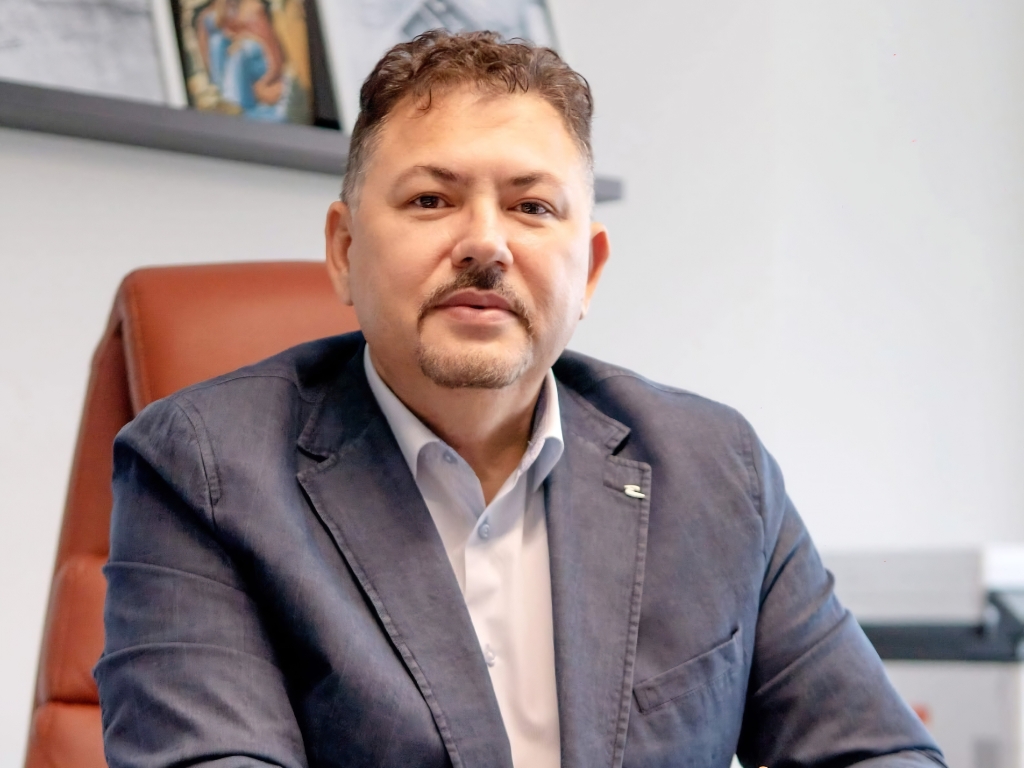
Discover an exclusive interview with Doru Huțuțui, management consultant, entrepreneur, and PhD candidate, on leadership, strategic communication, adaptive management, artificial intelligence, decision-making, and building resilient, high-performing organizations.
Doru Huțuțui is a management consultant, entrepreneur, and PhD candidate in Management, conducting research on adaptive communication strategies in resilient organizations. After nearly 25 years in management, progressing through every professional stage—from Branch Manager, National Trainer, Regional Director, Human Resources Director, and General Manager—he chose to dedicate his accumulated experience to supporting entrepreneurs, CEOs, and executive teams. For ten years, he built his own company alongside his executive career, and for the past seven years, he has been fully devoted to entrepreneurship. Today, he helps organizations strengthen their management, align their executive teams, and make better-informed decisions, firmly believing that sustainable performance begins with people who understand the direction they are heading.
C&B: How would you describe yourself in a single sentence to capture the attention of someone who doesn’t know you?
Doru: After nearly 25 years in management, I believe that, above all else, I am someone who has learned that high-performing organizations are not built through spectacular solutions, but through people, accountable decisions, and consistency.
C&B: Looking back, what has been the common thread guiding your professional journey?
Doru: I never pursued job titles for their own sake. Instead, I wanted to understand how organizations function and what it truly means to lead people in different contexts.
I had the opportunity to grow step by step, from operational management to the position of General Manager. Looking back, I realize that every stage required me to learn something new. In sales, I learned the discipline of achieving results. In training, I discovered how much a person can grow when someone believes in them. In human resources, I understood that trust is an organization’s most valuable asset. And as a General Manager, I learned that, in the end, every decision converges in the same place: responsibility.
Another defining moment was the decision to build my own company. For ten years, I did this while continuing my executive responsibilities. Those were years when my workday often ended late at night, and many weekends turned into working days. It was not easy, but I did not want to take the leap into entrepreneurship until I felt that the experience I had gained could create value for organizations beyond the one I was leading.
Looking back, I believe the common thread throughout my career has been the conviction that success has no elevator. There are only stairs, and each step prepares you for the next.
C&B: What was a difficult moment or failure that truly changed you?
Doru: One of the moments that changed me was realizing that you can be right from a managerial perspective and still fail to achieve the desired outcome.
During an organizational transformation project, I was convinced that the direction we had chosen was the right one. From a technical standpoint, the decision was well-founded. However, I did not dedicate enough time to helping people understand the change and the reasons behind it. As a result, the implementation proved far more difficult than I had anticipated, leading to financial losses for the organization.
That experience completely changed my perspective on management. Today, before proposing solutions, I strive to understand the people and the context. I listen more than I speak, and I pay attention not only to what is being said but also to what remains unspoken. I learned that resistance to change often arises not because people reject change itself, but because they do not understand where they are headed.
C&B: What is one bold (or counterintuitive) decision that significantly influenced your career path?
Doru: The most important decision I made was choosing entrepreneurship after nearly two decades in executive management. It was not an impulsive decision. For ten years, I built my company alongside my corporate responsibilities. I wanted to understand whether my experience could generate results in other organizations, not just the one I was leading.
When I finally took the leap into entrepreneurship, I did not feel that I was leaving management behind. On the contrary, I felt that I was continuing it in a different form. Today, I have the privilege of working alongside entrepreneurs, CEOs, and executive teams from various organizations, each with its own challenges and objectives.
At the same time, if tomorrow I were offered the opportunity to lead an organization where I could create real value and where I felt aligned with its culture and direction, I would seriously consider that possibility. To me, management is not about job titles—it is about the responsibility of building something meaningful.
C&B: How have you changed over time as a leader and professional?
Doru: At the beginning of my career, I believed that a leader had to have an answer to everything. Today, I believe that a great leader is the one who asks the right questions.
Experience has made me more patient and more attentive to context. In the past, I made decisions very quickly. Today, I prefer to understand how others see the same situation because I have learned that different perspectives usually lead to better decisions.
I have also become more attentive to people. During a meeting, I pay attention not only to what is being said but also to what remains unsaid. Body language, hesitation, or the absence of a reaction can sometimes communicate information that is just as important as the arguments themselves.
I believe this is one of the greatest lessons management has taught me: before leading processes, you must first understand people.
C&B: What do you think the people who work directly with you would say about you—beyond your public image?
Doru: I believe they would say that I am someone who listens carefully and tries to understand before expressing my own point of view. I have often received feedback that I help people see the same situation from a different perspective—not because I come up with spectacular solutions, but because I ask questions that encourage them to analyze things more deeply.
They would probably also say that I am demanding. I value discipline in execution, and I believe that honoring commitments is one of the core values that builds trust within a team.
At the same time, I strive to remain a genuine dialogue partner. I do not believe in consulting where someone arrives with ready-made answers before taking the time to understand the organization.
C&B: What truly sets you apart in the way you build or lead?
Doru: I believe my nearly 25 years of management experience allow me to understand organizations from the inside, not just from the perspective of a consultant.
Whenever I am invited to work with an entrepreneur or an executive team, my first objective is not to propose solutions. Instead, I first seek to understand how decisions are made, how information flows, where bottlenecks appear, and whether the team is genuinely aligned around the same goals.
My role is to create the environment in which leaders can examine situations from different perspectives and make well-informed, accountable decisions. I believe this is why I am invited into the strategic discussions of various organizations—not because I bring universal answers, but because I help teams develop their own answers.
C&B: How has today’s context—technology, AI, and the economy—changed the way you work?
Doru: We are living through a time when change is no longer a project but the everyday reality of every organization. The economic environment is more volatile, technology is evolving at an unprecedented pace, and artificial intelligence is already transforming the way we work and make decisions.
I believe, however, that there is a risk. In the race to adopt new technologies, we may forget that organizations are led by people. Artificial intelligence can analyze vast amounts of information and accelerate processes, but it cannot replace judgment, responsibility, or the courage to make decisions when information is incomplete.
In my work, I use these tools and encourage leaders to integrate them into their organizations. However, I always tell them the same thing: AI should support management, not replace it.
At the same time, the current economic environment requires leaders to pay much closer attention to costs, efficiency, and the speed at which their organizations can adapt. I believe the coming years will not be won by the largest companies, but by those with management teams capable of learning quickly and making accountable decisions.
C&B: Is there a habit or routine that has significantly influenced your performance?
Doru: There is one habit I have maintained for many years: after every major project or difficult decision, I set aside time for reflection. I try to answer three simple questions:
What went well?
What could I have done better?
What lesson is worth carrying forward?
I believe that experience is not simply about the number of years spent in a profession. Experience comes when you take the time to learn from what you have lived through.
At the same time, I strive to stay continuously connected to the changes taking place in management. That is one of the reasons I decided to pursue doctoral studies—not for the title itself, but because I felt the need to gain a deeper understanding of the mechanisms that make organizations resilient and capable of adapting to an environment of constant change.
C&B: What principles guide your most important decisions?
Doru: The first principle is to understand the context before making a decision. I have learned that the same solution can work exceptionally well in one organization and very poorly in another.
The second principle is responsibility. Every decision affects people, and I believe leaders should never lose sight of that.
The third principle is dialogue. In many of the projects I am involved in, I often notice that the real issue is not the lack of a solution, but the fact that people begin from different understandings of the same situation. When the objective is clear and the team is aligned, decisions become much easier to take ownership of.
From my experience, management is less about having all the answers and more about creating the environment in which an organization can make the best possible decisions.
C&B: How do you see your field evolving over the next three to five years?
Doru: I believe management will become less about control and increasingly about adaptability.
Leaders will have to navigate economic, technological, and social changes simultaneously. In this context, the ability to learn, communicate effectively, and build trust will become a significant competitive advantage.
I already see that entrepreneurs and CEOs are no longer looking only for one-off solutions. They are seeking trusted thought partners who can help them better understand their organizations and develop their own strategic thinking.
I believe this is also the direction in which management consulting is heading: fewer ready-made formulas and much closer collaboration with executive teams.
C&B: What role do you hope to play in this evolution?
Doru: I want to remain close to the leaders who are building organizations and taking responsibility for both people and results.
I want to contribute to the development of a more mature management culture in Romania—one in which decisions are well-founded, communication is treated as a strategic tool, and performance is built with a long-term perspective.
At the same time, I want to share more of the experience I have gained through conferences, articles, and projects dedicated to leaders. If my experience can help others avoid mistakes I have made or make better decisions, then I believe I have fulfilled my role.
C&B: What genuine advice would you give to someone who wants to build something meaningful today?
Doru: The first thing I would say is: be patient. Today, we often see people’s results, but we rarely see the years of work behind them. I believe there is no elevator to success. There are only stairs. Sometimes you climb faster, sometimes more slowly, but every step prepares you for the next.
My second piece of advice is to invest in people. Technology, products, and strategies will continue to change, but high-performing organizations are built by teams that trust one another.
And perhaps most importantly, never stop learning. After nearly 25 years in management, I am still studying, still researching, and still discovering new things. I believe that the moment you think you know everything is the moment you actually begin to fall behind.
C&B: What is an uncomfortable truth about your field that few people are willing to talk about?
Doru: I believe one of the uncomfortable truths is that many organizations look for quick solutions to problems that have taken years to develop.
Companies invest in technology, systems, and procedures, but sometimes invest far too little in developing management itself. No application and no consultant can replace the responsibility of leaders to build trust, communicate effectively, and make accountable decisions.
Another thing I frequently observe is that, in many organizations, communication is still regarded as a secondary skill. From my experience, communication is one of the most important management tools. The way a leader communicates determines the level of trust within the team, the speed at which change is implemented, and the organization’s ability to remain united during difficult times.
Ultimately, I believe management is not about having all the answers. It is about having the courage to ask the right questions, listening carefully, and making decisions you are prepared to stand behind—even when the circumstances are challenging.
Doru Huțuțui’s interview provides valuable insights into modern leadership, strategic management, and the essential role of communication in building resilient organizations. Drawing on nearly 25 years of management experience, he explores decision-making, executive leadership, organizational alignment, artificial intelligence, and continuous learning as the foundations of sustainable business performance.

 UK
UK
 IT
IT
 ES
ES
 DE
DE
 FR
FR
 RO
RO
 PT
PT
 HU
HU


