


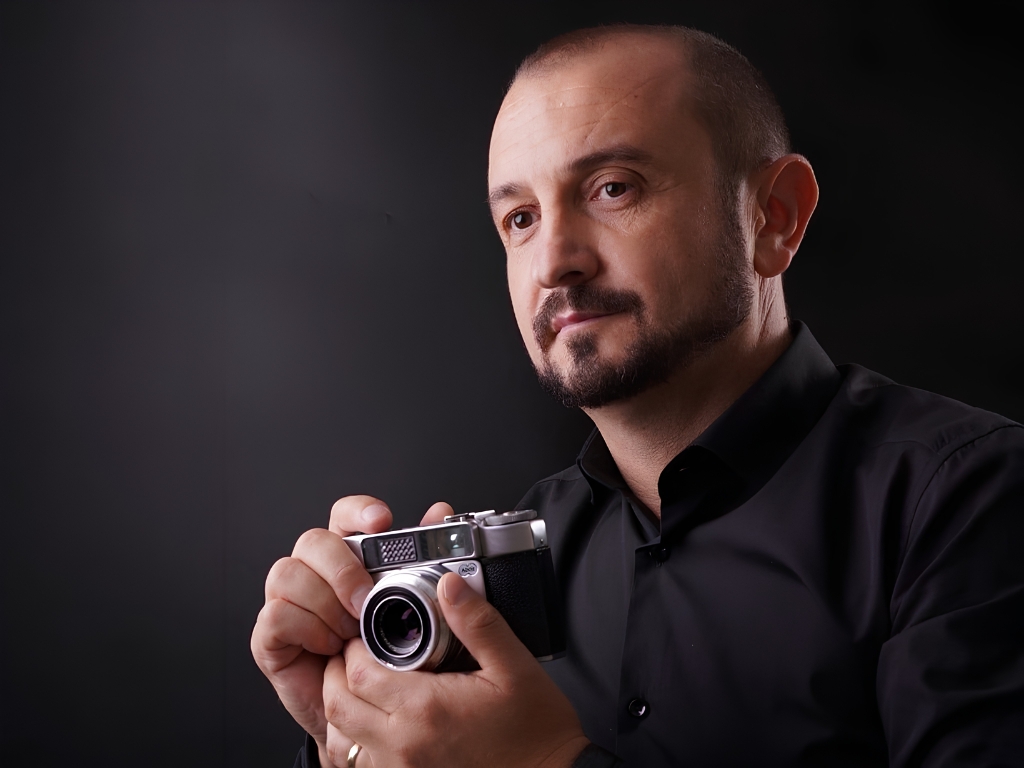
Discover our interview with Sorin Daniel, founder of Unic Studio Foto and Unic Flow Lens, on entrepreneurship, corporate photography, videography, artificial intelligence, leadership, business strategy, branding, and the future of visual content for companies.
Sorin Daniel is the founder of Unic Studio Foto, a professional corporate photography and videography studio based in Bucharest, and of Unic Flow Lens—an ecosystem dedicated to visual content for companies, built on more than 20 years of passion for photography and entrepreneurial experience gained in parallel.
C&B: How would you describe yourself in a single sentence to capture the attention of someone who doesn’t know you?
Sorin: Many years ago, I entered the fields of IT and economics to learn business. For nearly 20 years, I combined entrepreneurship with photography as a passion, and for the past two years I have been bringing to market exactly what I personally lacked throughout all those years.
C&B: Looking back, what is the “common thread” that has guided your professional journey?
Sorin: Photography has been part of my life for more than 20 years, but for a long time it was a passion rather than a profession. I photographed events and products alongside another business, depending on the opportunities available at the time, not as my primary activity.
The real common thread wasn’t photography itself, but a constant frustration: I had lighting ideas and creative concepts I wanted to test, but I had nowhere to do it. A professionally equipped studio is expensive, my time was limited because of my other business, and such an investment didn’t make sense for someone who photographed “whenever possible” rather than full-time. I wanted to find someone who could provide me with a space, at little or no cost, simply so I could practice.
No one offered that.
So I decided to build that place myself.
In 2024, I opened Unic Studio Foto—not just as a photography studio, but as a place where I could finally practice what I had wanted to do for years, while also solving a problem I had personally experienced for a long time: creating an accessible space for photographers and videographers who have the skills and professionalism but lack the resources to own a studio. At the beginning of 2026, I started actively promoting this project under the name Unic Flow Lens, and the results have already begun to show—not only through the team that has formed around it but also through the collaborations we have secured together.
The constant throughout this journey has been simple: I have always built what I personally needed, not what I thought “should” exist in the market. My 20 years in business gave me maturity and discipline; photography gave me passion; and Unic Studio Foto emerged precisely where those two met a genuine need that no one else had addressed.
C&B: What was a difficult moment or failure that truly changed you?
Sorin: I can’t say I’ve experienced a financial failure or a client project that collapsed. The studio has been consistently supported, and the quality of our work has always been my main performance indicator. But I did experience another kind of failure—less visible, yet just as costly: I built my online presence without a clear strategy.
As Unic Studio Foto, and later Unic Flow Lens, evolved, I kept creating new accounts whenever I felt the need to separate a project, a sub-brand, or a new direction—the studio page, the product account, accounts for specific collaborations. Eventually, I found myself managing more accounts than I could handle consistently, each with its own audience, tone of voice, and posting history.
The result was exactly the opposite of what I wanted. Instead of creating a strong and easy-to-follow brand identity, I ended up confusing my own content between accounts—posting on the wrong profile, losing consistency, and making it difficult for people to know where to find us and understand who we are and what we do. I invested time and energy in creating high-quality content, but without a structure that could maximize its impact, much of that effort became diluted.
The lesson was simple, yet difficult to accept: production quality does not compensate for a lack of clarity in communication. You can have the best photographs and the best projects, but if people don’t know where to find you or what to expect from you, your work remains invisible.
That is why I am now taking a completely different approach: clear, consistent posting with dedicated time allocated specifically for content creation—not improvised between other tasks. It’s a discipline I now treat just as seriously as I treat a corporate photography project: with planning, structure, and accountability for the final result.
C&B: What is one bold (or counterintuitive) decision that significantly influenced your trajectory?
Sorin: When I opened Unic Studio Foto, the easiest choice would have been to keep the studio exclusively for myself, for my own projects, or at most rent it out at market rates. That would have been the safe option, with predictable income and no additional risks. I deliberately rejected that path because it wasn’t the reason I had built the studio.
Instead, I chose to open the space to photographers and videographers who had real skills and professionalism but lacked the resources to own a studio—people who, just like me years ago, had ideas and simply needed a place to test them.
The risk was obvious: quality. You can’t allow strangers to work in a space that carries your name without accepting the consequences if something goes wrong. I managed that risk through a rigorous selection process involving numerous meetings and genuine evaluations, not just an application form. I didn’t accept everyone—I selected only those who demonstrated through both their portfolio and our conversations that they deserved my trust.
The results came faster than I expected. Less than six months after launching the project under the Unic Flow Lens brand, I can already rely on a real network of professionals—photographers, editors, and videographers—with whom I win and deliver corporate projects that require far more than one person behind the camera. What initially seemed like a risk to my brand has become the very reason I can now take on projects that I could never have completed on my own.
C&B: How have you changed over time as a leader and professional?
Sorin: In the beginning, my work was structurally simple, even though it was technically demanding: me, the camera, and the client. The decisions were mine alone, and so was the pressure.
Nearly two years after founding the studio, my work looks completely different. I now coordinate teams on complex projects—photographers, a drone pilot, and editors—and I have to manage multiple workflows simultaneously without allowing them to overlap. For example, while covering a sports championship as the official photographer, we were running two parallel content streams: one for the organizers and one for our own brand, each with its own pace, tone, and deliverables, delivered every evening in real time.
The biggest difference compared to a few years ago isn’t photography itself—that remains a foundation I have mastered well. The real difference is that my decisions now affect other people’s work, not just my own shots. I’ve learned to make fast decisions under real-time pressure—I no longer have the luxury of endlessly reconsidering a frame; it has to be delivered. I’ve learned to delegate without compromising quality and to build clear processes—checklists, fixed roles, and non-negotiable rules, such as placing a watermark on every photograph—that work even when I’m not the one pressing the shutter.
In practical terms, I’ve evolved from being the photographer who delivers the work to the leader who ensures the entire team delivers work of the same quality, regardless of who is holding the camera.
C&B: What do you think the people who work directly with you would say about you—beyond your public image?
Sorin: I believe my team would first mention consistency. I don’t change direction easily, and the ideas I propose remain stable over time. I don’t jump from one project to another without a clear reason.
They would probably also mention how demanding I am when it comes to the quality of our deliverables. I don’t accept “good enough”; I expect the work to be exactly what it needs to be.
And I think they would say I’m someone who stays involved when problems arise. I’m the kind of person who remains engaged until the issue is solved, not someone who leaves it for others to deal with.
That said, there are also traits that are less comfortable. I find it difficult to say no to a client. I’m persistent—perhaps sometimes too persistent—in trying to win a project, even when it might be easier to walk away. I’m also impatient with slow decision-making. I don’t like waiting too long to make a decision, nor do I like seeing a new idea put aside without being analyzed immediately. I think my team feels this as well—the pace I set is sometimes faster than they would prefer because I want things moving from day one.
These are qualities that help me complete projects successfully, but I also know they can make it challenging for the people around me to keep up.
C&B: What truly differentiates you in the way you build or lead?
Sorin: I don’t claim that “we’re different.” I prefer to show how we work and let others draw their own conclusions.
That said, I would point out that I built Unic Flow Lens as a complete ecosystem rather than simply expanding our services. When a corporate client needs visual content, they don’t just get a photographer—they gain access to a photographer, videographer, editor, graphic designer, and even professional models, all working within one coordinated structure. Most small studios remain one-person operations or expand only into photography. I chose to build the complete team before having a guaranteed client volume that would financially justify it.
I measure the project’s success through how carefully I select collaborators. I have never accepted people into the team simply because they own good equipment. Every candidate goes through real meetings, portfolio evaluations, and assessments of professionalism, because everyone at Unic Flow Lens works under my name with corporate clients who don’t forgive mistakes.
I also focus on visibility in the way we deliver large-scale projects. At the events we cover, we simultaneously run two separate content streams—one for the client or event organizer and another for our own brand—each following clearly defined rules and never interfering with one another.
Ultimately, the difference isn’t found in a slogan. It’s in treating every project with the same structure and discipline, regardless of its size. That’s how you build long-term trust—not just a client who’s satisfied once.
C&B: How has today’s environment—technology, AI, and the economy—changed the way you work?
Sorin: AI has already become an integral part of how we work—not as an experiment, but as part of our actual deliverables. One of the services we’re currently developing is corporate aftermovies featuring AI-generated soundtracks tailored to each client’s brand identity—something that would have been impossible to offer just a few years ago at today’s cost and speed, while also avoiding music copyright complications.
On the production side, I’ve built my own digital tools to automate processes that previously took hours—from organizing photographs and optimizing content for social media to creating workflows where the camera connects directly to our applications. I don’t wait for off-the-shelf solutions to solve my specific needs. If a process slows me down, I’d rather build my own tool than adapt my work to generic software.
Economically, today’s market has also changed client demand. Companies increasingly want video content for LinkedIn and presentations rather than simple still photography, while digital marketing budgets among medium-sized businesses continue to grow. That has encouraged us to expand beyond photography into video production, aftermovies, and soon corporate podcast production, allowing us to stay relevant where purchasing decisions are increasingly being made.
C&B: Is there a habit or routine that has significantly influenced your performance?
Sorin: I have several routines that have become part of my daily life, each serving its own purpose.
The first—and probably the most visible outside the studio—is that I consistently publish blog articles on unicstudiofoto.ro on the same day every week. It’s not a spectacular activity, but over time that consistency has built a genuine online presence—the exact opposite of the social media chaos I experienced in the past. A fixed rhythm, maintained no matter how busy the week becomes, matters far more than sheer volume.
The second routine is operational discipline. Before every event, I go through a comprehensive checklist to ensure nothing has been overlooked—equipment, team roles, deliverables, and logistical details. It sounds simple, but on projects involving multiple people, where you never get a second chance to recreate a missed shot from a one-time event, that checklist is the difference between flawless delivery and a project full of gaps.
The third is more personal, but it sets the tone for my entire day. Every day at the studio begins with a quality coffee made from freshly roasted beans. It’s not just a small indulgence—it’s the ritual that helps me focus before diving into work, no matter how demanding my schedule is.
All three routines have one thing in common: they’re small, repetitive, and easy to overlook in the short term—but over time, they’ve become the foundation that supports everything we deliver.
C&B: What principles guide your most important decisions?
Sorin: The first principle is that quality is non-negotiable, regardless of time or budget constraints. I’d rather decline a project than deliver something below the standard I’ve set for myself.
The second principle is choosing long-term partnerships over quick profits. When I decided to open the studio to other photographers and videographers instead of simply renting it out at market rates, I chose the path with greater risk and slower returns because my goal wasn’t immediate income—it was to build a genuine community of professionals. In the long run, that is worth far more than rental income.
The third principle is to build what is missing, not what the market obviously demands. Unic Studio Foto and Unic Flow Lens were born from a need that I personally experienced for years, not from a market research study.
This last principle was put to the test when I decided to open the studio to other professionals through a rigorous selection process, without any guarantee of immediate benefits. The risk was real—other people’s work would carry my name—but the principle of “build what’s missing, not what’s safe” prevailed over the easier and financially safer option. Less than six months later, that principle proved itself through the collaborations and projects we secured precisely because of the team we had built.
C&B: How do you see your industry evolving over the next three to five years?
Sorin: I believe the direction is already clear—it’s no longer just a prediction. Video is continuing to replace still photography as the default standard rather than a premium option. Short-form, vertical, mobile-first content is becoming the norm, both on social media and in corporate communication, where more and more companies are requesting content designed specifically for LinkedIn and short-form platforms instead of simply building photo archives.
At the same time, artificial intelligence is rapidly becoming part of the production process—from generating original music for aftermovies to tools that automate image selection and basic editing. I don’t believe AI will replace experienced photographers or videographers, but it will raise expectations. Clients will expect faster delivery, multiple content formats from a single project, and greater cost efficiency. Professionals who fail to integrate these tools into their workflow will become slower and more expensive than their competitors.
The real risk for the industry, in my opinion, is increasing polarization. On one side, there will be fast, inexpensive, AI-generated content for companies seeking only volume. On the other, there will be a premium segment demanding strategy, brand storytelling, and genuinely high production quality—not just beautiful visuals, but content that serves a clear business objective. I believe the studios that will survive and grow are those that firmly position themselves in the second category, acting as strategic partners rather than simple image providers.
The greatest opportunity lies exactly where we are already positioning ourselves: serving small and medium-sized companies that still don’t have a consistent visual content partner and instead hire providers only when needed. Their demand will continue to grow as competitive pressure increases and businesses recognize the importance of maintaining a professional online presence. Those who build long-term retainer relationships instead of relying solely on one-off projects will benefit the most from this growth.
C&B: What role do you intend to play in this evolution?
Sorin: I don’t want to be just another service provider adapting as the market changes. I want to build the structure that anticipates exactly where corporate demand is heading.
In practical terms, that means continuing to develop Unic Flow Lens as a complete ecosystem—not just photographers and videographers, but an integrated content team including editors, graphic designers, web developers, and models, capable of delivering everything a company needs for its visual identity through a single trusted partner instead of multiple fragmented suppliers. I believe the near future will strongly favor this model. Companies no longer want to coordinate four or five different collaborators for content—they want one reliable point of contact.
At the same time, I intend to integrate AI wherever it creates genuine value: original music for aftermovies, greater production efficiency, and smarter workflows—without sacrificing what technology cannot replace: artistic judgment, direct client relationships, and a deep understanding of each client’s brand strategy.
I don’t want to compete on volume or the lowest price. I want to be the preferred choice for companies that understand their visual identity is an investment, not an expense.
My medium-term objective is simple to express but difficult to achieve: to transform Unic Studio Foto and Unic Flow Lens from occasional service providers into long-term content partners for an increasing number of companies while simultaneously building a genuine community of photographers and videographers who grow professionally through the projects we create together.
C&B: What genuine advice would you give to someone who wants to build something meaningful today?
Sorin: My first piece of advice is this: build what is missing, not what seems safe. I started Unic Studio Foto because of a personal frustration—I couldn’t find a place where I could experiment with creative ideas without significant costs. Instead of looking for an existing solution, I decided to become that solution for others. More often than not, the best business ideas don’t come from market research—they come from solving a problem you’ve personally experienced.
My second piece of advice is not to underestimate communication simply because your product or service is of high quality. I made that mistake myself. I invested everything in delivering outstanding projects while neglecting consistency in my online presence. I created multiple accounts without a clear strategy and ended up diluting my own efforts. High-quality work doesn’t promote itself—it needs to be communicated and supported with the same discipline you apply when creating it.
Third, choose your partners with the same level of rigor you use when choosing your clients. When I opened the studio to other photographers and videographers, the biggest risk wasn’t financial—it was reputational. Every collaborator works under your name. Don’t accept everyone just because you want to grow faster. A rigorous selection process may slow your growth initially, but it is what protects your brand over the long term.
And if I had to summarize everything in one idea, it would be this: build the structure before you have proof that it will work. I assembled a complete team before I had enough clients to financially justify it. It was a calculated risk—but that very risk is what led to the results we have today.
C&B: What is an uncomfortable truth about your industry that very few people are willing to say?
Sorin: The most uncomfortable truth is that most studios in the local market compete on price rather than value—and that keeps the entire industry undervalued compared to what it could truly become. The B2B photography and video market in Bucharest is estimated to be worth tens of millions of euros annually, yet many of us accept fees that barely cover our costs simply to avoid losing projects to competitors. The result is a race where the cheapest provider wins instead of the best one, and genuine quality ends up being treated as a luxury rather than the standard.
The second uncomfortable truth is that many clients still view visual content as a one-time expense rather than a marketing asset capable of generating measurable long-term results. A website with poor-quality photographs, an inconsistent LinkedIn presence, or an amateur aftermovie all carry a very real—but invisible—cost in terms of the trust you lose with partners and potential clients. Yet because those consequences don’t immediately appear on an invoice, investing seriously in brand image is constantly postponed until “later.”
And perhaps the most uncomfortable truth of all is that many of us within the industry fail to publicly acknowledge that business fundamentals—communication, strategy, and consistency—matter just as much as the talent behind the camera. We prefer talking about equipment and portfolios instead of admitting that even an outstanding photographer without a solid business structure remains invisible in the marketplace, no matter how talented they truly are.
And perhaps the most uncomfortable truth of all is that many of us within the industry fail to publicly acknowledge that business fundamentals—communication, strategy, and consistency—matter just as much as the talent behind the camera. We prefer talking about equipment and portfolios instead of admitting that even an outstanding photographer without a solid business structure remains invisible in the marketplace, no matter how talented they truly are.
Sorin Daniel’s interview provides an authentic perspective on how corporate photography, videography, artificial intelligence and business strategy can work together to build a strong brand and long-term client partnerships.

 UK
UK
 IT
IT
 ES
ES
 DE
DE
 FR
FR
 RO
RO
 PT
PT
 HU
HU


