


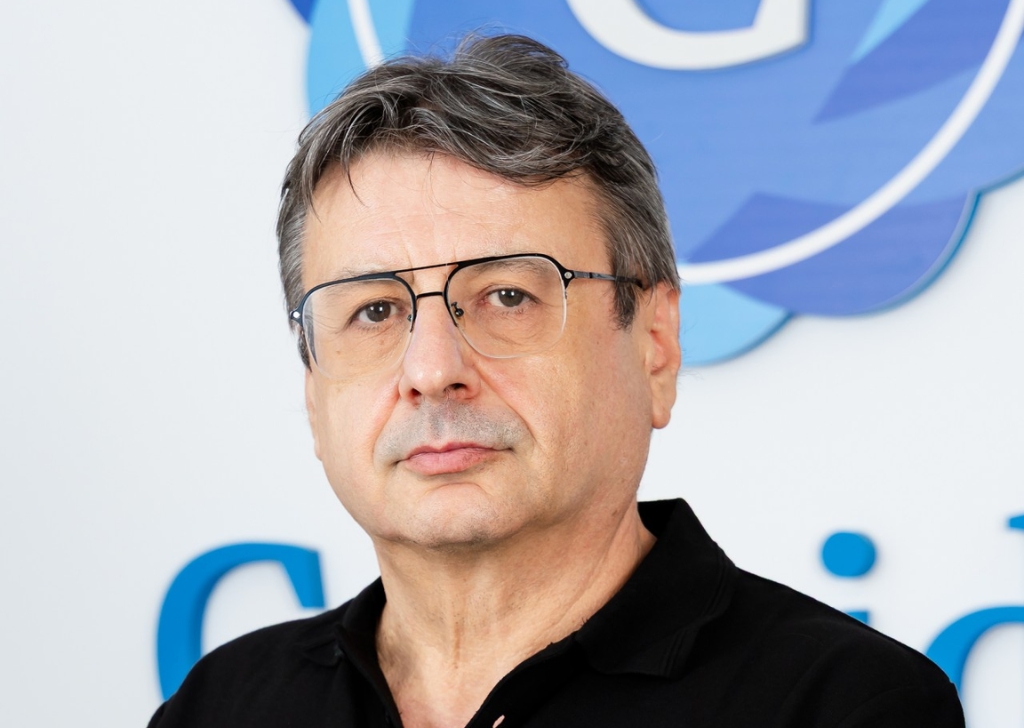
Ottavio Serbanescu, Cresida leader, discusses managing over 6,000 apartments, transparency, digitalization, AI, leadership and the future of homeowners’ association management.
Ottavio Serbanescu leads the Cresida group of companies and has 20 years of experience in homeowners’ association management: in 2006, he founded one of the first property management companies in Bucharest, which he sold in 2010, and in 2018 he took over Cresida — at the time a young company with 5–6 associations in its portfolio — and grew it to more than 6,000 apartments currently managed in Bucharest and Ilfov, with a fully in-house team and its own IT system.
C&B: How would you describe yourself in a single sentence, in a way that would capture the attention of someone who does not know you?
Ottavio: I am the man who manages apartment buildings, but whose real job is something else: turning homeowners’ distrust — “I wonder where our money is going?” — into data they can verify for themselves.
C&B: Looking back, what is the “common thread” that has guided your professional journey?
Ottavio: The common thread is my refusal to accept “good enough.” In apartment building management, “good enough” is the unwritten rule of the market: ring binders, verbal promises, figures that no one can verify. I have been in this profession for 20 years, as of May 2026, and three moments have defined my journey. In 2006, I founded my first management company — I built it from scratch, sold it in 2010, and remained involved with it until 2018. The second moment was taking over Cresida in 2018 — a company founded one year earlier that had only 5–6 associations at the time. I built it according to the same principle I had believed in from the beginning: a fully in-house team — accountants, cashiers, certified technical property managers, call center — instead of the market’s usual model of external collaborators, because you cannot guarantee the quality of something you do not control. The third was the decision to develop our own IT system on top of the market’s standard tools, because I wanted to be able to demonstrate the work, not merely claim that it had been done. The constant throughout all three: control is built, not hoped for.
C&B: What was a difficult moment or failure that truly changed you?
Ottavio: Losing a major contract. A single association represented a significant share of our revenue, and when the contract ended, the decline was felt immediately and painfully. The mistake was not the loss itself — contracts are lost — but the fact that I had allowed one client to matter that much. From then on, I changed two things: I started monitoring client concentration as a risk indicator, just as seriously as collections, and I shifted our growth strategy from “as many large contracts as possible” to a balanced portfolio in which no single departure could destabilize the company. It was the lesson that taught me that, in a recurring-services business, stability does not come from large clients, but from the structure of the portfolio.
C&B: What is one courageous (or counterintuitive) decision that significantly influenced your trajectory?
Ottavio: The decision NOT to build an “all-in-one” IT system. When we decided to develop our own software, instinct — and the advice we received — told us to completely replace the existing platforms. I refused. A complete system would have meant years of development, huge costs, and the risk of delivering something mediocre across the board, too late. We chose the opposite approach: keep the market’s standard platform for what it does well — the online notice board — and build our own system on top of it, specifically in the areas where the market offers nothing: tracking, monitoring, reporting, debt recovery. The result: functional modules in production within months, not years, and a real point of differentiation from the competition. And at the beginning of 2026, when payments through a platform used by 1.6 million apartments were suspended overnight by the authorities, it confirmed the complementary lesson as well: for critical workflows, you need your own backup plan.
C&B: How have you changed over time as a leader/professional?
Ottavio: The biggest change: I moved from “I’ll do it myself, so it gets done right” to “I’ll write the rule, so it gets done right without me.” For years, I was the person who personally checked everything — it worked with a few dozen associations, but eventually became the main brake on growth. Today, I work differently: every important process has a written rule and a clearly assigned person responsible for it, and I only step in when there are exceptions. I delegate based on rules, not blind trust. The way I handle pressure has also changed: at first, any problem at any association reached my desk that same day and consumed my evening; now I have learned to separate the urgent from the important and accept that a good system solves more problems than a tireless founder. Perhaps this is the hardest lesson for someone who started from scratch: understanding that the company grows precisely to the extent that you stop being indispensable.
C&B: What do you think the people who work directly with you say about you — beyond your public image?
Ottavio: I suspect the first word would be “strict.” I am demanding, and my standards are non-negotiable: in our profession, a small error on a maintenance statement can turn into a major confrontation at a homeowners’ association meeting, so checking is not an option; it is basic hygiene. I know that standard can sometimes be exhausting. But I believe those same people would also say the second part, which matters more: that I stand up for them and support them in any situation. When an angry homeowner or association president unfairly attacks one of my colleagues, I stand between my person and the storm — I do the criticizing only myself, only internally, and only behind closed doors. Demanding standards without protection is simply intimidation; protection without high standards is simply weakness. Together, I believe they form the only fair contract between a leader and their team: I expect a lot from you, but I will never leave you alone. The fact that the key people have stayed by my side for years tells me that this contract works.
C&B: What truly differentiates you in the way you build or lead?
Ottavio: Specifically, three things. First: while the overwhelming majority of property management companies offer “transparency” through a third-party online notice board — where homeowners can see invoices and payment statements, and that is about it — we have built our own tracking and reporting layer on top of that notice board: every complaint, every maintenance job, every outstanding debt being followed up has a visible trail, with deadlines and responsible people. Second: our fully in-house team — we do not outsource accounting or cashier operations, because that is where quality control is lost. Third: important processes are codified in writing — operating rules, validation criteria, escalation steps. It sounds bureaucratic, but it is the opposite: written rules are what allow us to grow without every new client creating new chaos. The difference is most visible when an association is handed over: we can show the complete history of everything that has happened, rather than a ring binder.
C&B: How has the current context — technology, AI, the economy — changed the way you work?
Ottavio: Fundamentally — but not in the spectacular way shown in presentations. We use artificial intelligence as “agents” that perform repetitive office operations: for example, bank reconciliation — matching payments from bank statements with the records of each association — tedious work that used to consume hours of human labor every day. Our rule is strict: the agent does the work, the human validates the exceptions. The economic effect is simple: labor costs in the market are constantly increasing, and companies that remain purely human-driven will see their margins shrink year after year. We are turning precisely this pressure into an advantage: the same team can manage an increasing number of apartments, while people shift from mechanical work toward what matters — relationships with homeowners’ associations. We have not laid anyone off because of AI; we have freed people up to focus on clients.
C&B: Is there a habit or routine that has significantly influenced your performance?
Ottavio: Two, one physical and one work-related. The physical one: 30 minutes of exercise every day, five days a week, following a structured program — plus a weekly weigh-in and review on Sundays, under the same conditions, so that I can make accurate comparisons. I discovered late in life that energy is a business resource, not something to be taken for granted. The work-related one: every project has a “status log” — a single place where what has been done, what is blocking progress, and what comes next are recorded, with dates. It sounds mundane, but it solves the real problem faced by any entrepreneur juggling multiple directions: when you focus intensely on one, the others quietly die. The logs allow me to pick up any thread again within five minutes, without archaeological digs through emails. Both routines follow the same logic: progress measured in the same way, at fixed intervals, beats enthusiasm measured randomly.
C&B: What principles guide you when making important decisions?
Ottavio: Four principles, all learned the hard way. First: one variable at a time — I do not introduce a new change until the previous one is stable; when you change three things simultaneously and a problem appears, you no longer know which one caused it. Second: validate, then scale — every new service is tested with a few known associations before being offered to everyone. Third: I never risk what works for something that might work. Fourth: rules live in writing, not in memory — what is not written down gets lost. The real test of the first principle is our ancillary services. The first one we built was debt recovery — because outstanding payments are the open wound of any association — and only after it became a stable process, with consistent results, did I allow myself to think about the next one. Clients have been asking us for cleaning, green spaces, installations for years — and we will do them, one at a time. As a horticultural engineer, green spaces are my personal temptation; precisely because of that, I know that the biggest trap for an entrepreneur is launching what they like rather than what is ready. A service launched in a rush of enthusiasm is born sick — and clients will not forgive a poor service simply because the rest are good.
C&B: How do you see the evolution of your industry over the next 3–5 years?
Ottavio: Three major developments. First: consolidation. Legal certification requirements, mandatory funds with serious fines, and increasing complexity are pushing individual property managers, especially older ones, out of the market — and their portfolios will be taken over by medium-sized, professionalized companies. Second: demand is changing. With maintenance costs visibly increasing, homeowners are no longer looking for “someone who collects the money,” but “someone who can demonstrate what is happening” — the media is already full of stories about unexplained differences in maintenance fees and fraud involving property managers. Real transparency is becoming a selection criterion, not price. Third: automation is moving from pilot to production. AI tools are becoming accessible to everyone, so the advantage will not be “we use AI” — it will be who has the processes codified and the accumulated data needed to use it safely. The main risk in the market remains dependence on single platforms: the beginning of 2026 showed what happens when infrastructure used by 1.6 million apartments goes down overnight.
C&B: What role do you intend to play in this evolution?
Ottavio: We are building several concrete things. First: the ability to manage several times more apartments with the same team, by automating office work — that is the foundation. Second: a “control room” for homeowners’ associations — reporting that allows the president and committee to constantly see the status of their building: collections, outstanding payments, work, complaints. Third: modernizing the way we monitor the technical condition of buildings — monitoring no longer means a property manager walking around once a month and looking up from the ground; we are preparing a first-of-its-kind solution for the local market, which we will announce soon, so I cannot say more for now. And in the medium term, the system we are building for ourselves could also serve other property managers — but one step at a time: first, we will prove it within our own company.
C&B: What real advice would you give someone who wants to build something relevant today?
Ottavio: Three pieces of advice, all based on my own mistakes. First: write down your rules, do not keep them in your head. Any process that exists only in your memory cannot be delegated, cannot be automated, and dies when you are tired. The day I started writing operating rules was the day the company began growing without me being involved in every detail. Second: change one variable at a time. Enthusiasm pushes you to start five things simultaneously; the discipline of stabilizing one before opening the next may seem slow, but it is the only approach that compounds over time. Third: do not wait for the perfect system — build on top of what already exists. I lost less time accepting the imperfections of existing tools and adding our own layer of value on top of them than I would have lost building everything from scratch. Perfection is a project that never gets delivered.
C&B: What is an uncomfortable truth about your industry that few people talk about?
Ottavio: The “transparency” that most property management companies sell is not transparency. It is an online notice board rented from a third party, where homeowners can see scanned invoices and payment statements — essentially the exact same documents from the traditional notice board, simply moved onto a screen. What they cannot see is whether their complaint has been taken up, who is working on it, why the repair cost what it did, or what happened with the people who are behind on their payments. The second uncomfortable truth, for my colleagues in the industry: the purely human business model is slowly dying. Salaries are constantly increasing, fees cannot rise at the same pace, and the difference will ultimately be paid for either through lower quality or through companies disappearing. Anyone who does not automate their office work in the coming years will not be competing with us — they will be competing with their own operating costs. And a third truth, about clients: an association does not buy property management; it buys peace of mind. The day you understand that, you stop selling services and start demonstrating control.
The story of Ottavio Serbanescu and Cresida shows how a traditional industry can be transformed through clear processes, technology, transparency and a disciplined approach to growth.

 UK
UK
 IT
IT
 ES
ES
 DE
DE
 FR
FR
 RO
RO
 PT
PT
 HU
HU


