


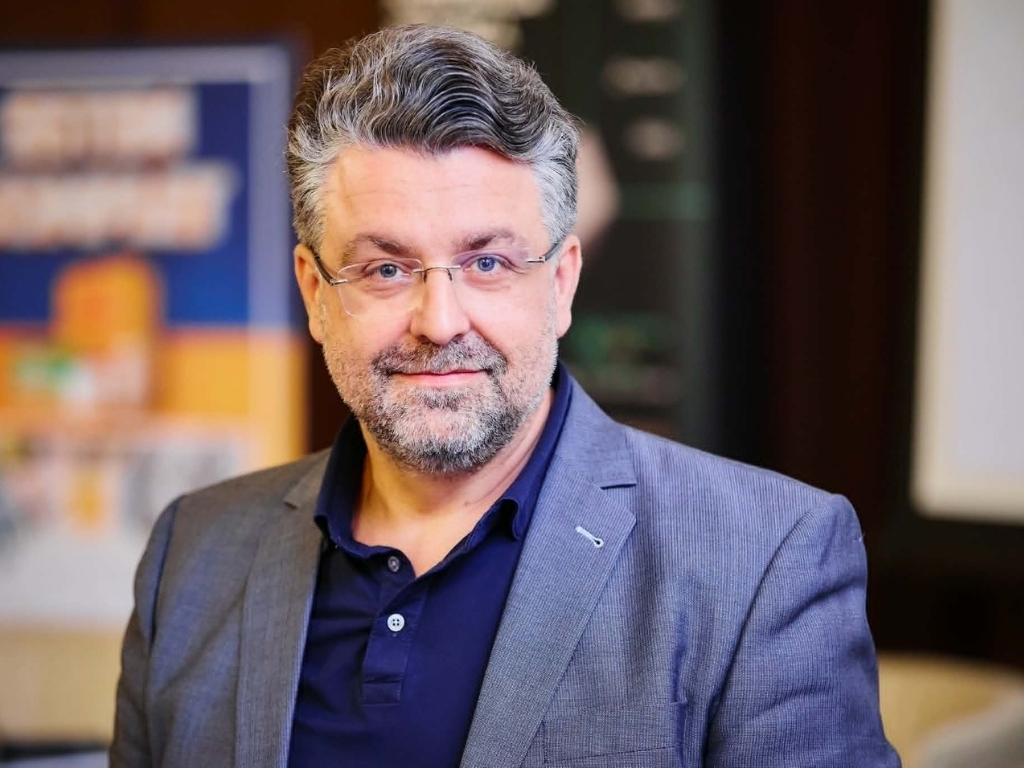
Marius Luican, Founder of Reveal Marketing Research, discusses market research, AI, data-driven decisions, consumer behavior and the future of marketing.
Marius Luican is the Founder and General Manager of Reveal Marketing Research, a company he has led for nearly two decades, through which he has coordinated hundreds of research projects for organizations in Romania and abroad. In recent years, he has focused his work on how artificial intelligence is transforming the relationship between consumers and companies, including the development of AI Source Map – a research tool that analyzes how artificial intelligence models recommend brands, products, and services. He is a strong advocate of data-driven decision-making and of an organizational culture built on a deep understanding of human behavior.
C&B: What is the mission you have taken on through your work?
Marius: I believe that the most expensive decisions are those made without understanding people.
This is the mission I took on nearly 20 years ago, when I founded Reveal Marketing Research: to help companies and organizations make better decisions based on what people actually think, feel, and do, rather than on what we assume about them.
At the beginning of my career, I believed that the role of research was to provide answers. Today, I believe that its role is, above all, to ask the right questions. The difference between a good decision and a wrong one is, most of the time, not a lack of information, but the fact that we start from incorrect assumptions.
In recent years, we have witnessed the biggest change of the past few decades: the emergence of artificial intelligence as an intermediary between companies and consumers. If until yesterday people searched for information through a search engine, they are now increasingly asking an AI assistant which product to buy, which bank to choose, or which hotel to book.
That is why we developed AI Source Map. Today, I believe it is no longer enough to understand the consumer. We will also need to understand the logic through which artificial intelligence comes to recommend one brand over another.
C&B: What is the most important problem you see today in your field, and how do you think it can be solved?
Marius: Paradoxically, the biggest problem is no longer a lack of data, but an excess of it.
Companies today have more information than ever before. Dashboards, analytics, CRMs, social media, studies, AI. And yet, many decisions are still made based on instinct or according to the opinion of the person with the greatest authority in the room.
Data does not replace intuition, but it disciplines it.
At the same time, artificial intelligence is radically changing the rules of the game. In the coming years, competition between companies will no longer be only for consumers’ attention, but also for the trust of the algorithms that will make recommendations on their behalf.
For this reason, I believe market research needs to evolve. It is no longer enough to measure brand awareness or satisfaction. We need to understand the mechanisms through which a brand’s reputation is built both in people’s minds and within AI ecosystems.
I am convinced that, in the very near future, major companies will have two distinct communication functions: one dedicated to people, built around emotion, creativity, and the relationship with consumers, and another dedicated to artificial intelligence, built around product attributes, factual information, and credible sources from which AI models form their recommendations. In fact, global players have already begun organizing themselves in this direction. This is why we developed AI Source Map: to help companies understand what criteria artificial intelligence uses when recommending a brand, what information influences its responses, and through which online channels this information is sourced. In the very near future, competitive advantage will no longer depend solely on what you communicate to consumers, but also on what artificial intelligence understands and recommends about your company and products.
Organizations that learn to experiment, measure, and quickly adjust their decisions will have an enormous competitive advantage.
C&B: What is the most valuable lesson you have learned throughout your experience, and what do you believe is worth passing on to others?
Marius: The most important lesson is that success comes from the ability to change your own beliefs when reality proves you wrong.
I have seen highly intelligent managers time and again miss important opportunities simply because they tried to confirm what they already believed.
There is an unwritten rule in research: if the results of a study confirm every time what you believed before starting it, you probably have not learned anything new.
Curiosity is one of the most underestimated qualities of a leader. The world is changing at an unprecedented pace. Business models are changing, consumers are changing, technology is changing. The only strategy that remains valid is the willingness to keep learning continuously.
I believe the leaders of the future will not be those who have the most answers, but those who ask the best questions.
C&B: If you had the opportunity to change just one thing in Romania, what would it be and why?
Marius: I would change the way public decisions are made.
Romania has competitive entrepreneurs, highly skilled professionals, and enormous economic potential. However, too many public policies are still developed without measuring their impact or evaluating their results.
In the private sector, it is almost impossible to invest millions of euros without performance indicators and a rigorous analysis of the results. In public administration, this still happens far too rarely.
I would like to see a culture in which important decisions are accompanied by clear objectives, measurable indicators, and regular evaluations. Not to find someone to blame, but to be able to quickly correct what is not working.
I believe Romania could close the gap with many European countries at a surprisingly fast pace if we introduced this discipline of evidence-based decision-making.
C&B: How can we work together to help people, companies, and communities develop more effectively?
Marius: I believe development begins when we replace ego-driven competition with trust-based collaboration.
Companies need to listen more carefully to their customers and employees. Institutions need to listen to their citizens. Universities need to collaborate more closely with the business community. And the private sector needs to share more of the experience it has accumulated.
At the same time, I believe artificial intelligence will democratize access to knowledge in ways we still underestimate. Anyone will be able to access expertise, analysis, and high-quality information. The difference will not be made by access to technology, but by the ability to ask the right questions and use the answers responsibly.
From this perspective, I believe the future belongs to organizations that invest simultaneously in technology and people.
Technology can accelerate performance, but trust, collaboration, creativity, and the ability to understand the needs of others will always remain deeply human.
Ultimately, this is also why I continue to believe in research: not because it produces charts or statistics, but because it helps us understand people better. And when we understand people, we make better decisions. Better decisions produce healthier organizations, stronger communities, and, ultimately, a society that continues to evolve.
As data, artificial intelligence, and consumer behavior continue to evolve rapidly, Marius Luican highlights the importance of evidence-based decision-making and a deep understanding of people. From market research and consumer behavior to the impact of AI on brands and recommendations, the future belongs to organizations that can combine technology with critical thinking, curiosity and adaptability.

 UK
UK
 IT
IT
 ES
ES
 DE
DE
 FR
FR
 RO
RO
 PT
PT
 HU
HU


