


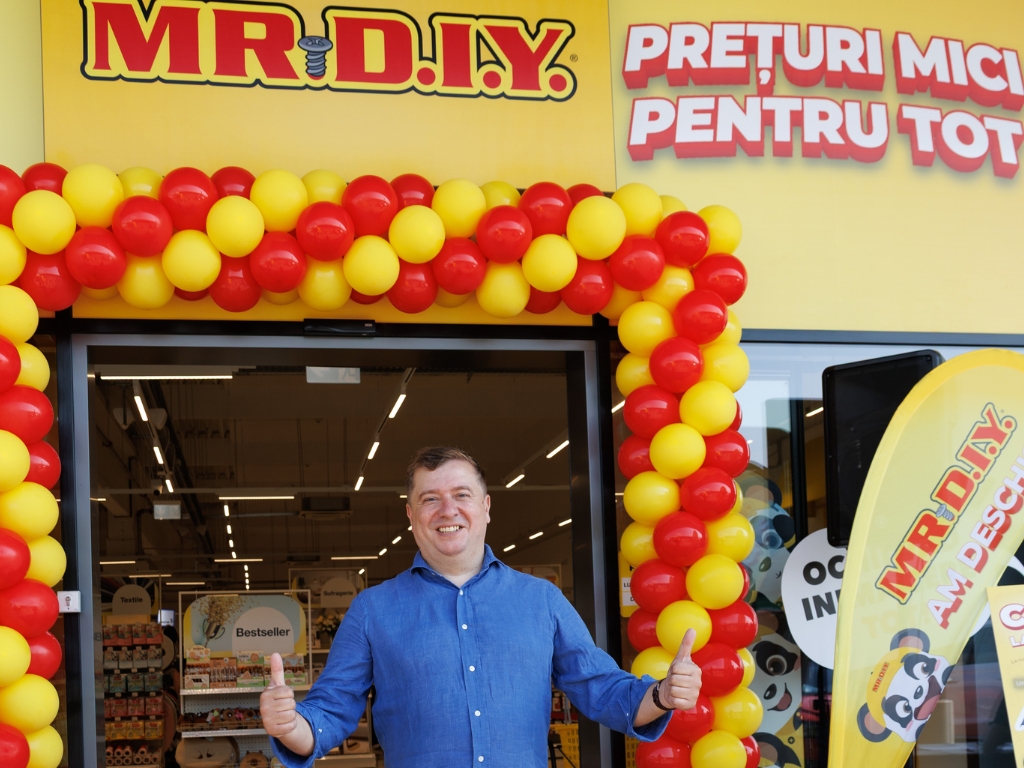
Cătălin Ionuț Secăreanu, Country Business Development Manager at MR. D.I.Y. Romania, discusses retail, expansion, leadership, investments, and sustainable business growth.
Cătălin Ionuț Secăreanu is Country Business Development Manager at MR. D.I.Y. Romania, with more than 20 years of experience in retail, real estate, and investments. His professional journey includes companies such as Pepco, Altex, Cabot Group, and CBRE, as well as extensive exposure to international business environments across Central and Southeastern Europe. He studied at the University of Bucharest and Université de Bordeaux, where he completed part of his doctoral studies, and today he leads MR. D.I.Y.’s development in Romania, contributing to building the local platform of one of the major international value retail brands.


C&B: What is the mission you have taken on through your professional work?
Cătălin: Looking back, I believe that a large part of my career has been about building things.
Sometimes it meant building a store network, other times developing a real estate project, building a team, or helping a company establish itself in a new market.
What I have always liked about retail and real estate is that the result is very tangible. You can have an excellent strategy and an impressive presentation, but ultimately, a store has to open, customers have to walk through the door, and the business has to work.
At Pepco, I had the opportunity to be directly involved in the development of almost 200 stores in Romania. It was an intense period, during which I learned a great deal about large-scale expansion: how important pace is, but also how much discipline is required for an organization to grow alongside its store network.
What I do today at MR. D.I.Y. is quite different, and that is precisely part of what makes the project so interesting to me.
MR. D.I.Y. started in Asia and grew to become a major international retailer, with thousands of stores and a very clear proposition: a wide range of practical products for everyday life, offered at affordable prices.
In Romania, however, we are still at the beginning of this story.
Our first store opened in 2026, so what we are building today means much more than opening individual locations. We are building the local platform almost from scratch: the store network, relationships with landlords and business partners, processes, the organization itself, and, very importantly, awareness among Romanian consumers.
In many Asian markets, MR. D.I.Y. is already part of everyday shopping habits. In Romania, we still need to introduce the concept, earn customers’ trust, and understand how the international model can best adapt to the local market.
I find this challenge particularly interesting because entering a new country never means simply copying what worked somewhere else. You have to understand the local consumer, the competition, and the specific characteristics of the market, and then adapt without losing what makes the concept work in the first place.
If I had to describe my professional mission in one sentence, it would probably be this: to turn strategy into a business that works in reality and can continue to operate sustainably over the long term.
C&B: What is the most important problem you currently see in your field, and how do you think it can be addressed?
Cătălin: One of the biggest challenges I see in retail today is finding the right balance between the speed at which companies want to grow and the time required to make good decisions.
Any growing company feels the pressure to expand. That is perfectly normal. The problem arises when the number of openings becomes more important than the quality of those openings.
A wrong decision is also much more costly today than it used to be.
Rents have increased, construction costs have increased, salaries, utilities, and logistics are more expensive, while consumers are also better informed, more price-conscious, and have far more options.
A poor location, therefore, no longer means just a few disappointing months of sales. It can mean a five- or ten-year lease, a significant investment in fitting out the store, and a great deal of organizational energy allocated to a project that may never achieve the expected results.
Over the years, I have learned that a good city does not automatically mean a good location. And the fact that you are in a successful shopping center does not mean that every space within that center will necessarily be suitable for your brand.
Sometimes the numbers tell you one story, while what you see on site tells you a slightly different one.
That is why I still spend a great deal of time personally visiting locations.
I want to see how people move through the area, how easy it is to access the parking lot, which retailers are nearby, where customers naturally stop, why they come to that destination, and what alternatives they have.
Sometimes, an hour spent observing a location raises questions that a 50-page report would never reveal.
That does not mean that data is less important. On the contrary. I believe the best decisions emerge when you combine good data with experience, common sense, and direct observation.
There is also another dimension: the relationship between the retailer and the landlord.
Throughout my career, I have had the opportunity to sit on several sides of the table — as a retailer, developer, investor, and consultant. This taught me that landlords’ and retailers’ interests are often much more closely aligned than they may appear when negotiations become difficult.
If the retailer’s store performs well, the landlord has a healthy and stable tenant. If the property performs well and the landlord continues to invest in it, the retailer benefits as well.
In my experience, the best deals are not necessarily those in which one party gets every possible concession at the negotiating table.
They are the agreements where, five years later, both parties still feel that they made the right decision.

C&B: What is the most valuable lesson you have learned throughout your career, and what do you believe is worth passing on to others?
Cătălin: Probably not to confuse experience with certainty. Methodical doubt is the principle I try to apply every time. 😊
After more than 20 years in a field, you inevitably begin to recognize certain patterns. You have seen similar negotiations, difficult projects, periods of rapid growth, and periods of crisis.
This experience is extremely useful. It helps you move faster, ask better questions, and sometimes identify problems before they arise.
But experience can also become a trap.
The moment you start thinking, “I’ve seen this before, I already know the answer,” you risk listening less carefully.
My education also played a role in shaping this perspective. I studied at the University of Bucharest and spent an important part of my doctoral journey at Université de Bordeaux, in France. Later, my professional career brought me into contact with investors, managers, and organizations from many different countries.
This exposure taught me something quite simple: there is rarely only one correct way of doing things.
The way we approach a problem in Romania is not necessarily the only solution. At the same time, something that works very well in France, the United Kingdom, or Asia cannot automatically be copied in Romania with the expectation that it will produce the same result.
You have to remain curious.
I believe this matters just as much after 20 or 30 years of experience as it does at the beginning of a career.
I try to have clear opinions and make decisions, but at the same time I try to remain open to changing my point of view when someone has better information or a stronger argument.
The other important lesson concerns people.
In any complicated project, there is usually a moment when the initial plan stops being the plan. 😊 Something gets delayed, a permit becomes more complicated than anticipated, a supplier fails to deliver, a technical issue arises, or a negotiation gets stuck.
That is when you discover the true strength of a team.
The people I have learned to value the most are not necessarily those who never face problems. They are the ones who take responsibility when a problem arises and work to solve it.
Competence is obviously important, but seriousness, character, and a sense of responsibility matter just as much.
C&B: If you could change one thing in Romania, what would it be and why?
Cătălin: I would probably choose predictability.
Not because Romania lacks opportunities. Quite the opposite. I believe that the very large number of opportunities is what makes this issue so important.
Romania has a large consumer market, cities that continue to develop, highly capable entrepreneurs, talented people, and genuine interest from international companies.
The fact that I studied in France and later worked with international investors and organizations gave me a very good understanding of how important predictability is when making long-term investment decisions.
No country has a perfect administration. And I do not believe there is any country where companies are completely satisfied with every tax or every regulation.
What matters is whether you can plan.
An international company entering Romania is not thinking only about the next quarter. A retailer may sign a lease and invest in a store with a ten-year horizon. A real estate investor may be looking 20 or 30 years ahead.
Investors do not necessarily expect every rule to be in their favor. But they need to understand the rules and have a reasonable degree of confidence that these rules will not fundamentally change from one year to the next.
In Romania, companies can still spend a great deal of time and energy managing legislative changes, complex administrative procedures, or different interpretations of the same regulation.
That energy has a cost.
It is energy that could instead be used to open a new store, develop a project, train people, introduce technologies, or simply improve the business.
At the same time, I believe it is important to recognize how much Romania has changed for the better.
The country where I started my career more than 20 years ago and Romania today are very different places. The progress has been enormous.
For me, the next step is to move from being a country that attracts investment primarily because of its opportunities to being a country that also attracts and retains investment because of trust, stability, and predictability.
C&B: How can we work together to help people, companies, and communities develop more effectively?
Cătălin: I believe that, first of all, we need to recognize that people, companies, and communities do not develop independently of one another.
A successful company needs good people, infrastructure, competitive suppliers, effective institutions, and healthy local communities.
And, in turn, I believe that a healthy company should leave something behind in the community where it operates.
Retail makes this relationship particularly easy to observe.
When we open a store, from the company’s perspective it is a new location in the network. At the local level, however, it means jobs, taxes, projects for contractors and suppliers, more options for customers, and often more activity around a commercial area.
As MR. D.I.Y. continues to expand in Romania, we see every new store as an opportunity to become part of the local community, not simply to add another location to the network.
For me, however, one of the most valuable things a company can do is help people develop.
Throughout my career, I have seen colleagues start in junior positions and, through hard work, dedication, and the opportunities they were given, later go on to manage stores, teams, and entire regions.
These stories stay with you.
They may be less visible than a major investment or a new building, but they represent a very concrete form of impact.
I also do not believe that corporate responsibility always has to begin with a large-scale program or a highly visible initiative.
Sometimes it starts with very ordinary things: paying a supplier fairly and on time, keeping your word after a negotiation, giving someone the opportunity to grow, investing in their development, and treating business relationships as something that should last longer than a single transaction.
I also believe there is room for much closer cooperation between companies, public institutions, and the education system.
Companies often complain that they cannot find enough people with the skills they need. At the same time, many young people graduate from university without clearly understanding what employers will actually expect from them.
The business community should perhaps do more than simply point out this gap. We should become more involved in reducing it.
Ultimately, a community does not develop because of a single spectacular decision. It develops because hundreds of relatively small decisions are made well and consistently over many years. There are no miracles, only serious work behind the scenes.
Ultimately, when people are given the opportunity to grow, companies become stronger as well. And when companies grow in a healthy way, the communities around them generally have a better chance of developing harmoniously in turn — as places where people want to stay, rather than places they want to leave.
With more than 20 years of experience in retail, real estate, and investments, Cătălin Ionuț Secăreanu brings a broad perspective on how businesses can be built and developed for the long term. From expanding store networks and selecting the right locations to managing partnerships, developing people, and understanding the importance of predictability for investment, his professional journey is defined by well-grounded decisions and sustainable growth.

 UK
UK
 IT
IT
 ES
ES
 DE
DE
 FR
FR
 RO
RO
 PT
PT
 HU
HU


