


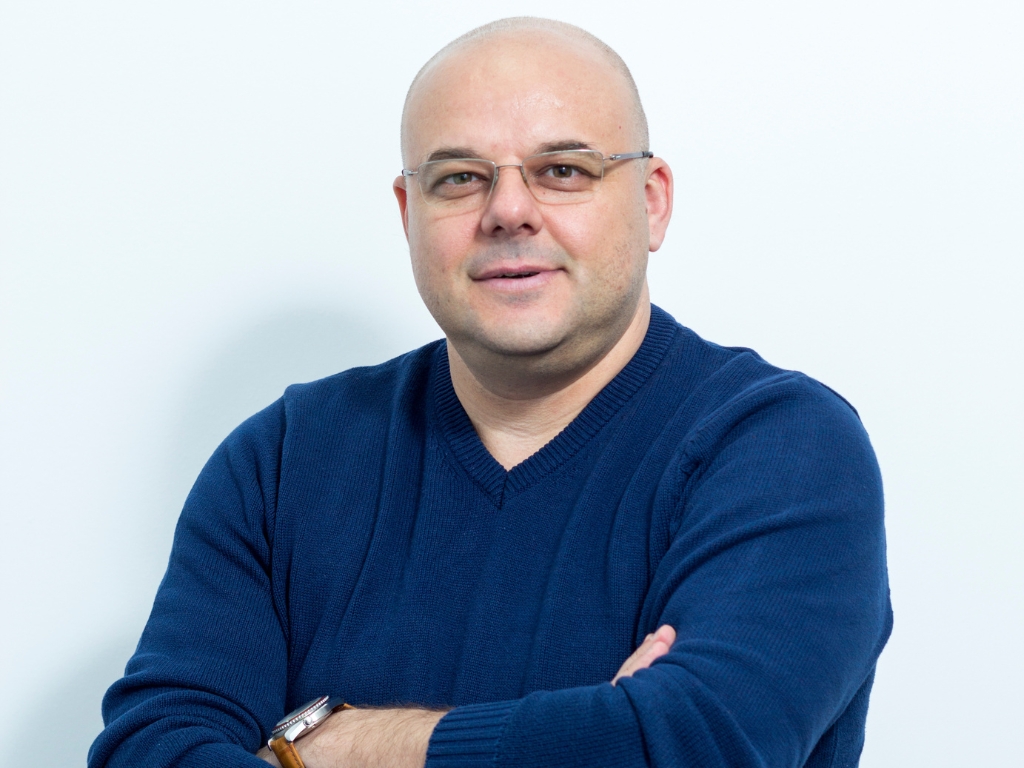
Călin Vlad, General Director of Serra Software, discusses ERP solutions, digitalization, business competitiveness, education, entrepreneurship and the long-term development of companies in Romania.
Călin Vlad is General Manager of Serra Software, a SAP Business One partner in Romania, with over 20 years of experience in management and business development in the technology sector, contributing to the development of solutions and services dedicated to improving processes and driving the digital transformation of companies.
C&B: What is the mission you have taken on through your work?
Călin: The professional goal I have set for myself is to contribute to increasing the competitiveness of Romanian companies by giving them access to world-class technology solutions and, above all, by implementing them correctly and adapting them to the local reality.
I started from a simple belief: a Romanian company should not be disadvantaged in international competition because of the IT systems it uses. For this reason, we have chosen to build our activity around top ERP and CRM solutions, as partners of SAP, the global leader in enterprise management software solutions. For us, however, technology is only part of the equation. Real value emerges when the solution is implemented by people who deeply understand both the technology and the client’s business.
At the same time, we have taken on a second mission, which I consider equally important: making it as easy as possible for international companies to enter the Romanian market. When a foreign company comes to Romania and already uses a solution such as SAP Business One, I do not believe it is reasonable for it to have to change its system simply because it is entering a new market. Our role is to provide a localization of SAP Business One that is very well adapted to Romanian legislation and practices, allowing the company to keep the same platform, the same processes and the same business logic it uses internationally.
That is why we have placed a very strong emphasis on the quality of our team. We did not want to build an organization based on volume, but one based on expertise. Our team includes senior consultants and accounting experts, including members of the Body of Expert and Licensed Accountants of Romania – CECCAR. I believe that this combination of technical experience, an understanding of business processes and accounting expertise is essential for an ERP implementation that truly works.
Ultimately, our mission goes beyond simply implementing software. It is about helping companies work better, make better decisions and become more competitive by giving them access to global-level technology, combined with expertise and a deep understanding of the realities of Romania.
C&B: What is the most important problem you currently see in your field, and how do you think it can be solved?
Călin: I believe that one of the biggest problems in Romania’s ERP market is the lack of truly specialized human resources. I am not referring only to the number of consultants available, but especially to their level of experience and their willingness to make the intellectual effort required by a serious ERP implementation.
An ERP system is not a product that you install and then hand over to the client. A good implementation requires you to deeply understand the company, analyze its processes, identify problems, rethink workflows and, sometimes, have the courage to tell the entrepreneur that certain things they have been doing for years are no longer appropriate for the stage the company is in. It is a process that requires experience, patience and a great deal of analytical ability.
On the other hand, we also have a particularity of the Romanian market. We are talking about a market that is still relatively young when it comes to ERP. In Western economies, companies began working with ERP systems as early as the 1970s and 1980s. In Romania, the adoption of these solutions really began to develop after 1997–1998, largely alongside the entry and expansion of international companies on the local market.
This means that we still have a significant gap, but also an extraordinary opportunity. From my point of view, the Romanian market is far from mature when it comes to the use of integrated management systems.
At present, if we look at the total number of active companies in Romania, probably only around 10% represent the real potential market for mid-range and high-end ERP solutions. We are talking about approximately 50,000–60,000 companies. At the same time, competition among solution and service providers is very high relative to the size of this market.
The paradox is that if we broaden the definition of digitalization, we can say that almost all Romanian companies are digitalized to some extent. They have accounting software, issue electronic invoices or use various applications. But this does not necessarily mean that they are digitalized from a management perspective.
A company may have its accounting in one piece of software and invoicing in another application, while still managing inventory, procurement, sales, production, projects, cash flow or customer relationships through Excel spreadsheets, emails and, ultimately, through the memory and experience of key employees. This is where I believe we have one of the greatest vulnerabilities of Romanian entrepreneurship: businesses are still highly dependent on people, when they should be dependent on processes and systems.
I believe we can significantly reduce this gap in the coming years, but to do so we need to focus simultaneously on two directions: technology and education.
The technology already exists. Access to high-performance solutions is no longer the problem. The challenge is to help entrepreneurs understand what these solutions can do for their companies and, above all, to understand that digitalization does not mean replacing a paper ledger with an Excel spreadsheet or issuing an electronic invoice. Real digitalization means building processes that operate coherently, measurably and predictably, independently of the presence of a single person.
If we succeed in accelerating entrepreneurs’ education in this direction and simultaneously developing the human resources capable of implementing these technologies, I believe Romania can reach a relatively short-term digitalization level of 60–70% among companies for which such systems are relevant.
This is, in fact, one of Romania’s great opportunities: not simply trying to catch up with Western economies, but closing the gap much faster by using technologies that are already available today. We have the opportunity to compress into 10–15 years a maturation process that took several decades in other economies.
C&B: What is the most valuable lesson you have learned throughout your experience and that you believe is worth passing on?
Călin: The number one lesson I have learned is that no matter how good the product or service you offer is, in the long run people choose and maintain partnerships where trust exists. And trust cannot be built quickly and cannot be replaced by a contract.
Experience has shown me that you have to keep learning, specialize and become very good at what you do, while at the same time understanding that you cannot build alone. You need very good partners and strong relationships built over time.
In our case, I would even say that the main product we sell is not software, but partnership. Software is the tool through which we work together with the client, but what makes the difference is the relationship built around it.
We have clients with whom we have been working for more than ten years. For me, this is one of the most important results a service company can achieve. It means that you were not merely the provider of a solution at the time of implementation, but that you managed to become a partner to that company throughout its development.
Our field is also an extremely sensitive one. By the nature of our activity, we have access to a large part of an organization’s information: financial and commercial data, information about employees, customers, suppliers, inventory, margins, internal processes and sometimes even information that can directly influence the company’s strategic decisions. Essentially, we become deeply involved in the client’s business.
That is why, when I build a team, I do not look only at professional competence. Expertise is mandatory, but it is not enough. I must be able to place complete trust in the people to whom I give access to our clients’ information. I apply the same logic to our collaborators and suppliers. I consider them partners, not simply external resources.
I believe this is an important difference between a business built for quick results and one built for the long term. In a relationship based exclusively on price, the client will constantly look for a better price. In a relationship based on trust, expertise and results, the client is looking for a partner they can rely on.
If I were to reduce this lesson to three words, they would be: partnership, trust and expertise. In our field, the three are inseparable. You can have the right technology and a very good team, but without trust, the partnership will not last. You can have trust, but without expertise, you cannot generate value. And expertise without a genuine partnership ultimately remains just a technical skill.
I believe a company’s success is built when these three elements come together and are consistently maintained over many years. And based on my experience, the longevity of relationships is one of the best measures of the value you create for others.
C&B: If you had the opportunity to change just one thing in Romania, what would it be and why?
Călin: I would minimize the state’s involvement in the economy and give as much space as possible to the market economy to operate through competition, performance and merit.
I am not saying that the state should not exist in the economy. Its role is to create clear rules, enforce them correctly and ensure a predictable framework for companies and people. The problem arises when the state becomes such an important economic actor that it begins to distort competition, generate bureaucracy and influence mechanisms that should naturally be regulated by the market.
A significant reduction in this involvement would, in my opinion, have a chain effect: less bureaucracy, genuine competition between companies, a healthier market economy and, very importantly, a labor market based more on competence, performance and merit.
A simple example seems highly relevant to me. Why should a highly skilled business analyst in a Romanian private company reach a salary of €2,000–€3,000 and need years of experience and results to build their career, while a person in a management position or on the board of directors of a state-owned company can earn three, four or even five times more without the level of competence and responsibility always being comparable?
The problem is not just the difference in income. The problem is the signal the system sends.
A highly qualified professional will inevitably ask themselves: “Where is my value appreciated?” And if the answer is not Romania, that person will leave. They will go to another country or to an international company where their skills are assessed in a more competitive market. And Romania loses exactly the capital it needs most in the medium and long term: human capital.
It is a loss that is not immediately visible on a balance sheet. But it can be seen in productivity, companies’ ability to grow, innovation and the competitiveness of the economy.
From this perspective, I believe we need an economy in which success is determined as much as possible by the value you create and as little as possible by proximity to the state, privileged positions or administrative mechanisms.
There is also a direct connection here with my own entrepreneurial experience. A business like ours is scalable primarily to the extent that there are enough economically healthy companies that need the expertise we provide. We can grow through competence, technology and people, but we cannot create a sufficiently large and healthy market on our own.
A dysfunctional market limits, to some extent, even companies that operate correctly.
That is why, if I had the opportunity to change just one thing, I would not choose a specific measure for a particular sector. I would choose a principle: a state that creates the framework and the rules, but allows the economy to reward competence, investment, work and results.
I believe that a Romania where competent people are rewarded for the value they create and companies compete in as fair an environment as possible would have not only a more efficient economy, but also a much stronger reason for talented people to stay and build their future here.
C&B: How can we work together to help people, companies and communities develop better?
Călin: I believe the development of people, companies and communities must be viewed as a single ecosystem. We cannot have high-performing companies without well-trained people, and we cannot have prosperous communities without competitive companies that create value and jobs.
The first thing I would start with is education. We need university education to be more effective, closer to the real economy and much more focused on research, innovation and the practical application of knowledge. University should not simply be the place where you accumulate information in order to obtain a degree, but the place where you learn to think, research, create and solve real problems.
At the same time, we need a competitive market in which merit matters. A healthy economy must reward competence, work, investment, innovation and results. If we want to retain talented people in Romania, we need to offer them the prospect of a career and professional life in which their performance is recognized and rewarded.
Another essential element is predictability. Companies can make difficult decisions, invest and adapt to economic changes, but they need to know that the rules of the game will not constantly change. We need fiscal stability, simpler rules and a significant reduction in bureaucracy. Entrepreneurs should spend their energy building their companies, not trying to understand from one month to the next what has changed in legislation.
I also believe we need to develop a much stronger entrepreneurial culture based on partnerships. Romania has many highly qualified people and many companies capable of doing excellent things, but we still tend to view competition too narrowly. Partnerships between Romanian companies, between entrepreneurs, universities and research centers, and especially international partnerships can accelerate development enormously.
We need to start thinking globally.
I do not believe a Romanian company should be limited to the local market simply because it was founded in Romania. The global market is accessible today in a way it has never been before. We can export products, services, software, know-how and ideas. We can build companies that are born in Romania but think and operate internationally from their earliest years.
In our field, for example, we work with global technology and companies that operate internationally. This experience has shown me that a Romanian provider can compete very well internationally when it has the right competence, discipline and partnerships. We should not see ourselves as a peripheral market. We should see ourselves as part of a global economy in which we can contribute and succeed.
At the same time, development cannot be measured solely in terms of turnover or GDP. We need communities where people have access to education, opportunities and well-paid jobs, while companies are able to grow and invest over the long term.
I believe Romania has very strong economic growth potential, including double-digit growth during certain periods, if we manage to address these issues correctly: future-oriented education, a competitive economy, stability and predictability, less bureaucracy, entrepreneurship and, above all, a global mindset.
I do not believe we lack potential. I believe we need to learn how to make better use of it.
And if we manage to build an environment where talented people want to stay, good companies want to invest, entrepreneurs want to build, and Romanian ideas can reach international markets without barriers, then development will no longer be just an aspiration. It will become the natural result of a system that works.
Digitalization, expertise, and long-term partnerships can become essential drivers of competitiveness for Romanian companies. In the interview, Călin Vlad, General Manager of Serra Software, discusses the role of ERP solutions, the importance of people and processes, the need for entrepreneurial education and Romania’s opportunity to accelerate its digital transformation.

 UK
UK
 IT
IT
 ES
ES
 DE
DE
 FR
FR
 RO
RO
 PT
PT
 HU
HU


