


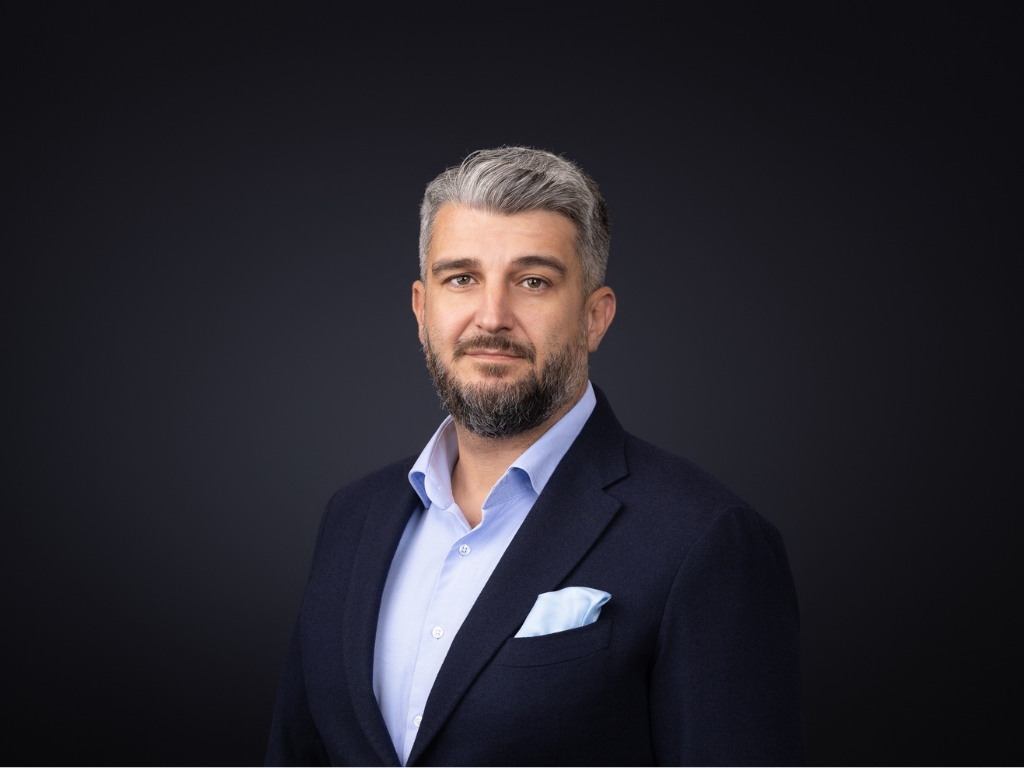
Alin Dumitru Mihăilă, Commercial Director of Electrogrup, discusses energy infrastructure, investments, management, specialist development and projects supporting Romania’s growth.
Alin Dumitru Mihăilă, Commercial Director of Electrogrup, a company part of the E-INFRA Group, is a professional with over 20 years of experience in construction and infrastructure, having built his career both in the private sector and within major public companies such as Metrorex and CNAIR. He has extensive experience in developing and managing complex transport and energy infrastructure projects, as well as an academic background combining technical fields – Hydrotechnical Engineering and Railway, Road and Bridge Engineering – with economics – Management and Marketing. He firmly believes that, regardless of the field or the complexity of a project, performance always starts with having the right people in the right positions.
C&B: What mission have you taken on through your professional activity?
Alin: First and foremost, I have taken on the mission of turning opportunities into real and sustainable projects. In commercial activity, it is relatively easy to talk about figures, contracts, or sales targets. Much more important, however, is ensuring that what you promise during the commercial stage can actually be delivered by the organization under the agreed conditions.
Perhaps this perspective also comes from my professional journey. I have been working in construction and infrastructure for over 20 years, and I did not start my career in sales, but on construction sites. I have worked in project management, contract management, transport infrastructure, and business development, and today I coordinate Electrogrup’s commercial activity in an extremely dynamic sector – energy infrastructure.
I have had the opportunity to work both in the private sector and within major public infrastructure companies such as Metrorex and CNAIR, and to be involved in major metro and highway projects. At first glance, the transition from transport infrastructure to energy infrastructure may seem like a major change of field. From a management perspective, however, I have found that the fundamental principles remain the same: you need to understand the project, build the right team, properly assess the risks, make timely decisions, and honor your commitments.
My academic background has followed the same logic. I chose to combine my economic education in Management and Marketing with technical training in Hydrotechnical Engineering and Railway, Road and Bridge Engineering. I have always believed that, in order to make sound commercial decisions in a technical business, you need to understand both worlds well enough. You do not have to be the best technical specialist in the room, but you need to be able to ask the right questions and understand the consequences of a decision.
The experience of recent years has perhaps confirmed this more than anything else. Today, at Electrogrup, we are simultaneously involved in projects comprising more than 10 electrical substations, over 1 GWh of battery storage capacity, a wind farm with 56 turbines and an installed capacity of 396 MW (the second-largest built in Romania to date), a 160 MW combined-cycle power plant, as well as a major transport infrastructure project. Electrogrup built the entire hybrid energy complex in Câmpia Turzii and the storage unit in Florești.
These projects are very different from a technical and execution perspective, but the management challenges are essentially the same: people, resources, deadlines, costs, risks, and the ability to make the right decisions at the right time. For me, this is one of the important conclusions of my professional journey so far: technologies evolve and industries change, but the principles of sound management remain the same.
That is why I believe in the business philosophy of the E-INFRA Group, which Electrogrup is part of: commercial development does not mean taking on as many contracts as possible, at any cost. We are a team of professionals, and we have also turned down significant opportunities when we believed that the contractual risks, deadlines, or commercial conditions did not justify taking on the project. Sometimes, one of the best commercial decisions is precisely to say “no.” A large contract that cannot be executed profitably or under the agreed conditions is not a commercial victory, but a problem transferred to the organization. The same discipline can be found in the way E-INFRA builds its long-term development: through committed investments, economically sustainable projects, and genuine execution capacity. The Group has invested more than €500 million in recent years and has an investment program of nearly €1 billion underway through 2029, focused on developing Romania’s infrastructure and energy capacities.
The mission I have taken on is therefore to contribute to the company’s healthy and predictable development: to identify the right projects, build long-term partnerships, and commit only to what we know we can deliver.
For me, success is not the moment when we sign a contract. Success is when, at the end of the project, the client would sign with us again.
C&B: What is the most important problem you see today in the sector you operate in, and how do you think it can be solved?
Alin: I believe that the main challenge facing the energy sector is, and will continue to be, the ability to support the very large volume of announced investments, first and foremost from the perspective of design and subsequently execution.
From what we see in the market today, one of the critical resources is no longer just financing, but also the availability of specialists capable of designing and managing an increasing number of increasingly complex energy projects simultaneously. Without good design delivered on time, problems inevitably move into procurement and then onto the construction site, where they become much more costly and difficult to correct.
I believe the solution lies in the accelerated development of engineering capabilities, the training of specialists, and realistic project planning aligned with the resources actually available. We can have capital, technology, and very good projects, but without the capacity to design and execute them, they remain investments on paper.
That is why, at E-INFRA level, we support the development of future engineers and energy specialists through partnerships with educational institutions in the field. In Cluj, for example, we supported the opening of a laboratory at the Technical University of Cluj-Napoca (UTCN) dedicated to energy research, and we are developing scholarship programs for students at technical high schools.
Beyond these initiatives, I believe that Electrogrup and the other E-INFRA companies are, in themselves, genuine schools for engineers: young people have access to complex projects, work alongside experienced professionals, and learn the standards of an industry in which expectations are constantly rising. Education and the training of new generations of specialists are important to us, and this is something I am personally proud of.
C&B: What is the most valuable lesson you have learned throughout your experience and believe is worth passing on?
Alin: The most valuable lesson I have learned is that an organization’s performance depends, above all, on the people it has and on management’s ability to place them in positions where they can make the best use of their potential. This is the principle that Jim Collins captures very well through “the right people in the right seats,” and it is something I strongly believe in.
I remember the case of a very good engineer in whom I saw much greater potential than he saw in himself at the time. I offered him a promotion, which he initially turned down, mainly because he lacked confidence that he was ready for the new role. I encouraged him to give himself this opportunity and, after the promotion, we worked together to understand the principles and responsibilities of the new position. That change became a genuine professional boost for him. From the role of Deputy Contract Manager on a project, he eventually went on to coordinate several major projects simultaneously.
This experience confirmed to me that a manager’s role is not only to assess the performance they see today, but also to identify the potential that the person in front of them may not yet see themselves. Sometimes you need to believe in someone before they have enough confidence in themselves, while at the same time providing the support they need to grow into their new role.
That is why I believe one of the most important responsibilities of a manager is to find the right people, put them in the right positions, and then give them trust, responsibility, and room to grow.
I believe a manager’s success can also be seen in the people who have grown professionally alongside them.
C&B: If you had the opportunity to change one single thing in Romania, what would it be and why?
Alin: If I could change one thing in Romania, I would probably change the way we, Romanians, relate to our own country. I believe we are far too critical of ourselves and sometimes have the reflex of explaining anything that does not work well enough by saying that “we are in Romania” or that “this is how things are done here.”
I do not believe we should hide our problems or settle for less. On the contrary, comparing ourselves with the best is necessary if we want to progress. But I believe we need to learn how to compare ourselves correctly. We tend to choose the leader in a particular field and compare ourselves directly with them, without always taking into account the context, history, accumulated experience, or the starting point of each society.
My professional experience, including my work at Electrogrup, has given me the opportunity to work with organizations and people from many countries, and I have found that problems, delays, wrong decisions, or bureaucracy are not uniquely Romanian characteristics. Differences do exist and we have many things to improve, but there are also many areas in which Romania has made enormous progress, as well as Romanian professionals who perform at the same level as those from much more developed economies.
That is why I would like us to maintain our high standards while giving up, at least to some extent, the reflex of putting ourselves down. We should look at the best in order to learn from them, not to constantly prove how badly we are doing.
I believe a society needs a critical spirit in order to progress, but it also needs confidence in its own capabilities in order to build.
C&B: How can we work together to help people, companies, and communities develop more effectively?
Alin: I believe that the development of people, companies, and communities should be viewed as a circle in which each contributes to the development of the others. For example, a business such as Electrogrup creates jobs, infrastructure, services, and facilities that improve people’s lives and create the conditions for communities to develop. In turn, a developing society generates better-prepared people, new needs, investments, and, implicitly, new business opportunities.
We can see this mechanism very clearly in the field of critical infrastructure. A highway, railway, or new energy infrastructure is not merely a project in itself. Around them, investments emerge, companies develop, people’s and goods’ mobility increases, and opportunities are created that may not have existed before. These opportunities, in turn, generate the need for new investments.
I believe companies also have a role in understanding that developing the environment in which they operate is in their own interest. Investing in people, infrastructure, or communities should not be viewed exclusively as a social responsibility, but also as an investment in the ecosystem of which the business itself is part.
The better we manage to make this circle work, the more we grow together.
Alin Dumitru Mihăilă, Commercial Director of Electrogrup, part of the E-INFRA Group, discusses the challenges and opportunities facing Romania’s energy infrastructure sector, investments in energy and infrastructure, and the importance of having the right people in the right positions when developing complex projects. With more than 20 years of experience in construction, infrastructure, project management, contract management and business development, Alin Dumitru Mihăilă emphasizes that sustainable performance is built through strong teams, responsible decision-making, long-term partnerships and genuine execution capacity.

 UK
UK
 IT
IT
 ES
ES
 DE
DE
 FR
FR
 RO
RO
 PT
PT
 HU
HU


