


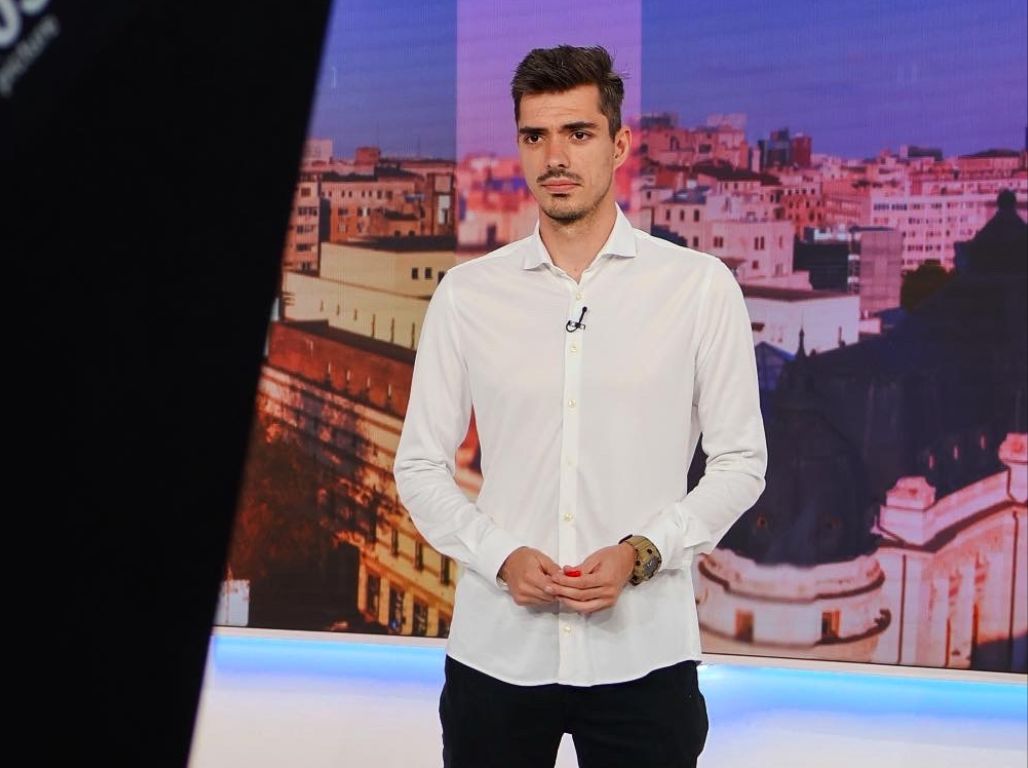
Discover the journey of Bogdan Dinu, an Observator journalist with more than ten years of experience, dedicated to event reporting and investigations in the field of internal affairs. A story about curiosity, perseverance, trust and the evolution of a career built step by step.
Since 2020, Bogdan Dinu has been signing event and investigative reports for Observator, focusing mainly on the field of internal affairs. With more than ten years of experience in print, radio and television, he closely follows the work of the Romanian Police and the Ministry of Internal Affairs, turning every intervention into a clear and easy to follow story for viewers. He is one of the few journalists who also brings the same stories he documents for television into the online environment, presenting them in an accessible and engaging format.
C&B: If we were to look at the narrative thread of your career, what were the defining key moments?
Bogdan Dinu: It may be an overstatement to say that I began my career back then, but I started practicing this profession in my teenage years. I knew from the very beginning what direction I wanted to follow and I was certain that I wanted to work in journalism. At the age of fifteen, I started volunteering at the local television station in my hometown. Of course, it cannot be compared with the pace, workload and dynamics of a national TV station, but it was an important first step, an entry level experience from which I had a lot to learn. Interestingly, I still work today with people who were there with me at the beginning. One of my cameramen today is the same person who, many years ago, showed me how to do the white balance on the old studio cameras in Ploiești. We practically grew professionally together.
The next step was toward print media, more precisely online. I regret that I never had the chance to work in a printed newspaper newsroom, but it helped me tremendously to learn, from the very beginning, the rules of digital journalism, and there are many. I am sure you know what I mean. In 2019, I moved toward national media and joined the newsroom of an important radio station. I spent a year there and I had colleagues to whom I am grateful for all the hours in which they would literally lock me in the voice booths. I would read the news until I knew it by heart. They listened to me and sent me back in front of the microphone. And I started again. Whenever I meet someone new from the industry, I hear, “You have such a voice. Why are you not doing radio?” The question amuses me every time. For almost six years, I have been signing, reporting live and asking questions under the name Observator, Antena 1. Without a doubt, this is where I learned most of the things that define television journalism. From interview techniques and live reporting to critical thinking and knowing how to react under pressure. These are skills formed in the newsroom and in the field, and they help me every day, even outside the job. It becomes easier to read people and gain their trust. In our profession, if people do not trust you, something is not right.
C&B: What has been the most difficult moment in your journey so far and how did you overcome it?
Bogdan Dinu: I believe the most difficult moments have always been the beginnings. Every time I started a new project. That is because every newsroom works differently, with its own workflow, its own pace and its own hour when the rush begins. Most of the time, that is also the most intense moment of the day. You feel the adrenaline because you know that in just a few minutes or tens of minutes, millions of people will read, hear or see the information you have just found out. And the challenge is to package it as simply and clearly as possible so that people from all backgrounds understand it, without losing the essential. It was also difficult in the field at first, until the people I worked with started to know me. Many times, the public has a certain image of a journalist, maybe one who is older or “more experienced in life”. This can be a small obstacle because you feel you must prove from the very first moment that you are there for a reason. On the other hand, it is also an advantage. I am part of the new generation of journalists and I believe this helps me integrate more easily in certain environments, understand how young people think and bring a fresh perspective into the newsroom.
C&B: Has there been a dream or ambition that has always guided you, no matter the obstacles?
Bogdan Dinu: I was a curious child. Maybe not as vocal or bold as I am now. The career I chose was probably a surprise for my family, who knew me as a shy child. But the curiosity was always there. Beyond the classic “why” questions that any child asks, I always had the desire to see what was happening, to be where things were happening and, most of all, to tell the story. I always felt that going out in the city, visiting someone or even a simple phone conversation had to start with a good story that kept the other person engaged. Later, I learned that this is called a lead or a hook. I was drawn to journalism, especially television. In every newsroom I worked in, my former colleagues can confirm that I always had an inclination toward the video side. I would try, even just a little, to integrate it into my work. Because no matter how good of a storyteller you are, an image truly is worth a thousand words.
C&B: How did you look at the beginning of your journey and how do you feel you have transformed since then?
Bogdan Dinu: At the beginning I was much more restless. It is not me saying it, it is my colleagues. The problem is that when you are that agitated, you do not give yourself the necessary time to think your actions through. If I compare myself to the first months in the field, it is clear that now I manage my work much better. I am more organized and I better understand the pace of those around me. I often find myself surrounded by police officers, gendarmes or firefighters. And after spending so much time with them, I came to know them. Some by name, others only by their eyes, as much as the mask allows. I came to understand, at least partially, how they react in tense situations. And this helps me tremendously to obtain the best information and images, without altering reality and without getting in their way. Because, let us be honest, a journalist can sometimes be seen as too curious or intrusive. Sometimes that is good, other times not so much. But it is part of the job. We must be where things happen.
C&B: If we were to meet your collaborators, what do you think they would say about you?
Bogdan Dinu: I have been told that I can be stressful, insistent, maybe even tiring at times. That is because I do not like to leave things unfinished. But in the end, the people I work with are most of the time happy with the final product. Both the colleagues in the newsroom who put the story on air and those who appear in it. For me, even if we are not colleagues in the contractual sense, I still see them as part of the team. Whether they are communication officers, spokespersons or field personnel whom I film during interventions. We are all there together, on the same curb, in the same rain, in the same cold or in the same burning sun. And I know many of them would say that I am discreet. Ironically, right? Journalists are the ones who find information and tell it to the whole country. But even so, I know when and how to keep things confidential. Because sometimes our work means giving a voice to those who do not want to step into the light. Many avoid the cameras but still need to be heard. And that is exactly where we come in.
C&B: What is the most important decision you have made that changed your trajectory?
Bogdan Dinu: The most important and best decision, every single time, was to take the risk of trying new things. I trusted that I could learn quickly and that I would become good at what I do. I believe that is the key. It is impossible to gain other people’s trust if you do not trust yourself first. And yes, sometimes it is not easy. We are human, we have moments of doubt or uncertainty. But it is essential to overcome them. If I had not had that mindset, I probably would not have taken the step toward national media. I probably would not have had the courage to appear on television, to hear my voice on the radio or to see my articles published. Every step taken with confidence is, in fact, a small victory.
C&B: How did you build your leadership style or the way you make decisions? Was it a natural process or a learned one?
Bogdan Dinu: Newsroom work means, above all, teamwork. You cannot do anything alone. In the field, cameramen or assistants are indispensable, each having an essential role. The same goes for the newsroom. There cannot be a news story without a reporter, without images, without editing, without directing or without the anchor. The decisions you make can help everyone or, on the contrary, disrupt the entire process. This is how I learned, over time, to make decisions that take into account all those involved. And honestly, I do not think this is something you can learn in school with a notebook in front of you at a strictly theoretical level. It is a lesson that comes from experience and from mistakes. On the other hand, not all decisions must be made by one person alone. That is the beauty of a team. Some decisions are made together. It can be something trivial, like where to get your coffee while on assignment, or something much more important, such as the tone of a news story. The first decision affects only you, maybe you end up drinking bad coffee and that is it. The second can affect thousands or even millions of people directly or indirectly.
C&B: What does a typical day look like for you now and what moments bring you the greatest satisfaction?
Bogdan Dinu: Speaking of coffee, the workday always begins with one. My colleagues laugh at me because I do not drink it out of necessity, I do not need it to wake up. I could easily fall asleep half an hour after drinking it. I drink it simply for pleasure, for the taste. And I like discovering new coffee shops around the city and trying new blends. With this occasion, I also discover new people. After the coffee come the phone calls. Usually, I know from the evening before what story I have to work on, because we discuss it ahead of time. That is unless something unexpected happens and turns everything upside down, which in this profession is not rare at all. If the day is calmer, I like keeping a more relaxed pace. I believe a report turns out better when you have time to build it without pressure. Even though we work against the clock, creativity is still needed. Including from the cameramen, who can capture spectacular images if they have the right context and enough time. After lunch we arrive at the newsroom and the writing begins. That is when we see how everything connects and we get a clear idea of how the story will look on air. And the most satisfying moment is, without a doubt, seven o’clock in the evening when we see the report in the newscast. It may sound like I am praising my colleagues again, but I am truly lucky to work with very experienced people. People who have been doing television for many, many years. And who are not afraid to tell you clearly what is good and what could have been done better. It is important to have your work recognized, but it is just as important to be shown how you can grow.
C&B: What values or principles guide you in what you do and how do you apply them every day?
People who follow you daily are essentially giving you their trust. They welcome you indirectly into their homes, as if you were sitting at the table with them. You talk to them about the most important topics of the day and they rely on you for all the essential information. This is why honesty is crucial. It is an obligation. Everything you say in live reports, the questions you ask in the field, all come with great responsibility. Because in the end, you are there in the place of the person watching. You are asking the questions they would ask. You are, in a way, their special envoy.
C&B: If you were to send a message to the people who follow your example, what would it be?
Bogdan Dinu: Many high school students write to me. And often, I see myself in their messages. They ask me the same questions I used to ask in high school, out of the same curiosity. What I always tell them is to never give up the desire to learn. And to stay curious. In this profession, just like in life, success does not appear overnight. And no matter how much you achieve, it is never enough. Because the moment you feel it is enough, stagnation appears. Every experience, no matter how small, shapes you. All that matters is to take the first step.
From his first footage filmed in adolescence to the reports broadcast every day at 7 p.m., Bogdan Dinu remains true to the values that shaped his path: honesty, responsibility and a continuous desire to learn. A journalist who turns every experience into a story and every story into a lesson.

 UK
UK
 IT
IT
 ES
ES
 DE
DE
 FR
FR
 RO
RO
 PT
PT
 HU
HU


