


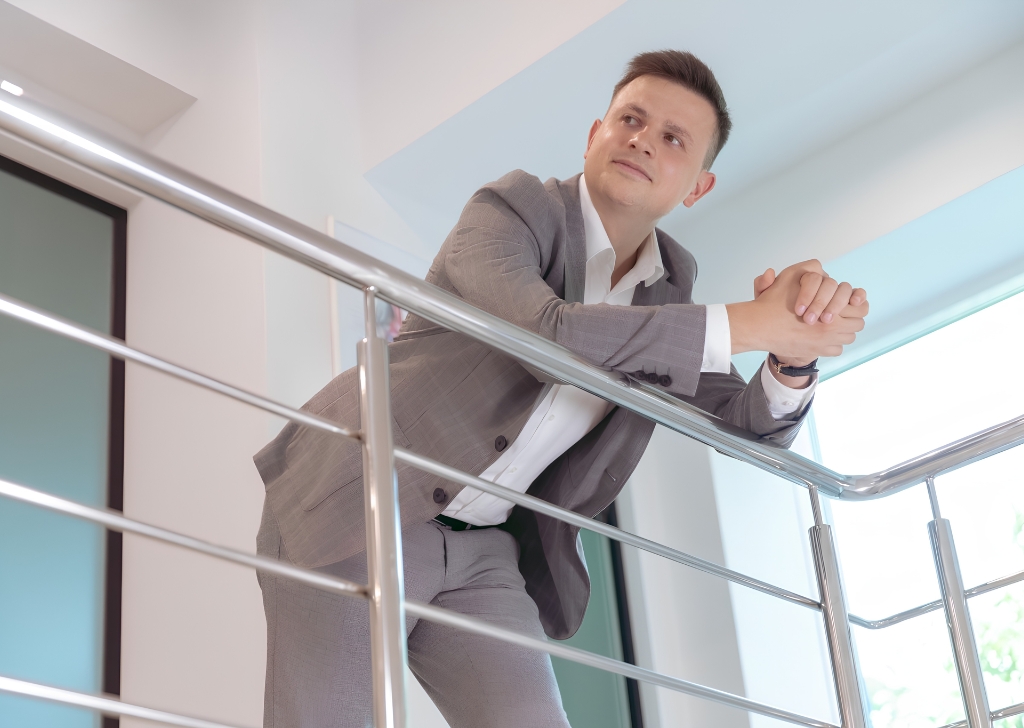
George discusses entrepreneurship, medical podiatry, leadership, technology, and building a clinic network. Discover his insights on courage, education, innovation and creating a scalable business.
C&B: How would you describe yourself in a single sentence that would capture the attention of someone who doesn’t know you?
George: I’m ambitious, creative, and constantly connected to multiple directions—an entrepreneur who finds focus and energy precisely in the dynamics and challenges of building systems and businesses.
C&B: Looking back, what is the “common thread” that has guided your professional journey?
George: The common thread has been realizing that entrepreneurship is the environment where I truly perform at my highest potential. Like most people, I initially started with the desire to make money—quickly discovering that it’s much harder than being an employee—but I realized that my personality (slightly ADHD-minded) finds its order and purpose in entrepreneurship. It was the best decision of my life.
C&B: What was a difficult moment or failure that truly changed you?
George: The period between 2015 and 2017 was a real turning point. In the Republic of Moldova, I had opened a bakery, a pizzeria, managed my parents’ event restaurant, and launched a consultancy center for EU funds and loans. When the 2015 crisis hit (the billion-dollar bank fraud), the market froze: loans and projects disappeared overnight, while my debts doubled. I borrowed heavily from non-banking financial institutions, friends, and acquaintances, and by 2017 I realized I couldn’t keep going. I decided to give up everything and return to Romania. Until 2015, my self-confidence had grown more than it should have, and the setbacks that followed taught me humility: if you hit the crossbar, it’s not 100% your fault—but if you succeed, it’s not 100% your credit either. Luck and circumstances play an enormous role.
C&B: What is one bold (or counterintuitive) decision that significantly influenced your trajectory?
George: The decision to enter a field I had absolutely no connection with: first by opening a small medical pedicure salon without any podiatry background, and then by taking the huge leap of building a clinic from scratch without medical training. I went from a small location to a clinic with ten treatment rooms and multiple specialties simply because I saw the enormous potential of this niche. Those were two incredibly difficult years of learning by doing, but I don’t regret a thing.
C&B: How have you changed over time as a leader and professional?
George: In the beginning, I tried to solve every problem using only my own reasoning. Over time, I understood that we need the intellectual humility to recognize our limits and accept that many people have already faced similar challenges. Today, I no longer reinvent the wheel: when I encounter a roadblock, I research, seek advice from more experienced people, and implement systems that have already been validated—adapting them to my business.
C&B: What do you think the people who work directly with you say about you beyond your public image?
George: They probably say that I’m sometimes too soft and understanding with employees. They also know I’m extremely ambitious—I often take on more goals simultaneously than seems possible—but they appreciate the creativity and vision I bring to the table.
C&B: What genuinely sets you apart in the way you build and lead?
George: The courage to step into large projects even when I don’t yet have all the resources or a rigid plan. I have the agility to act quickly and find solutions along the way, turning bold ideas into stable operational systems.
C&B: How has today’s context—technology, AI, and the economy—changed the way you work?
George: Economically, rising taxes have a direct impact on every business. As for AI and technology, we’ve moved beyond experimentation into real solutions: we developed a mobile app for nail diagnostics and assessment, implemented automated financial workflows for rapid P&L calculations, and built our own lead management system and intelligent phone platform—resources that would otherwise have cost us tens of thousands of euros through an external company.
C&B: Is there a habit or routine that has significantly influenced your performance?
George: Since I’m someone who always has multiple projects in motion, I need moments to reset. At least once a month, I go to bed very early so I can wake up at 3 a.m., come to the office, and work in complete silence—just me with my thoughts. I analyze what’s working and what isn’t, where I need to accelerate or pivot, and I rethink my original plans through small but meaningful reorganization processes.
C&B: What principles guide your most important decisions?
George: People and life come first: Money and companies are artificial constructs; the real goal is to enjoy life, work hard, and treat your team with respect and fair compensation.
The patient’s benefit comes before profit: I’m frustrated by the fact that in private healthcare, a significant number of procedures aren’t truly necessary. In our clinic, we always prioritize the patient’s best interest first, and only then do we build the business model around it.
Speed of execution: If something needs to be done, we start immediately—even if we don’t have every resource or aren’t 100% prepared.
100% transparency and legality: We’re probably the only podiatry business in the market that pays real salaries officially through employment contracts. Even if it’s financially frustrating in the short term, it’s the only sustainable path for a scalable and ethical business.
C&B: How do you see your industry evolving over the next 3–5 years?
George: The market will consolidate. Instead of being extremely fragmented, it will be dominated by two or three major players, and large medical chains will begin acquiring businesses in this niche. The field will become regulated, and the public will be much better educated, understanding the essential collaboration between dermatologists—who provide the initial consultation and diagnosis—and podiatrists, who then perform the technical treatment procedures.
C&B: What role do you want to play in that evolution?
George: I want to be a catalyst for change and for the recognition of podiatry at international standards in Romania. Through the development of our school and our clinic network, I aim to create a genuine bridge of interdisciplinary collaboration between podiatrists and medical specialists, raise patient education standards, and demonstrate that correct, non-invasive treatments can prevent severe complications.
C&B: What practical advice would you give someone who wants to build something meaningful today?
George: Apply the Lean Startup approach: Don’t invest large amounts of money in ideas that exist only in your head, and don’t go into debt from day one. Start with a minimal budget of around €1,000–2,000, validate the idea in the market, gain traction, and only then seek funding to scale.
Invest in education: Always maintain intellectual humility. Accept that there’s always something new to learn, and consistently invest in your own development.
Measure yourself by effort, not only by results: Success is not entirely your merit, and failure is not entirely your fault—circumstances matter enormously. Give your maximum effort, and if you fail, get back up without wounded pride and keep moving forward.
C&B: What is an uncomfortable truth about your industry that few people talk about?
George: The uncomfortable truth is that the industry is still largely unregulated and lacking standardization. A huge amount of work is done unofficially—in salons or even private apartments—and very few people have genuinely heard of medical podiatry, despite the enormous demand that exists in the market.
The interview with George offers an authentic perspective on entrepreneurship, medical podiatry, and building a scalable business in an industry undergoing significant transformation. From failures and bold decisions to the use of AI and the development of a clinic network, his story highlights the importance of adaptability, education, and discipline in entrepreneurship.

 UK
UK
 IT
IT
 ES
ES
 DE
DE
 FR
FR
 RO
RO
 PT
PT
 HU
HU


