


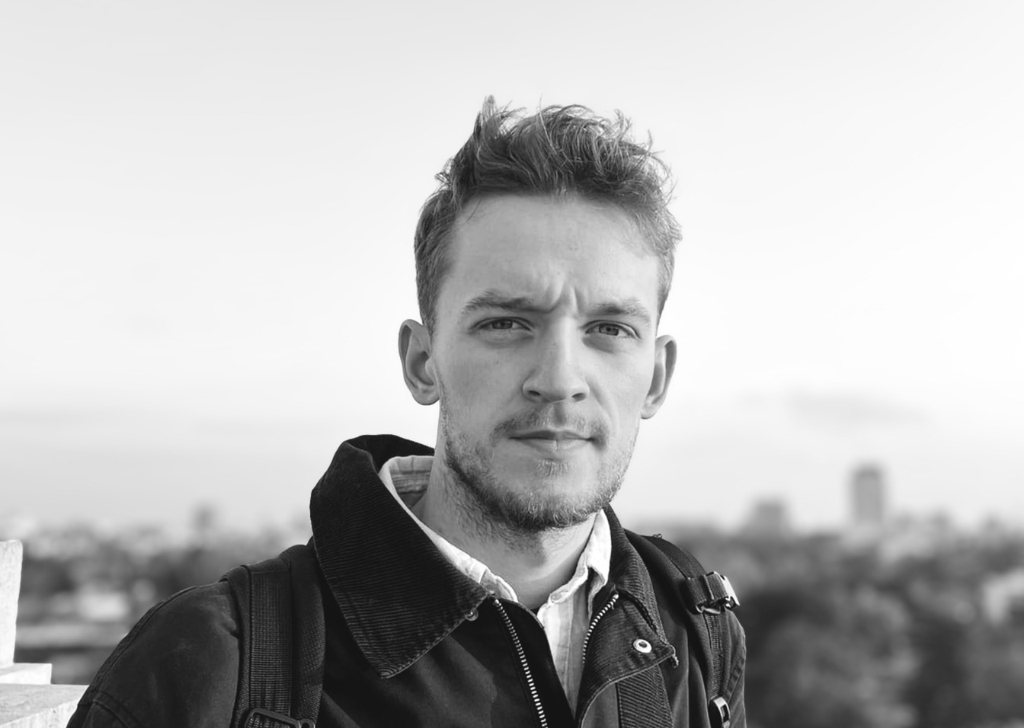
Andrei Leverin, designer and founder of Leverin Studio, talks about design, visual identity, communication, AI, and the relationship between design and the city. Discover his perspective on the future of design and how designers can make the world easier to understand.
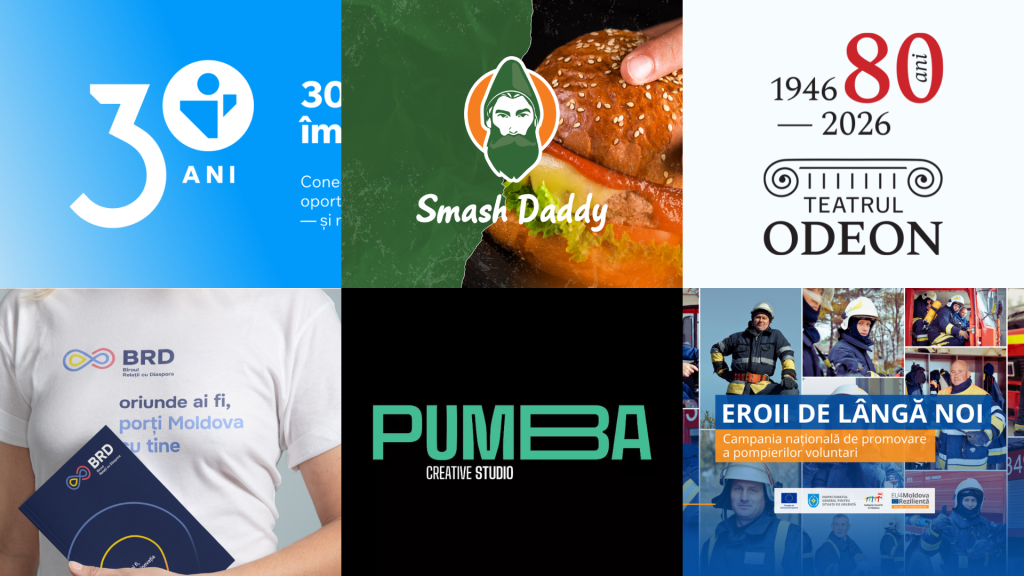
Andrei Leverin is a designer and the founder of Leverin Studio. For him, design is more than a pretty image; it is a way of understanding problems and translating them into a language that people naturally use. He works on identity, communication, and wayfinding projects, at the intersection of design and the city.
C&B: How would you describe yourself in a single sentence, in a way that would capture the attention of someone who does not know you?
Andrei: I am someone who uses design to make the world a little easier to understand and more pleasant to live in.
C&B: Looking back, what is the “common thread” that has guided your professional journey?
Andrei: My professional journey, like life in general, resembles a game of chess more than anything else. Every decision, if thought through strategically, brings you closer to a certain “checkmate” that everyone has in mind.
Looking back, the common thread has always been my interest in the way people understand the things around them. Because the way we understand the world influences our decisions and the reality we go on to build. That same curiosity concerns me as well: how I understand the world and how I choose to act based on it.
I think that interest is precisely what led me, without realizing it, toward design. Suddenly, I found myself doing graphic design, and along the way I understood that it means much more than the visual side. It means organizing information, human behavior, wayfinding, and the way things come to work better for people.
That is what I am trying to do today through Leverin Studio, which is, in a way, my professional extension: to start from real questions and problems, rather than simply from the desire to produce something beautiful.
C&B: What was a difficult moment or failure that truly changed you?
Andrei: I do not really look at things through the lens of failure. I think we put overly definitive labels on moments that are, in fact, stages of learning.
Every person has successful and unsuccessful moments. You learn the most from the unsuccessful ones: you explain to yourself what should have been done differently, where you should have made a decision faster, where you should have turned right instead of left.
If we are talking about a difficult moment, it was after my first year of university. I had been thinking about the idea of a design studio for a long time. After the first exam session, I set it in motion. After the second, I came to believe that I no longer needed university and that I could achieve more in design and entrepreneurship without it.
But the situation got the better of me. After many conversations with people close to me, I decided to continue university. Looking back, I think it was one of the good decisions. If I had dropped out then, I probably would not have discovered the connection between the city and design, which today defines an important part of my work.
Along the way, I understood that design is not just about aesthetics. It is about interaction, about behaviors that you encourage or discourage, about what works and what does not, whether on a poster, in a park, or at a street intersection.
C&B: What is a bold or counterintuitive decision that significantly influenced your trajectory?
Andrei: Probably the decision to come to Bucharest, a city that almost everyone runs away from. Most of my friends told me not to come: it is ugly, dirty, crowded.
Paradoxically, that is precisely what attracted me. I saw a complicated city, with many visible problems, but also with a great deal of potential. For a designer, that means there are many things that can be understood and improved. This is where I feel I have the most work to do.
C&B: How have you changed over time as a leader/professional?
Andrei: Leader is a word that it is in poor taste to claim for yourself.
But as a professional, I think the biggest change has been the way I understand control. At the beginning, I was focused on execution and on the idea that everything had to be done by me, as well as possible.
Over time, I understood that a studio is not built alone. It is built together with the people around you and with the clients who gradually come to believe in what you do and become ambassadors for your work.
C&B: What do you think the people who work directly with you would say about you, beyond your public image?
Andrei: I think the most accurate answer would come from them.
I hope they would say that I am a man of my word, responsible for the things I take on, and involved in the projects I am part of. They would probably also say that I am critical and attentive to detail, sometimes perhaps even excessively so. But that attention comes from the desire to avoid superficiality.
C&B: What truly differentiates you in the way you build or lead?
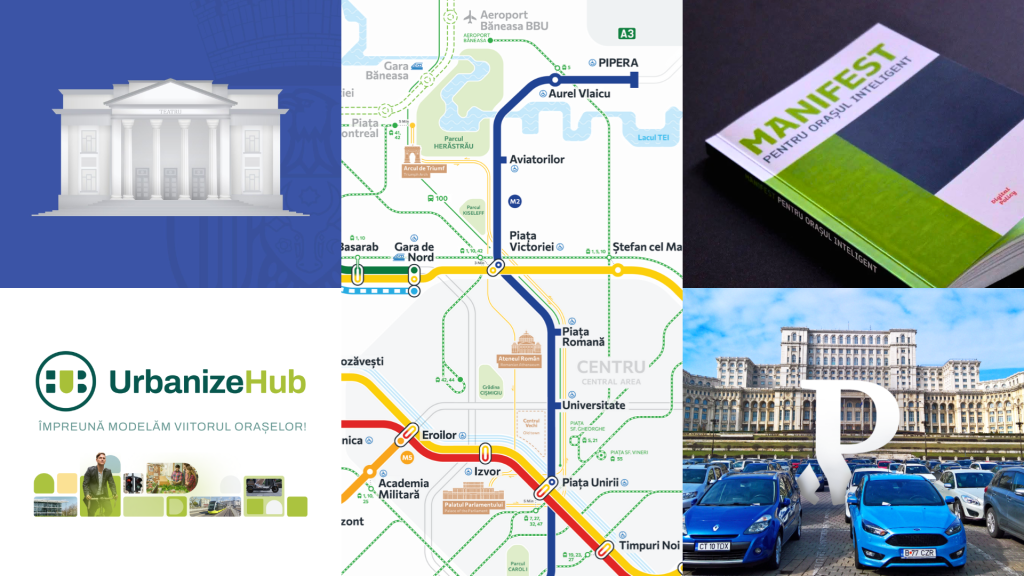
Andrei: If we compare it to the Google suite of applications, a good designer is like Google Translate. They receive complicated realities, coded information, services, or products and translate them into a language that people can easily understand.
A transportation map, for example, is not just a drawing with lines and stations. It is a tool that tells a person where they are, where they can go, and how they can make the best decision. The same thing happens with a visual identity, a campaign, a book, or an institution’s communication.
If the translation is poor, the message gets lost, because almost nobody can read the original; everyone reads the translation. And the role of a designer is to make that translation as clear and faithful as possible.
C&B: How has the current context — technology, AI, the economy — changed the way you work?
Andrei: Design cannot exist without technology and without a market economy. As the world becomes more technologically advanced, design changes along with it.
I believe, however, that what has changed most is where value is created. Demand has decreased for design that means nothing more than rapid execution, and many results have started to look alike. We see the same effects and the same formulas repeated both online and in print.
At the same time, the value of people who know how to ask good questions has increased. Today, it is extremely important to formulate the problem correctly before looking for the solution. A good prompt is, ultimately, a well-asked question. I probably would have reached this conclusion much later without AI, but when you ask a person a question, it matters just as much how clear and precise the question is. The answer generated by a person will be as good as the question.
C&B: Is there a habit or routine that has significantly influenced your performance?
Andrei: I think one of the most important habits for a designer is to observe.
I use public transportation a lot, I walk, I occasionally try new streets and routes, I photograph things that catch my attention, and I write down ideas. These habits, but not only these, train my powers of observation.
The subway is a good example in this sense. It is a place where you can see thousands of people every day, each with their own route and story. Everyone interacts with the wayfinding system, sometimes gets on the wrong platform, misses a train, speaks on the phone in a certain way, and you simply find yourself involuntarily listening to the conversation on your way to Eroilor. For a designer, carefully observing what is happening around you can be the best teacher available.
I sincerely believe that a designer must train their eye and mind first, and only then their hand.
C&B: What principles do you use when making important decisions?
Andrei: I would not say that I have fixed principles for this, but I have a few questions that I try to answer every time: What is the real problem? How important is it? What is the priority? And does the decision actually belong to me, or am I simply being handed a ready-made one, like the cookie button that you just have to confirm?
I believe good decisions emerge when you manage to step outside your own perspective and see the broader context. Sometimes I manage to do that. Other times, I only realize it after I have made the decision.
C&B: How do you see the evolution of your field over the next 3–5 years?
Andrei: Many people are afraid that AI will eliminate the designer profession. I honestly believe that they do not understand their profession very well and reduce it to the programs they use. The truth is that it cannot be eliminated as long as there are people who think. There will always be design, in one form or another, with the hope that people will continue to think.
In our recent history, this profession has somehow been appropriated abusively by those who knew programs such as Photoshop or Illustrator. Many of them, however, did not even have the courage to call themselves designers; they preferred to call themselves graphic artists who create and execute graphics. So a significant portion of them obviously feel targeted by this risk.
But with artificial intelligence, access to visual creation has become much more democratic. Yes, the quality is often absolutely mediocre, and the confidence with which some people create such things can genuinely be frightening, but broadly speaking, today it is much easier to execute; you just need to know how to formulate a prompt well enough.
I believe the difference will be made by people who understand problems, experience them, ask good questions, and can make decisions to solve them. Generating images or code with ChatGPT will be no different from using Photoshop, because design is, first and foremost, about the problem you are solving. Everyone chooses their own tool.
C&B: What role do you aim to play in this evolution?
Andrei: If I allowed myself to dream, I would say that I want a Romania where design is viewed as a process, as part of our culture, and is not limited to beautification.
Realistically, however, I will continue to work with those who genuinely want things to work. I want the studio to be a partner for companies, organizations, and people who want to communicate more clearly. There may be fewer of them, but I believe those who only want a profile picture deserve to be turned away with basil.
Even so, there are many things that could be clearer, more coherent, easier to use, or easier to communicate.
C&B: What real advice would you give someone who wants to build something relevant today?
Andrei: Well, the first step is to lay a solid foundation. For each person, this can mean different things: solid knowledge of the field, vocabulary, passion, curiosity.
The second step would be the walls, windows, and door, which can represent the people you surround yourself with: friends, colleagues, family, community.
And the third step is the roof, which can represent your own view of the world and the place you want to occupy in it.
Whether it is relevant or not is ultimately decided by the others, the people who enter the house. Maybe you chose the wrong location, maybe you installed the windows crooked, maybe you also need a garden, maybe the foundation is not yet solid enough. What matters is to keep building and learning from every stage, even if that sometimes means rebuilding part of what you have already built.
C&B: What is an uncomfortable truth about your field that few people talk about?
Andrei: Nothing comes to mind that is more obvious than the fact that design in Romania is still underdeveloped, both as a thinking process and as a problem-solving process.
Many decisions are made without any real process of understanding: who, in fact, is this thing being made for? At an institutional level, practically nobody truly cares whether things work, as long as they look like they work. A confusing map, a poor website, chaotic communication: nobody loses their job over that. Maybe someone only loses their job if discussions and heated debates start on Facebook or TikTok.
But design does not begin in Photoshop. It begins the moment someone tries to understand why things are not working and how they can make them work better. The visible part is only the result of a process that begins much earlier, with research, questions, and good decisions.
Perhaps the role of a designer is not, first and foremost, to make the world more beautiful. Perhaps their first role is to make it easier to understand. The rest comes almost naturally.
Andrei Leverin approaches design as something that goes beyond aesthetics and visual execution. From identity and communication to urban wayfinding and artificial intelligence, design becomes a tool for understanding problems and creating clearer, more coherent, and more useful solutions. For Andrei, the future belongs to those who know how to observe, ask the right questions, and use technology to solve real problems.

 UK
UK
 IT
IT
 ES
ES
 DE
DE
 FR
FR
 RO
RO
 PT
PT
 HU
HU


