


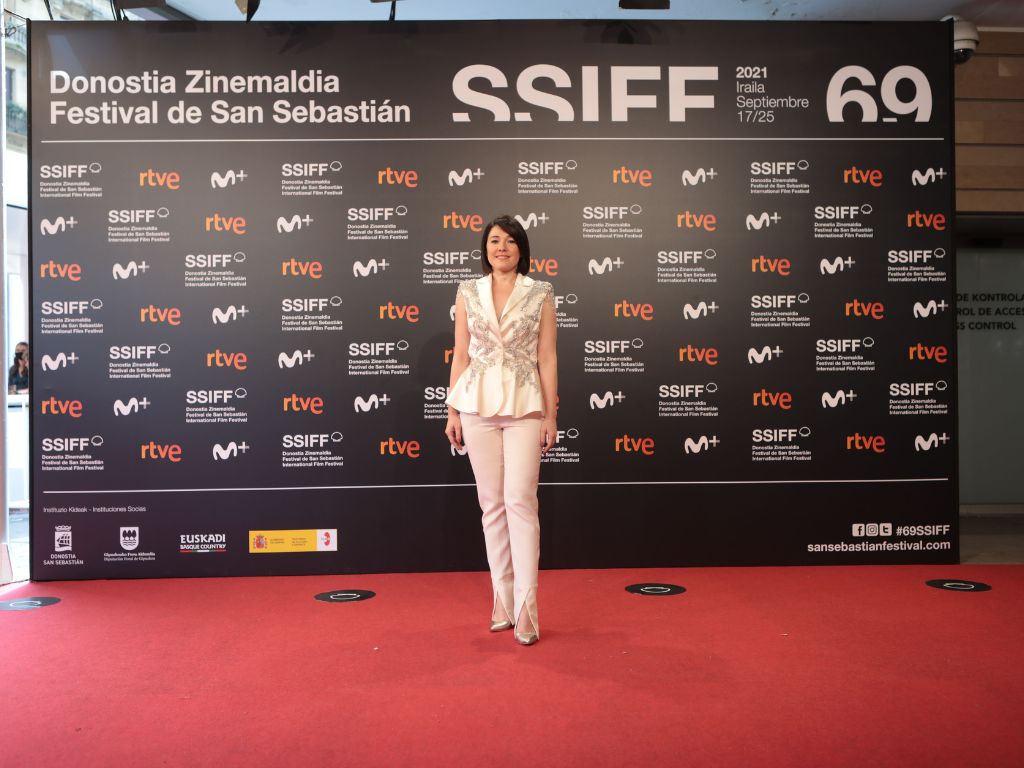
Interview with Gabi Suciu, film producer, about cinema, education, cultural production, Follow Art, and the social impact of film.
Gabi Suciu is a film producer with over 18 years of experience in film production and audiovisual content. She is the Vice Dean of the Film Faculty at UNATC and Director of the Master’s programs in Film and Content Production and TV Production. Her career consistently combines professional practice with academic research, she holds a PhD focused on international co-productions and is marked by major titles such as Crai Nou (2021), the first Romanian film to win the Golden Shell at the San Sebastián International Film Festival in its 74 editions, and When Night Meets Dawn, selected for the Quinzaine des Réalisateurs at Cannes. More recently, she became Vice President of the Alliance of Producers in Romania.
C&B: How would you describe yourself in a single sentence to spark the curiosity of people who do not know you yet?
Gabi Suciu: I am one of the people connecting cinema, education, and research in order to contribute to the development of a smarter, more empathetic, and more inclusive society.
C&B: If we were to look at the narrative thread of your career or business, what were the defining moments?
Gabi Suciu: I don’t really believe in defining moments. I would rather attribute my journey to the people I met along the way, people who made me passionate about this profession. Sorin Botoșeneanu was one of the people without whom I probably would not still be living in Romania today. He showed me that you can challenge deeply rooted norms and that change begins when you roll up your sleeves. Doina Maximilian trusted me enough to leave the Production Master’s program she had built with the care of a mother dedicated to her children’s education in my hands. Then, Ada Solomon brought screenwriter Andreea Cristina Borțun into my life, and with her I feel like I have been making films forever, always having several ideas in development together. Alina Grigore reinforced my belief that just as people sanctify places, they also sanctify films — that filmmaking is not about huge budgets or endless resources, but about passionate people who want to see a story told for what it truly represents. That is how we ended up making an award-winning debut feature for a director who had never formally studied film. I have a very long list of people who, one way or another, through a small decision or a few supportive words at the right time, helped me get where I am today.
C&B: What were the main challenges in turning your passion for art into a project with community impact?
Gabi Suciu: Challenges have been constant, and regardless of the number of awards or validations you accumulate, they continue to appear. The work of a producer involves a great deal of convincing potential institutional partners, financiers, or local authorities that art is not a luxury or just another box to tick, but a real instrument for social cohesion and transformation. There is still the perception that film is merely a form of entertainment, but what we try to do through our projects is precisely the opposite: not to let the audience simply relax. We want them to think, debate, stay alive, and remain engaged. This conversation is still ongoing in Romania.
Another challenge is structural: funding for culturally and socially driven projects remains fragile, dependent on the enthusiasm of a handful of people and on unpredictable funding cycles. The sustainability of a cultural project is not built from a single grant, but from layering multiple funding sources and building a community around the film — one that feels the project speaks to them and belongs to them.
And the third challenge, perhaps the most subtle one, is preserving artistic integrity when working with partners who have their own agendas. I have come to the conclusion that negotiating values is just as important as negotiating budgets.
C&B: Is there a dream or ambition that has always guided you, regardless of obstacles?
Gabi Suciu: Yes. To build the cultural infrastructure I wish I had found when I was starting out. I’m talking about an ecosystem where a talented young person without connections still has access to resources, mentorship, and a community that takes them seriously.
C&B: What were you like at the beginning of your journey, and how do you feel you have transformed over time?
Gabi Suciu: In the beginning, I was driven more by urgency than by strategy. I felt the need to do, produce, prove myself — it was powerful energy, but sometimes blind. Founding Atelier de Film with minimal resources taught me to stay flexible and find solutions where none seemed to exist. It also taught me to take risks that, looking back, I would probably manage differently today. Now I pay much more attention to the process and keep the final result in mind from the very beginning. But people continue to be the reason why I do what I do.
C&B: If we met your team or collaborators, what do you think they would say about you?
Gabi Suciu: That I am calm even in the middle of a storm. And probably that I am demanding but fair, that I have high standards both for myself and for others, but that I never ask anyone to do something I would not be willing to do first myself.
C&B: What is the most important decision you made that changed your trajectory?
Gabi Suciu: Trying my hand at marketing, distribution, and market research for films that I had not produced myself. I learned enormously about the entire process that follows production and about how difficult it is to create an impactful campaign capable of further supporting the film’s message.
C&B: How did you build your leadership style or decision-making approach? Was it a natural or learned process?
Gabi Suciu: It was more a process of unlearning. I unlearned the idea that a leader must always have all the answers. I unlearned the belief that asking for help or admitting uncertainty is a sign of weakness. And I unlearned the assumption that the speed of a decision reflects its quality.
The international programs I have been involved in throughout the years helped me better articulate what I had been doing instinctively and understand that a leader’s sustainability inevitably depends on delegation and on building structures that continue to function even without you.
C&B: What do you think differentiates your business or professional approach from the rest of the industry?
Gabi Suciu: I try to keep one foot in artistic logic and the other in economic logic, without falling into the traps of either extreme. The fact that I combine production with academic research and institutional responsibilities gives me a broader perspective that you simply do not have if you work exclusively in production or exclusively in pedagogy.
C&B: What does a typical day look like for you now, and which moments bring you the greatest satisfaction?
Gabi Suciu: A typical day usually means living in several parallel worlds. The morning might involve a faculty meeting or a class with the students from the Master’s programs I coordinate, the afternoon a negotiation related to a co-production project or a production meeting, and the evening inevitably includes reading, a film, or simply a meaningful conversation with friends and family. And any of these moments can suddenly become a shoot, a grant application deadline, a last-minute online meeting, or a consulting session for someone in need. My calendar is divided into very clear time slots throughout the week, from 6:30 A.M. to 11:30 P.M. Very often, flights or filming schedules push me beyond that routine.
C&B: What is the mission of Follow Art and what does it bring that is new to Romania’s cultural landscape?
Gabi Suciu: In 2025, I decided to focus on production and my academic career, step away from film distribution, and leave Follow Art in the hands of my co-founders Cristina Simion, Alexandra Morariu, and Adriana Iancu. The mission of Follow Art starts from a very simple place: love for cinema. Not film as a consumer product, but film as a human experience, as an art form capable of reaching places where other means of expression cannot always reach.
What does it bring that is new to the Romanian cultural landscape? With a limited number of films distributed each year, every release becomes an experiential event that opens conversations around different artistic forms. Currently, audiences can watch the period drama Primavera in cinemas, an emotional story inspired by real events in which Cecilia, a young violinist with extraordinary talent who comes from an orphanage, becomes the student of Antonio Vivaldi, a relationship that profoundly shapes her path. Shot in natural light and candlelight to preserve the authenticity of the period, the film becomes an audiovisual experience built around the music of the great classical composer and truly meant for the big screen.
As for films we hope will also generate community impact, this summer we are preparing the release of Andreea Cristina Borțun’s debut feature Malul Vânăt, which will premiere in Romania at TIFF. The film is based on six years of research in the rural south of Romania and is the first part of a trilogy about love in rural communities. We are planning a series of caravans and public screenings followed by audience discussions in locations without access to cinemas, especially in villages and communes from Teleorman, Călărași, Giurgiu, and Argeș counties, places that either inspired the project or served as filming locations.
C&B: How was the Follow Art Association born and what inspired you to co-found it?
Gabi Suciu: The mission of the Follow Art Association is to democratize access to culture and build genuine bridges between art and community, beyond major urban centers and beyond established cultural circuits. What it brings that is new is its orientation toward the margins: toward audiences who are not usually targeted by high-quality cultural projects and toward artists who lack the networks necessary to make themselves visible.
C&B: What advice would you give to young artists and cultural entrepreneurs who want to create authentic projects?
Gabi Suciu: Read constantly and keep learning something new from every field you can access. Follow the news from verified sources, not from social media status updates. Build your support network before you actually need it. And enjoy yourselves along the way — enjoy the process too!
Discover the story of Gabi Suciu, one of Romania’s most active film producers, involved in the development of cinema and cultural projects with social impact. From internationally acclaimed productions to initiatives such as Follow Art, the interview offers an authentic perspective on the film industry and the future of art in Romania.

 UK
UK
 IT
IT
 ES
ES
 DE
DE
 FR
FR
 RO
RO
 PT
PT
 HU
HU


