


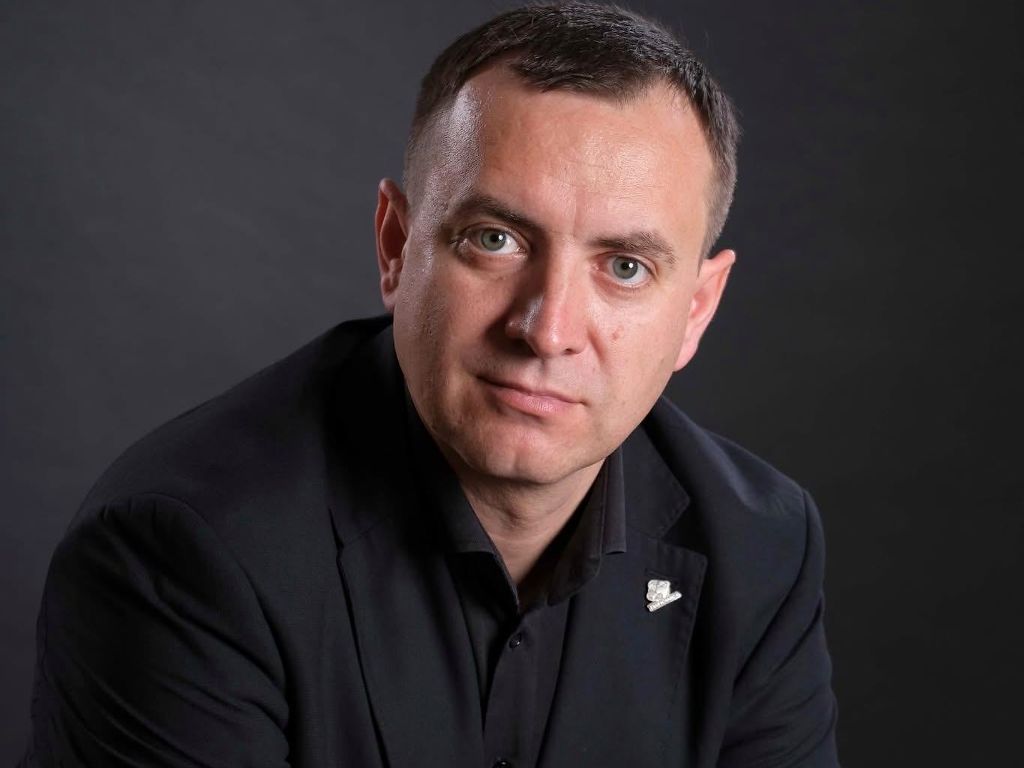
A conversation about leadership, operational discipline, and long-term building. Bogdan Buzu-Vasilache, Managing Partner at Balkanica Distral Romania, shares insights on exports, diaspora markets, logistics, and taste as a bridge between identity, trust, and growth.
Bogdan Buzu-Vasilache is Managing Partner at Balkanica Distral Romania, a business initially built around the idea of bringing the tastes of home to Romanian communities in the diaspora. Together with his team, the company has grown to export a portfolio of over 3,500 Romanian products to 14 markets and to develop a logistics infrastructure for recurring deliveries across Europe. Later on, the story of taste came back home as well, through a carefully curated selection of authentic Balkan flavors, delivered to Romania with the same rigor and the same respect for quality.
C&B: If we were to look at the narrative thread of your career, what were the key moments that defined you?
Bogdan: The first key moment was the period when I learned by starting “from the bottom” in a large company, with a fast pace and high standards. What shaped me was going through multiple roles and challenges and seeing, very concretely, how quality is built, how consistency is delivered, and what it means to make decisions when pressure is real.
The second moment was the move toward export and direct contact with the diaspora. There were many conversations with Romanians living abroad and, beyond the business aspect, I felt how strong the longing is for familiar tastes, for the flavors of childhood. That is where my “why” took shape: not just to sell, but to make a part of our identity accessible.
The third moment was the decision to build, step by step, a structure that could support growth: logistics, commercial relationships, operational discipline, and, above all, trust. For me, a career is a succession of responsibilities assumed, through honest work at every stage.
C&B: Balkanica operates in a complex and diverse region. What are the main challenges and opportunities of doing business in South-Eastern Europe?
Bogdan: South-Eastern Europe is a dynamic region, but deeply fragmented, with major differences from one market to another in terms of consumer behavior, sales channels, and how supply chains function.
In such a context, “almost good” is not enough. To deliver consistently, you need discipline, clear processes, and stable partnerships that work in the long term, not just on a one-off basis.
A major challenge is predictability. When you operate simultaneously in multiple countries, with different channels and varied customer profiles, success depends on the ability to manage complexity: inventory, logistics flows, controlled temperatures, deadlines, seasonality. We have consistently invested in infrastructure and compliance precisely to be able to deliver under controlled conditions, repeatedly and without compromise.
Added to this is a less visible but essential challenge: changing production mindsets, especially in Romania. Many producers are used to delivering over short distances of 200–300 km, with packaging designed for fast turnover and almost daily delivery rhythms. Transitioning to an export model requires not only technical adjustments, but also a convincing effort: believing in the project, understanding the need for standardization, for packaging suitable for international transport, and for a weekly delivery rhythm. This transition was perhaps the biggest challenge.
The opportunity, however, is very real. The region has a clear appetite for authentic products, and consumers are increasingly looking for quality, consistency, and real stories. In addition, proximity to production and strategic partnerships, such as the one with Deroni, bring control, stability, and trust to the portfolio, both for us and for our market partners.
C&B: Is there a dream or ambition that has always guided you, regardless of obstacles?
Bogdan: Yes. When you work with food products, you work with emotion, memory, and trust. That obliges you to be attentive, consistent, and to deliver the same experience every single time.
I don’t believe in growth if it compromises quality or relationships with producers. I believe in building: a good pace, but without rushing.
C&B: What were you like at the beginning of your journey, and how do you feel you have transformed up to the present?
Bogdan: At the beginning I was much more “operational”: I wanted to understand everything, check everything, keep things close. It was a good period; it gave me standards and quality reflexes, as well as respect for the work behind every delivery.
The biggest transformation came when I understood that leadership does not mean being everywhere, but having the right people in the right places and creating a framework in which performance becomes repeatable. Today, I try to be more about clarity and direction than about control.
I also learned, and am still learning, patience as a business tool: the patience to build relationships, to validate markets, to consolidate a portfolio before accelerating.
C&B: If we were to meet your team or collaborators, what do you think they would say about you?
Bogdan: I think the team would say that I am, at the same time, a colleague and a leader. I get involved in details when needed, but I also consistently bring direction and vision. I apply pressure when new objectives appear or when I know the potential is greater than the current result, but I try to do this with clarity, flexibility, and understanding of the real context on the ground. For me, performance means demanding standards, but also the ability to adapt the pace without losing direction.
At the same time, I believe the people I work with feel they can speak openly, make mistakes, and correct them, as long as there is accountability and a real desire to deliver better. I try to create a framework in which responsibility is clear, but where there is also room for learning and growth.
In my relationship with external partners, I try to be serious and consistent, but also present. I am among collaborators, not above them. I understand very well the challenges of small businesses at the beginning, and I try to support them, just as I understand the dynamics of rapidly growing businesses that may one day surpass us. I sincerely believe that solid relationships are built when you grow together with your partners, not when you try to gain only a short-term advantage.
C&B: What is the most important decision you have made that changed your trajectory?
Bogdan: The most important decision was leaving a comfortable and predictable path to build entrepreneurially. It meant moving from a clearly defined role to total responsibility and long-term accountability.
Looking back, I realize that approximately every four years, a strategic decision appears that changes the direction or the “calm” of the company. These are moments when what works is no longer enough and you must choose whether to stay in comfort or take the next step.
In 2017, we decided to expand deliveries at a European level and to approach major players in the diaspora, a step that forced us to invest in logistics, processes, and compliance and fundamentally changed the scale of the business.
In 2022, we initiated a pilot project with products for the Romanian market, a necessary exercise in validation and adaptation to a different market, with different rhythms and expectations.
The next stage is already clear: in 2026, we aim for sales in Romania to represent approximately 50% of turnover. It is not just a growth objective, but a sign of the company’s maturation.
Each time, these decisions disrupted short-term balance, but built long-term direction.
C&B: What was the personal motivation behind your involvement in developing Balkanica?
Bogdan: The motivation was and remains both emotional and pragmatic. Emotional, because all people live with desires that are reflected even in their food choices, and I am a person attentive to what happens around me. Pragmatic, because I understood that this longing can be served professionally: with good selection, a solid logistics chain, and fair partnerships.
In addition, I am motivated by the idea of supporting producers in our region to reach different markets without losing their identity. When products are good but lack infrastructure, distribution becomes the “bridge” between quality and the consumer.
C&B: What strategic decisions have had the greatest impact on the company’s evolution in recent years?
Bogdan: Strengthening infrastructure and compliance. Without a healthy logistics base and clear processes, the entire system can become fragile.
Focusing on consistency, not on gimmicks. We preferred portfolios that deliver the same quality, repeatedly, in volume and over time.
Partnerships that add real capacity. The Deroni example is relevant: access to modern production facilities, proximity, and quality stability; and for the market, this means safety and consistent quality.
Expanding the vision beyond the diaspora. Without losing our foundation, we have started to accelerate on the local market as well, where there are real opportunities.
C&B: What does the role of Managing Partner at Balkanica mean in concrete terms, and what does a “real” day in this position look like?
Bogdan: Concretely, my role is to keep the company connected to two things: what the market demands and what we can deliver flawlessly. This means strategy, but also a lot of execution: from portfolio decisions and partner negotiations to tracking operational indicators that show whether the promise is being kept on the ground.
A real day looks something like this: mornings are about numbers (sales, inventory, quality), then meetings with the team on priorities. In the second part of the day, partners (retail, local distributors, HoReCa) and producers, because you cannot lead distribution without being connected to the source. And in between, small decisions that, added together, make the difference: what we keep, what we remove, where we invest, where we say “yes” and “no”.
C&B: What values or principles guide you in what you do, and how do you apply them day to day?
Bogdan: Consistency. I prefer smaller, repeatable progress over a leap that breaks the chain.
Quality without compromise. In food, trust is everything; that is why partnerships and processes must support the same promise every time.
Respect for tradition, supported by technology. I like the idea that you can preserve authentic flavors using the technology of today.
Fair partnership. In the long term, it means stability.
I apply them simply: in how I choose partners, in how I say “no” to compromises, and in how I ask the team to deliver the same quality even when it is difficult.
C&B: What has been one of the most difficult decisions you have had to make as Managing Partner?
Bogdan: One of the most difficult decisions is always resource allocation: where you accelerate and where you deliberately remain conservative. When you have a strong foothold in the diaspora, the temptation is to stay only there. But strategically, you need the courage to build at home as well, on the local market.
In practical terms, this means choosing the right channels, making room in the portfolio, investing in visibility and listings, while maintaining delivery discipline: availability, consistent quality, flawless execution.
C&B: If you were to define Balkanica in a single word, what would it be and why?
Bogdan: Connection.
Because, in essence, that is what we do: we connect people with flavors, we connect producers with markets they would otherwise reach with difficulty, and we connect tradition with modern infrastructure. From my point of view, the essence of Balkanica is this: a bridge between quality and markets, built with trust, patience, and respect.
The Balkanica story goes beyond distribution or scale. It is about connection: between people and flavors, producers and markets, tradition and the infrastructure that allows it to travel further.

 UK
UK
 IT
IT
 ES
ES
 DE
DE
 FR
FR
 RO
RO
 PT
PT
 HU
HU


