


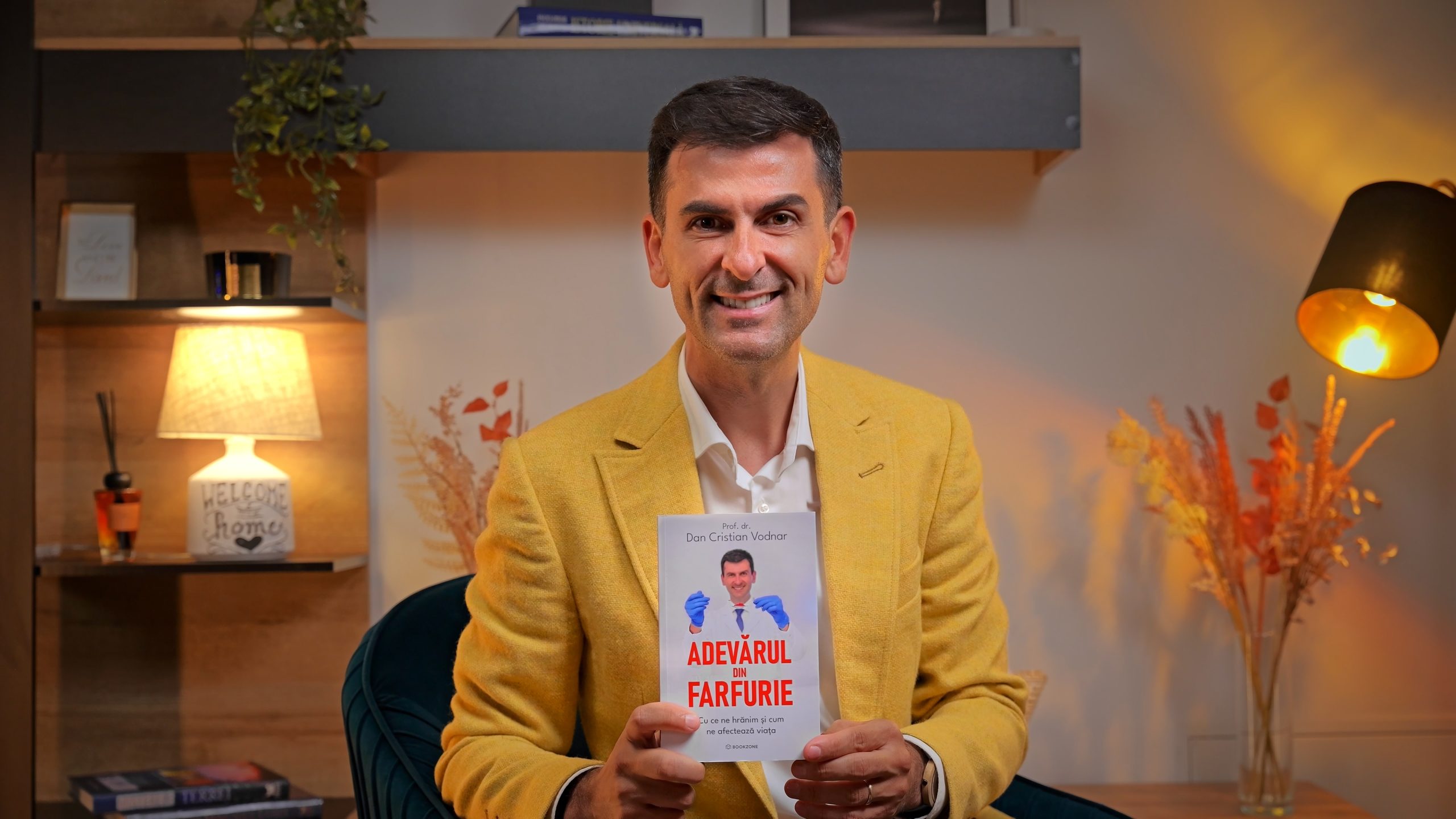
Prof. Dr. Dan C. Vodnar is one of the most influential Romanian researchers today, having been included for the sixth consecutive year in the top 2% of the world’s most cited scientists, according to the analysis conducted by the Stanford–Elsevier group, and designated a Highly Ranked Scholar 2025 by ScholarGPS. His work operates at the intersection of top-level academic research, international collaboration, and partnerships with the private sector. In addition to his university role, Prof. Dr. Vodnar collaborates with DY Nutrition Global and Vitema Pharmaceuticals on projects dedicated to developing innovative solutions in nutrition and health. He is also involved in educational initiatives aimed at bringing science closer to the general public, such as the “Professor Vodnar” podcast, which translates complex scientific topics into accessible language. In the interview below, we discuss relevant research, real-world impact, the relationship between science and industry, and the role of the researcher in a society caught between information and misinformation.
You have been included, for the sixth consecutive year, in the top 2% of the most cited scientists in the world. Beyond statistics, what does this indicator reflect about how research is built and validated globally?
This indicator does not measure only individual visibility; it reflects how research is constructed and validated at the global level. Citations do not occur by chance—they indicate that a paper is useful to other researchers, that it offers replicable methods, transferable concepts, or relevant data. Globally, research that truly matters is research that solves real problems, is interdisciplinary, and can be integrated into other scientific contexts. At the same time, this type of indicator shows a shift in focus: from the quantity of articles to their real influence. The global scientific community increasingly penalizes work that is formally correct but practically irrelevant. Visibility comes from consistency, collaboration, and international openness.
Looking back, which professional decisions mattered most in shaping your academic path? Were there key moments that changed the trajectory of the research you conduct today?
The most important decisions were those that pushed me out of my comfort zone. Choosing to work interdisciplinarily, to build teams, and to collaborate internationally—even when this involved professional risks or additional effort—was defining. Another key decision was investing time in training young researchers and in infrastructure, not just in my own CV. This profoundly changed the trajectory of the research group. Another turning point was assuming an academic and institutional leadership role. Research management is often underestimated, but without it, good ideas remain isolated.
Top-level research requires not only ideas, but also consistency, teams, and infrastructure. How is a high-performing research ecosystem built over time in a context such as Romania?
A high-performing ecosystem is not built through isolated projects, but through continuity. Predictable funding, usable infrastructure, and stable human resources are essential. In Romania, the issue is not a lack of intelligence or creativity, but fragmented efforts and the absence of a coherent long-term strategy. A solid ecosystem means internationally connected centers of excellence, real researcher mobility, public–private partnerships, and an administrative framework that supports research rather than blocks it. Without these elements, performance remains episodic.
In the international academic environment, competition is extremely intense. From your experience, what differentiates research that becomes globally cited and used from research that remains local?
The major difference is relevance. Globally cited research addresses questions that go beyond a local context and offers transferable solutions or methods. It is also published within international collaboration networks, not in isolation. Access to open data, methodological transparency, and the ability to integrate multiple perspectives are decisive factors. Research that remains local is often overly descriptive, poorly connected to international literature, and lacks a dissemination strategy.
You collaborate with both academia and the private sector. What are companies looking for in their relationship with scientific research, and what do they gain concretely from this collaboration?
Companies seek predictability, scientific validation, and access to advanced knowledge. They are not necessarily looking for articles, but for solutions—process optimization, product innovation, risk reduction, and market credibility. Collaboration with academia provides access to rigorous methods, research infrastructure, and highly qualified human capital. In turn, research gains relevance, alternative funding, and real-world testing of applicability.
You have often spoken about the importance of translating science for the general public. How do you see the role of the researcher in society, beyond publishing academic papers?
The researcher has a civic role—not only to produce knowledge, but to translate it, contextualize it, and contribute to informed decision-making. In a society oversaturated (obese) with information but poor in understanding, researchers must be clear, responsible, and accessible voices. This involvement does not diminish academic rigor; it complements it.
The launch of the volume “The Truth on the Plate” comes at a time when nutrition information is extremely fragmented. What is the stake of this book, and what did you aim to bring that differs from the dominant discourse?
The stake of the book is clarity. In a field dominated by extremes—miracle diets, food demonization, or contradictory messages—the book offers an evidence-based, balanced, and contextual perspective. It does not promise quick fixes, but explains the biological mechanisms underlying dietary choices. The difference from the dominant discourse lies in rejecting sensationalism and emphasizing understanding rather than rigid prescriptions.
If research were viewed as a business of ideas, what would be the main investments Romania should make in the coming years to remain relevant internationally?
The most important investments are in people, infrastructure, and governance. Well-trained, motivated, internationally connected people; modern but functional infrastructure; and an efficient, transparent research management system. Without these investments, fragmented funding does not generate lasting impact.
From an economic perspective, how is the value of scientific research measured? What are the real indicators that should matter to decision-makers and investors, beyond the number of publications?
The value of research is not measured only in articles, but in its capacity to generate solutions, products, public policies, and human capital. Relevant indicators include technology transfer, applied patents, industrial collaborations, skills development, and societal impact. Publications are important, but not sufficient to assess real value.
Where does Romania stand today in the global research and innovation chain? Are we providers of know-how, consumers of technology, or mere executors?
Romania occupies an intermediate position: it has the capacity to produce valuable know-how, but does not capitalize on it sufficiently. We are more providers of talent and data than creators of scalable technologies. With strategic investments and coherent policies, this position can be changed—but it requires vision and continuity.
Why can the same food “sit poorly” one day and feel perfectly normal on another? What factors influence digestion from one meal to the next?
Digestion is not an isolated process, but a function integrated into the entire organism. When we are relaxed, well-rested, and eat in a calm environment, the parasympathetic nervous system is active—exactly the state required for efficient digestion. On days marked by stress, haste, or fatigue, the body enters an alert mode, and digestion is no longer a biological priority. In addition, gastric acid and digestive enzyme secretion vary depending on circadian rhythm, previous meals, and stress levels. The gut microbiome itself is not identical from one day to another. What we ate yesterday influences which bacteria are active today. As a result, the same food can be fermented differently, producing more or less gas, discomfort, or inflammation. The body is not “capricious,” but highly adaptive.

 UK
UK
 IT
IT
 ES
ES
 DE
DE
 FR
FR
 RO
RO
 PT
PT
 HU
HU


