


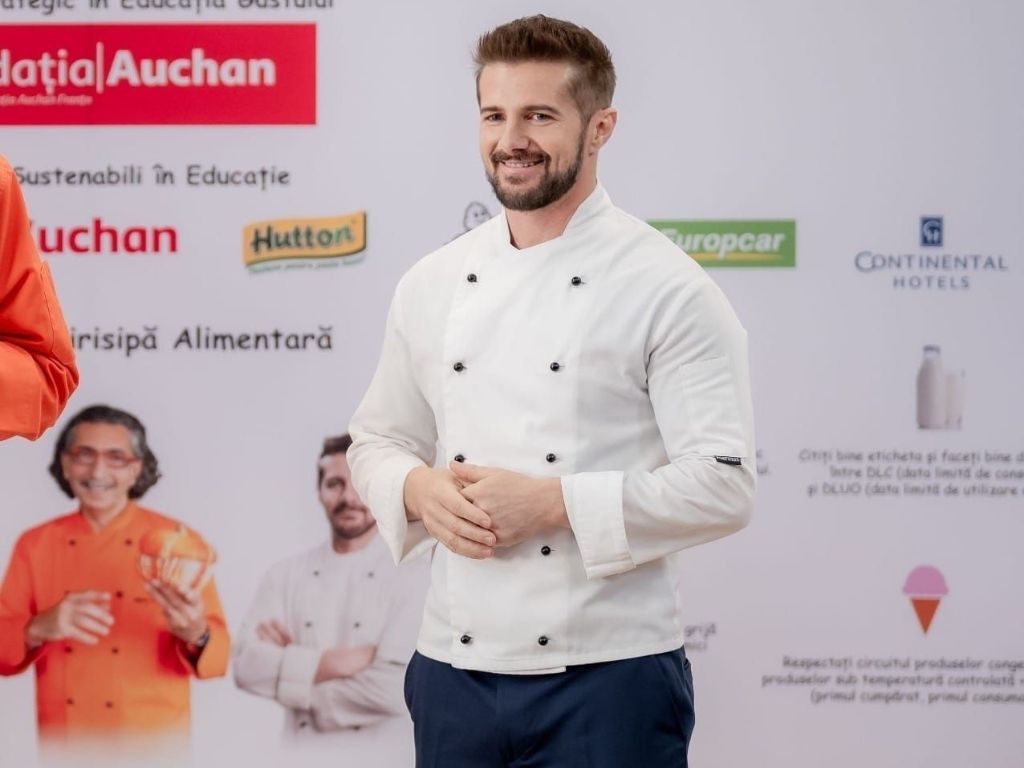
Daniel Dobre shares the mission and evolution of Taste Celebration, a project that turns food education into a living experience, connecting authentic taste with health, sustainability, and responsibility toward future generations.
What has defined Daniel Dobre’s career as a whole has been the consistency of his educational mission: “To educate future generations to eat more consciously, more healthily, and with respect for taste and nature.” He is not only a promoter of taste, but also a shaper of attitudes — a bridge between culinary tradition, education, and social responsibility.
By gaining experience in the food and HoReCa industry, he learned how taste connects with education and experience. Having inherited the art of traditional cooking from his mother and grandmother in Transylvania, the early 2000s marked the beginning of enriching his international cultural and gastronomic universe. During that time, he also became aware of international initiatives dedicated to responsible nutrition, which promoted awareness of healthy eating from childhood. Among these were programs such as “Education for Taste,” implemented in France, Switzerland, and Italy in the 1990s.
C&B: If we were to look at the narrative thread of your career, what were the key moments that defined you?
Daniel Dobre: Key moments: The official launch of the program in Romania (2010).
The first chapter of my journey was about passion for taste and tradition. Between 2000 and 2010, working in several Romanian, French, and Italian restaurants and visiting, as a tourist, some of the most important international culinary competitions, as well as meeting prestigious chefs, including Paul Bocuse in 2005, shaped my professional training in gastronomy. I discovered how culinary culture can be a powerful vector of education and identity, which over time transformed for me into a vision and a purpose in itself.
The second key moment was the launch and development of the educational program “The Celebration of Taste” in Romania, at the suggestion of Patrick Pierre Pettenuzzo, co-founder, as a Romanian-French educational program dedicated to cultivating taste culture, promoting balanced nutrition, and encouraging respect for local producers and seasonal food.
The creation of the “Lessons of Taste” tour — a traveling project through schools, where students learned about healthy food through taste and play.
The publication of the “Pedagogical Brochure of Taste,” a true manual of food education intended for children and teachers.
The program, officially launched in Romania around 2010, marked the beginning of a new stage in children’s food education. Within it, the “Lessons of Taste” tour was created, a traveling school project where students had the opportunity to learn about the importance of healthy eating. Complementarily, the “Pedagogical Brochure of Taste” was published, a true manual for children, parents, and teachers, offering diverse notions from fields such as general knowledge, mathematics, Francophonie, geography, history, and natural sciences. Thus, the program managed to combine food education with the development of knowledge and critical thinking, leaving a lasting imprint.
The third key moment was the program’s expansion nationally and internationally. In 2023, all third-grade students in Romania benefited from the educational program, marking an important step in consolidating its national impact.
In 2024, the Ministry of Education in Spain, through its official project submission procedure, approved the proposed study module in Spanish, intended for schools in the Valencian Community.
C&B: What has been the most difficult moment in your journey so far, and how did you overcome it?
Daniel Dobre: The most difficult moment was the period when the project’s enthusiasm and vision were greater than the available resources. The attempt to expand nationally brought serious challenges: coordinating multiple stakeholders, the lack of stable funding at the beginning, and the need to convince partners and institutions that education about food deserves long-term investment and trust, at a time when sustainability was not yet perceived as an imperative priority in the choices and concerns of partner companies. We could say we were ahead of our time, anticipating directions that would later become essential. Looking at it positively: better late than never — especially when it comes to education, responsibility, and the future.
It was a test moment, with a real risk that the project would remain small-scale or even stop. The team’s determination, resilience, and constant connection to international best practices played an important role. We sometimes had to readapt the format of certain B2B events to retain and attract potential sponsors while remaining consistent with our initial educational principles. Perseverance, open dialogue, and the belief that real change is built step by step, like the foundation of a house, transformed that difficult period into a moment of maturation for the project.
C&B: Is there a dream or ambition that has always guided you, regardless of obstacles?
Daniel Dobre: The dream that has always been present, regardless of obstacles, has been to change people’s relationship with food — not through fear, diets, or restrictions, but through understanding, joy, and respect.
From the beginning, the ambition was that every child, parent, or adult should know what they eat, where their food comes from, and what impact their daily choice on the plate has on their own health and on the planet. A simple dream in wording, but profound in its consequences: a society that eats more consciously is a society that is healthier, more balanced, and more responsible.
Enthusiasm and hope have always guided me, and this ideal has directed all important decisions, including in difficult moments when the road seemed too long or resources insufficient. The conviction that food education can become a form of culture, not just information, has been the engine that kept the project moving and gave it long-term meaning.
C&B: What were you like at the beginning of your journey, and how do you feel you have transformed up to the present?
Daniel Dobre: At the beginning, I was, above all, enthusiasm and intuition. A lot of energy, bold ideas, determination, and a sincere desire to do good, even if I did not yet have all the tools, structure, or experience needed for a large-scale project. We were guided by conviction and passion.
The transformation has been profound. Anchored in reality and organized, we are aware of the responsibility we have toward communities, partners, and the public to protect the future by improving the present. We have learned to balance idealism with pragmatism and to build for the long term.
Today, we feel like a mature team that has preserved its original spirit, enriched with experience, patience, and clarity. The transformation did not mean losing enthusiasm, but refining it — into a more solid, coherent, and powerful vision.
C&B: If we met your team or collaborators, what do you think they would say about you?
Daniel Dobre: Pleasant but demanding, passionate and deeply attached to the project’s moral values. That I genuinely care about people and impact, not just results or visibility, and that we put a lot of heart into everything we do.
Many would mention that the Romanian expression “you throw me out the door, I come back later through the window” suits me. They would say I am stubborn in moving forward even when things become complicated or when we receive refusals — persistent, but in a good sense — because I do not compromise when it comes to the quality of the message, education, or respect for food and the environment.
At the same time, I hope they would say that working with me means dialogue, openness, and the feeling of being part of a meaningful leadership journey — not just a project, but a community built on trust, collaboration, and strong shared values.
Team: Daniel Dobre is a true Swiss army knife, as precise as a problem-solver when facing complications and certain Romanian habits that range between imposture, bureaucracy, procrastination, and random time management. He is rigorous without appearing so, taking the time necessary to craft the right scenario while seeming not to have a clear direction. In fact, he knows exactly where he is going and can intuit what remains unsaid by his interlocutors, already having the appropriate answer prepared. With those who do not respect their word, he is direct, not easily fooled, and makes it clear he has no time to waste on nonsense. With him, there is no room for approximate answers; he will clearly show you where you stand if you only pretend to listen. He expects your answer and will not hesitate until you respond sincerely, without falsity.
Being strict with himself, he expects the same commitment from those with whom he debates. Without a serious argument, or in the face of digressions, he does not hesitate to bring people back to their responsibilities.
Yet he is also a pleasant person; often his actor’s side comes out. In relaxed moments, he can be Louis de Funès, Mr. Bean, or even Chaplin. Like all hardworking people, you must be ready to keep up and not pretend; you need stamina to match his pace. Still, he demonstrates every day that his tenacity and honesty bring results in advancing a complex and innovative project whose objectives go far beyond appearances.
C&B: What is the most important decision you made that changed your trajectory?
Daniel Dobre: Every year, the chef’s hat of the educational program receives the support and trust of some of the greatest chefs on the planet. It is more than a symbol — it is a message-promise passed from hand to hand, from generation to generation.
Since 2014, the chef’s hat has carried the signatures of three-Michelin-star chefs from around the world, such as the legendary Paul Bocuse, Jérôme Bocuse, Alain Ducasse, Alain Passard, Daniel Boulud, Massimiliano Alajmo, Yannick Alléno, Régis Marcon, Martín Berasategui, and others. In 2015, another remarkable moment followed: no fewer than 16 executive chefs from royal households, presidencies, and governments around the world signed it — from France, the United Kingdom, the United States, Italy, Israel, Canada, Monaco, and beyond. And the story continues with a surprise.
It may sound unusual, but I want to share an episode from the history of The Celebration of Taste, which took place in 2016 and relates to the question above, hence this introduction.
I met the famous French chef Marc Veyrat, awarded three Michelin stars. After visiting him at his invitation, he generously signed the chef’s hat, and for three days I had the privilege of working alongside him in his kitchen.
At the end, he offered me what for many would have been the ultimate dream: to stay and work for him in his three-Michelin-star restaurant. I said NO.
For many, that decision might seem like a missed opportunity. For me, even if it was somewhat difficult, it was an act of loyalty to my own vision. Even though at that time the project was going through difficulties and struggling to retain or attract partners, I chose to stay on my educational path.
It was not easy. But it was the choice that defined me — devoted and loyal to a vision alongside my team.
C&B: How was the partner network built, from public institutions to private companies and NGOs, and what role do they play in the success of the Taste Celebration?
Daniel Dobre: The success of the Taste Celebration would not have been possible without this network, built with patience, respect, and mutual trust—just as a good recipe needs the finest ingredients and skilled hands to bring them together.
We began with public institutions, which provided the official framework and support necessary for the project to be recognized and to achieve national impact.
Over time, the educational program has benefited from the consistent moral support of key institutions. The Ministry of Education has been present since the very beginning, in 2010, followed by the Embassy of France in 2012, the Ministry of Agriculture and Rural Development in 2014, the Bucharest City Hall in 2016, the Representation of the European Commission in Bucharest in 2017, the Department for Sustainable Development within the General Secretariat of the Government in 2019, the Ministry of Economy, Digitalization, Entrepreneurship and Tourism in 2024, and more recently, the National Sanitary Veterinary and Food Safety Authority – ANSVSA, in 2025.
The partners and sponsors we approached were carefully selected through a strategic and well-thought-out process, much like preparing a refined menu: each collaboration had to be perfectly balanced, based on shared values and mutual trust.
We carefully avoided partners whose products or services were contrary to the healthy lifestyle we promote; some were even declined, because the integrity of the project and its message have always been more important than any sponsorship opportunity.
At times, even when budgets were not what we had hoped for, we also faced limitations imposed by sponsors’ desire to be unique within their product category at events, which meant we could not collaborate simultaneously with competing companies. Even in such moments, we continued to be guided by the same principles and to build partnerships that truly served the vision and values of the Taste Celebration and, of course, those who believe in the program’s motto, even if this meant financial compromises or more limited resources.
C&B: The festival promotes the motto “Good for Taste, Good for Health, Good for the Planet!” What does this philosophy concretely mean for the founding team?
Daniel Dobre: If we want real change in society and in future generations, we must begin in childhood. School is the foundation of healthy thinking—the place where mindsets that define our future are built. The key lies in childhood, where education has the power to shape not only knowledge but also long-term values and behaviors.
As Abraham Lincoln said: “If you think education is expensive, wait until you see the cost of ignorance.”
At the same time, food is not a trivial act, but a deeply cultural and identity-driven one. Emil Cioran captures the essence of this idea: “Eating: a ritual, an act of civilization, a philosophical stance.”
Xavier Alberti completes this perspective by emphasizing that “at the table and in the kitchen there is far more than the act of eating itself; it is also where the foundations of our social patterns are defined.”
Thus, food education built from an early age, starting in school, can generate real impact and profound transformations in all aspects of individual and social life, contributing to the formation of more aware, responsible, and healthier generations, and of course to an innovative 360° vision for Romania—one that views food education not in isolation, but as an integrated system linking school, family, community, local producers, and the environment, with the goal of generating long-term sustainable change.
For the founding team, the motto “Good for Taste, Good for Health, Good for the Planet!”—the same motto as the French one-Michelin-star chef Alain Alexanian, “Bon, Bon, Bon!”, present at every launch of the educational program on World Food Day, October 16—is not an abstract slogan, but a clear set of criteria by which all festival decisions are made.
Good for Taste means real quality food: clean ingredients, authentic flavor, well-designed recipes, and producers or chefs who put passion and skill into what they do. The pleasure of eating well is essential.
Good for Health translates into promoting balanced foods, minimally processed, with an emphasis on transparent sourcing and options that support a healthy lifestyle without unnecessary excess.
Good for the Planet implies responsibility toward the environment: supporting local producers, reducing food waste, sustainable packaging, and choices that minimize impact on the ecosystem.
Overall, this philosophy reflects the team’s belief that excellent taste, care for people, and respect for nature can coexist harmoniously. In conclusion, it represents a mix of sustainable food ecology—and the Taste Celebration is the space where these values become concrete experiences for the public.
Raising awareness among younger generations, from an early age in school, about sustainable food is part of the 17 UN Sustainable Development Goals, more specifically Goal 4: Quality Education, which in turn positively influences Goal 3: Good Health and Well-Being, Goal 8: Decent Work and Economic Growth, Goal 10: Reduced Inequalities, Goal 12: Responsible Consumption and Production, and Goal 13: Climate Action.
C&B: What does a typical day look like for you now, and which moments of the day bring you the greatest satisfaction?
Daniel Dobre: A typical day for me is a balance between discipline and the satisfaction that the day has passed and something useful has been accomplished. My daily routine alternates between communication and meetings dedicated to building strategic collaborations that bring real value to the community and the Taste Celebration educational program, and moments directly in the field, alongside those who give meaning to our work: meetings in schools with third-grade students as part of the “Taste Lessons” tour.
These moments are, by far, the most fulfilling: interacting with curious children, the enthusiasm with which they welcome us, their lively questions, the joy of discovering flavors, and the affection they show us at the end of each session give us energy and reconfirm the educational impact of the project.
The fact that I was a performance athlete in childhood, later continued with fitness as an adult, and recently resumed competitive activity as a 100-meter sprint athlete within the Romanian Athletics Federation at the RMA club allows me to offer a concrete example of leadership through a healthy lifestyle, inspiring not only the younger generations involved in the project to practice sports, but also entire families and communities.
I feel the greatest satisfaction in simple yet profound moments, when I notice that during the day that has passed I have done something tangible and useful, when I see an idea come to life, when a partner resonates with our vision, or when I receive feedback from children, teachers, or Horeca professionals confirming that our work has real impact. At the end of the day, satisfaction comes from the feeling that I have remained faithful to my values and contributed, through education and personal example, to building a more aware, healthier, and more responsible future.
C&B: What values or principles guide you in what you do, and how do you apply them day by day?
Daniel Dobre: We often ask rhetorical questions about the meaning of life or the purpose of our existence on earth. In my case, the answer came naturally: do good around you—and that is enough. This principle guides me to live with integrity, to respect people regardless of their condition or level of education, and to always choose what I feel is right, even when it is not easy.
I try to live in such a way that each day has meaning, to put passion into what I do, and to set an example through my healthy and balanced lifestyle. Whether it is discipline, perseverance, or the joy of discovering and sharing beautiful things, I believe that the true measure of life lies in the impact you have on those around you and in the good you leave behind.
The world is evolving. If we look back at the progress humanity has made in the last 25 years, technology has made extraordinary leaps, changing the way we communicate, work, and learn. Why should we not become equally involved, morally and spiritually, in contributing to a deeper and more balanced understanding? Just as technology propels us forward, values, awareness, and reflection can help us use these advances wisely and harmoniously to create greater balance.
We can constantly ask ourselves: what can we do so that the people we meet are happier? For me, health is the highest priority—there is a saying that “if you have health, you can do anything,” and that says it all.
The healthy lifestyle I try to apply every day rests on four fundamental pillars:
A diversified and high-quality diet that provides the body with energy and balance;
Sport, for vitality, discipline, and mental balance;
Quality rest, to restore both body and mind;
Well-being through harmonious relationships, in order to live each moment with joy and awareness alongside those around us and within our environment.
C&B: How was the Taste Celebration born and what was the initial motivation for transforming education about healthy eating into a national project?
Daniel Dobre: The Taste Celebration was born from a simple yet powerful need: to reconnect people with real food and its meaning.
When we started, in 2010, the Ministry of Education and the Ministry of Health had already adopted a government decision encouraging primary school teachers to deliver lessons dedicated to a healthy lifestyle.
In this context, we responded to this initiative with educational material designed to help children discover, learn logically, and acquire responsible habits and behaviors related to nutrition, avoiding food waste, and adopting a balanced lifestyle.
We wanted the experience to be more than a playful activity, going beyond simply cooking in the classroom. Our objective was to create an authentic act of learning, based on practical and applied themes that would contribute to the development of critical thinking and children’s ability to make conscious choices.
The founding team started from the observation that, in the rush of daily life, eating had increasingly become an automatic act—fast, processed, disconnected from origin, seasonality, and its impact on health and the environment.
The ever-accelerating pace of modern life, combined with often superficial food choices, makes the challenges related to responsible consumption more complex and pressing than ever. In the pursuit of speed and convenience, we often lose touch with seasonality, product origin, and the impact on natural resources, amplifying waste and imbalances in how we eat and live. This includes not only food but also the consumption of resources such as gas, electricity, and water, highlighting the need for a more conscious and responsible attitude toward everything we use.
The initial motivation was educational. The founders noticed that information about healthy eating was often either too theoretical or moralizing and did not truly reach people. Thus emerged the idea of transforming food education into a living, accessible, and enjoyable experience: learning about food through taste, meetings with producers, workshops, culinary demonstrations, and real stories.
The transformation into a national project came naturally because the theme is universal. Health, taste, and care for the planet concern not just a small community, but society as a whole. The Taste Celebration set out to create a platform that brings consumers, educators, chefs, farmers, and institutions to the same table, offering a common language and concrete solutions.
Teaching young people and their parents to ask the right questions—what do I eat, how do I eat, why do I eat this way, and what impact will this have in the future on myself, my family, my community, and implicitly on nature—is essential. In this way, we contribute to the development of a sustainable food culture and provide younger generations and their parents with a logical framework of thinking, constructive and positive critical thinking to understand concretely what it means to eat healthily.
Long-term change in mentalities is not achieved through strict rules, but through the joy of taste, correct information, and the rediscovery of the value of food as a central element of a healthy and responsible life that allows us to live in a cleaner and more balanced environment.
C&B: What are the development plans for the Taste Celebration in the coming years? Expanding themes, new formats of engagement, or strategic collaborations?
Daniel Dobre: The development plans for the Taste Celebration in the coming years, aligned with our post-COVID 2023/2030 motto, focus on consolidating our educational mission and expanding the project’s impact. We aim to broaden the themes addressed, introducing new perspectives on healthy eating, sustainability, local traditions, and culinary innovation, so that participants can explore taste in all its dimensions.
We also intend to develop new engagement formats that allow everyone—from young students to industry professionals—to actively participate, whether through workshops, masterclasses, culinary competitions, or interactive experiences, transforming gastronomic education into a memorable experience.
At the same time, we aim to strengthen and expand strategic collaborations with public institutions, private companies, NGOs, and sponsors who share the same values, in order to create sustainable and innovative projects capable of inspiring entire communities and transforming the way people relate to food.
In essence, the coming years of the Taste Celebration will be about smart growth, authentic education, and culinary experiences designed to leave a lasting mark, contributing to building a better future for Romania—the Green Garden of Europe.
We also intend to expand the project’s impact by giving it a broader dimension and contributing to the creation of a common framework for food education at the European level.
I have a question for each of us, a rhetorical question of introspection: what is truly our purpose in this journey of life, in the place where we live? Beyond career and care for family, do we not also have the mission to bring progress to our community, to transform the environment in which we live, and to leave behind a more beautiful and harmonious place?
Through vision, consistency, and partnerships built on shared values, Taste Celebration proves that change begins with education and personal example. Beyond events and activities, the project creates a framework where taste, health, and care for the planet become tangible reference points for the community and for tomorrow’s Romania.

 UK
UK
 IT
IT
 ES
ES
 DE
DE
 FR
FR
 RO
RO
 PT
PT
 HU
HU


