


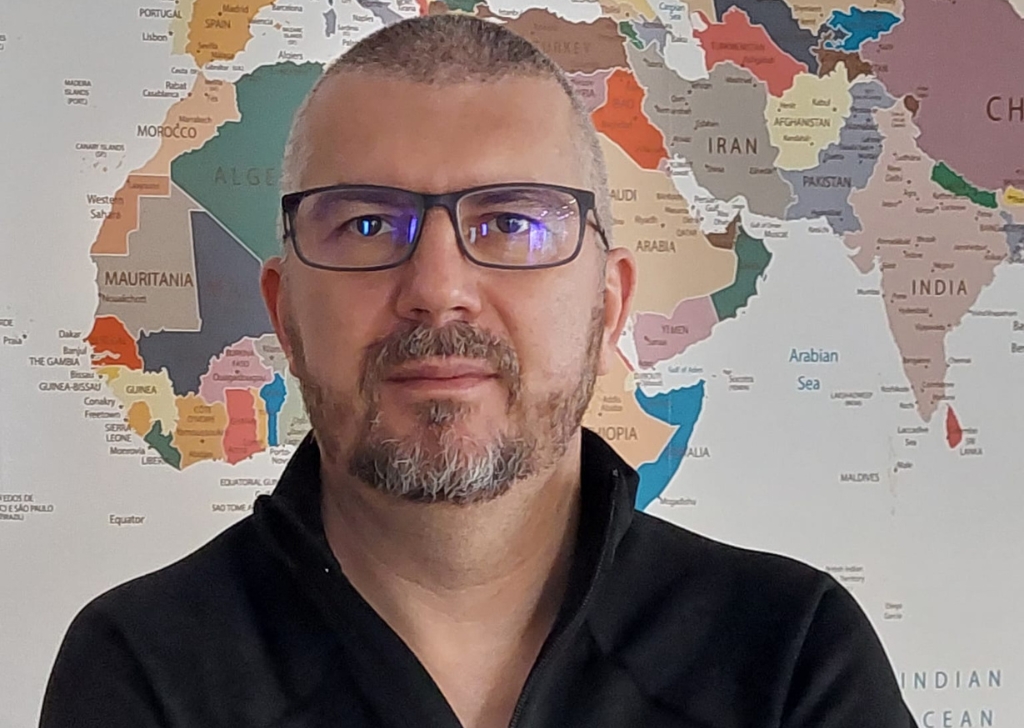
In an exclusive interview for Careers & Business, Ilie Preda, founder of AdeonaCamps, shares insights on entrepreneurship, leadership, adventure tourism, lessons learned from mountaineering, and the importance of consistency in building a sustainable business. An authentic perspective on success, values, and personal growth.
Graduate of the Technical University of Cluj-Napoca, Ilie Preda, founder of AdeonaCamps, is an unconventional entrepreneur fascinated by mountains, karate, people, and the philosophy behind every kind of ascent. At just 19 years old, he founded the Ochiul Muntelui Mountain Tourism Student Club. He never practiced in the field he originally studied, choosing instead to build his own vision of mountain tourism from a young age while continuing to climb some of the world’s great mountain ranges: the Tatras, the Alps, the Andes, and the Himalayas. Yet the ascent that matters most is undoubtedly AdeonaCamps. Even today, after 25 years, he remains actively involved in organizing mountain camps and excursions for children, playing a significant role in the development of adventure tourism in Romania.
He believes entrepreneurship is much like high-altitude expeditions. There are no guaranteed recipes for success, no certainties—perhaps only the beauty of each unique story. Attitude determines altitude!
C&B: How would you describe yourself in a single sentence that would capture the attention of someone who doesn’t know you?
Ilie: In the autumn of 2016, I decided to share lesser-known aspects of my life with people. Four years later, after repeatedly revisiting and rewriting entire chapters, a book emerged about a man who is always climbing, searching for a summit that does not exist—a Sisyphean effort whose ending remains uncertain.
On the Other Side brings together the years spent in the karate dojo, the mountains I have climbed, the entrepreneurial projects I have built, and the people who, in one way or another, influenced my transformation.
Even today, I firmly believe these worlds complement one another naturally because, at their core, they all require hard work, humility, determination, and respect.
C&B: Looking back, what has been the “red thread” guiding your professional journey?
Ilie: Avoiding a theoretical answer, I would rather highlight five personal moments that significantly contributed to my professional path and likely shaped me into who I am today:
- Founding a karate club for children at just 18 years old, together with a close friend who was equally fearless.
- Deciding to establish the Ochiul Muntelui Mountain Tourism Student Club in Cluj. It was an extraordinary opportunity and my first encounter with what I would later understand as leadership.
- Choosing to resign from what was then a very well-paid job after learning the basics of sales and deciding to follow my own dream.
- Signing the first long-term contract and building the first dedicated location for AdeonaCamps camps.
- Stepping away from the operational side of the business and delegating decision-making.
If I were to draw a common thread, I would say: vision, motivation, attitude, learning, values, and hard work.
Exactly in that order.
C&B: What was a difficult moment or failure that truly changed you?
Ilie: I believe people stubbornly refuse to learn much in the absence of pain.
Each of us evolves through the accumulation of experiences over time, but meaningful change only occurs when we are pushed beyond our limits.
For me, the critical moment came in 2021, immediately after the pandemic, when it became clear that my heart condition was far more complex than I had believed. Three medical interventions quickly pulled me into a new reality that was difficult to accept.
I was forced to understand that the mountains would remain the same without me and that the only true profit is life itself and my family. No one can stay at the summit forever.
C&B: What courageous—or counterintuitive—decision significantly influenced your trajectory?
Ilie: It happened in 2009, the year my daughter was born and also the year the global economic crisis was causing dramatic effects across every industry.
At that time, I signed a 15-year contract for a mountain lodge in the Retezat Mountains, a property requiring extensive renovations and a substantial budget.
It seemed crazy, but I took the risk and borrowed the money needed to start the investment, surprising everyone around me—including my own family.
It worked. From that year on, AdeonaCamps began a steadily upward journey.
There was very little time before the start of the summer season, and what followed felt worthy of a Hollywood movie. I described the episode in detail in the book I mentioned earlier. In short, our first guests had already left Timișoara while we were still landscaping the property.
Romania’s road infrastructure unexpectedly helped us. The group was delayed, and the extra two hours we gained before their arrival meant flowers throughout the courtyard and the smell of fresh paint everywhere.
Today, I remember those times fondly, especially since Lolaia remains part of the Adeona portfolio—a place very close to my heart.
C&B: How have you changed over time as a leader and professional?
Ilie: I believe the passing years and especially the health issues I mentioned earlier taught me to slow down.
Deadline-driven projects and an endless list of achievements—if I may put quotation marks around the word—come with a price, one paid first by the leader and later by the team.
I have come to the conclusion that the process is more important than the numbers, even if this somehow contradicts entrepreneurial thinking and is therefore difficult to accept.
It wasn’t easy for me, but I believe I eventually understood that in life—and therefore in business—everything should be measured, yet time is the most important resource. All other resources will naturally align afterward.
C&B: What do you think the people who work closely with you would say about you beyond your public image?
Ilie: I don’t have a professionally crafted public image. Some say that is not something to be proud of and that an entrepreneur or leader should embody the image of their business.
I don’t feel the need to be at the center of attention, although I have often found myself in that position and managed reasonably well.
In fact, I do not believe I deliver what is popular today—inflated numbers, clichés, and glitter—but rather a certain spirit of humility, perhaps even an excessive one, which I cultivated through mountain climbing and years spent in the dojo.
To answer the question, I would like to believe that I inspire the people around me, even if I am often challenging.
C&B: What truly differentiates the way you build or lead?
Ilie: I believe there have been two completely different stages in my evolution.
The first was before the age of 45, when deadline-driven projects were the norm. The second began with my health issues.
As I mentioned earlier, every action comes with a cost. When that cost is no longer measured in money but in days spent in a hospital, decisions become self-evident.
As for my leadership style, I genuinely believe organizational culture is what people do when the leader is not present—not what they say they do, but what they actually do.
For this reason, I have avoided controlling people and invested heavily in trust. The real battle was against inherited prejudices and my own fears.
Sometimes I was wrong. Sometimes I made poor choices. But that is part of the game.
I do not hide the fact that there were occasions—few, fortunately—when my perspective was completely mistaken and I treated valuable people unfairly. That too is part of my evolution, even if it is less comfortable to acknowledge.
C&B: How has the current context—technology, AI, and the economy—changed the way you work?
Ilie: A large part of AdeonaCamps’ activity takes place in nature, in the mountains, or on sports fields.
Apart from the inevitable business tools used for communication, promotion, and marketing, we are only minimally affected by technological transformations.
I could say that the current context dramatically influences the behavior of our customers, and that behavior, in turn, transforms us and the way we operate. However, that is a much broader discussion than the space here allows.
C&B: Is there a habit or routine that has significantly influenced your performance?
Ilie: First of all, I believe I should define what performance means to me in business: I managed to build a model organization in a niche field without resources, relevant information, or established examples to follow.
Today, Adeona’s impact is significant, confirmed by the tens of thousands of students who have participated in our programs over the years. For most entrepreneurs, performance is measured through revenue, number of employees, or profit.
My main routine is organization. I do not start projects until I know exactly what steps need to be taken and what scenarios might arise.
At the beginning of each year, I create a rigorous plan that includes personal goals, new projects, ongoing projects, development initiatives, and investments.
All of these are anchored in a calendar and supported by separate budgets.
This does not mean such planning guarantees success, but it certainly provides a mirror that accurately reflects reality.
It helps that I can break down long-term objectives into smaller ones and track their achievement in detail without excessive effort.
I believe we should make a habit of taking one small step every day toward the summit we are trying to reach.
Long-term results do not come from spectacular leaps but from small, consistent, repeated achievements that accumulate quietly until they become a difficult-to-match advantage.
Real progress appears when you do those “small things” even on the days when you don’t feel like it.
Rhythm beats intensity, and consistency becomes a multiplier of results.
This is the formula through which strong careers, resilient businesses, and highly capable people are built.
C&B: What principles guide your most important decisions?
Ilie: It is a complex question with many possible answers. I will try to limit myself to five principles derived from five questions that I consider essential:
- Why am I doing this? Is it important for me or for the business? How clear is the objective?
- What resources does the project require? Time, energy, and money—in that order.
- What are the possible scenarios? What is the downside risk for me or for potential partners?
- Who are the partners and people involved? Do we share the same values, standards, and expectations?
- Have enough days passed since I formulated my answers? Are those answers still valid? If yes, the project is probably viable.
I can honestly say that whenever I failed to answer one of these questions rationally and allowed emotions to dominate the analysis process—or avoided or vaguely answered one of them—I encountered problems in managing the project, some of them quite serious.
C&B: How do you see your industry evolving over the next three to five years?
Ilie: I believe there will be substantial transformations.
I expect a restructuring and resizing of the market, a clearer specialization by activity type—mountain camps, seaside camps, educational camps, sports camps, and so on—and, not least, a forced professionalization of the sector.
By that, I mean well-defined processes and standards established by the key players in the market.
C&B: What role do you intend to play in that evolution?
Ilie: AdeonaCamps is approaching the end of a stage marked by numerous organizational transformations.
It is time to consolidate the final conclusions and balance the elements that still do not function exactly as we would like within the systems we have built.
Once this process is completed, we will move toward an accelerated franchising strategy.
Franchising itself requires professionalism, processes, standards, evaluation methods, and more.
C&B: What practical advice would you give someone who wants to build something meaningful today?
Ilie: I will be as concise as possible and limit myself to five essential questions:
- Are you sure your dream or project is not just a passing trend or temporary whim? What will it look like years from now?
- Can you create transformation, progress, or meaningful impact in your chosen field?
- Do you have the necessary resources? What is their source?
- Who will accompany you on this journey?
- Who do you want to become by the end of it?
If the answers satisfy you, it is time to act.
If, after many years, you remain relevant, you probably answered those questions correctly.
If you need to constantly praise yourself on social media, you may be making money—I cannot say—but it is certain that you have not built anything truly meaningful.
C&B: What is an uncomfortable truth about your industry that few people talk about?
Ilie: Unfortunately, the children’s camp market—the market in which we also operate—is undergoing continuous transformation, and not necessarily in a positive direction. This is only my personal opinion and should be treated as such.
Behavioral patterns are changing at an astonishing speed from one generation to the next.
Social media and the isolation of young people are part of this irreversible process. The confusion between reality and the virtual world seems to be becoming acceptable.
Mountains, nature, and sports of any kind all require a certain level of physical effort.
What is sad is that fewer and fewer children are willing to make the effort necessary to experience the joy of a hike in nature or a ball game with friends. Instant gratification is only one click away.
The real issue is this: parents are part of this transformation as well.
The mountains are a way of life, and I believe each of us has a responsibility to bring them, in one form or another, into our children’s lives.
But perhaps that is a conversation for another time.
Ilie Preda’s story proves that authentic performance is built over time through discipline, patience, and the ability to remain true to one’s values. From mountain expeditions to the development of AdeonaCamps, every stage of his journey reflects the power of consistency and trust-based leadership.

 UK
UK
 IT
IT
 ES
ES
 DE
DE
 FR
FR
 RO
RO
 PT
PT
 HU
HU


