


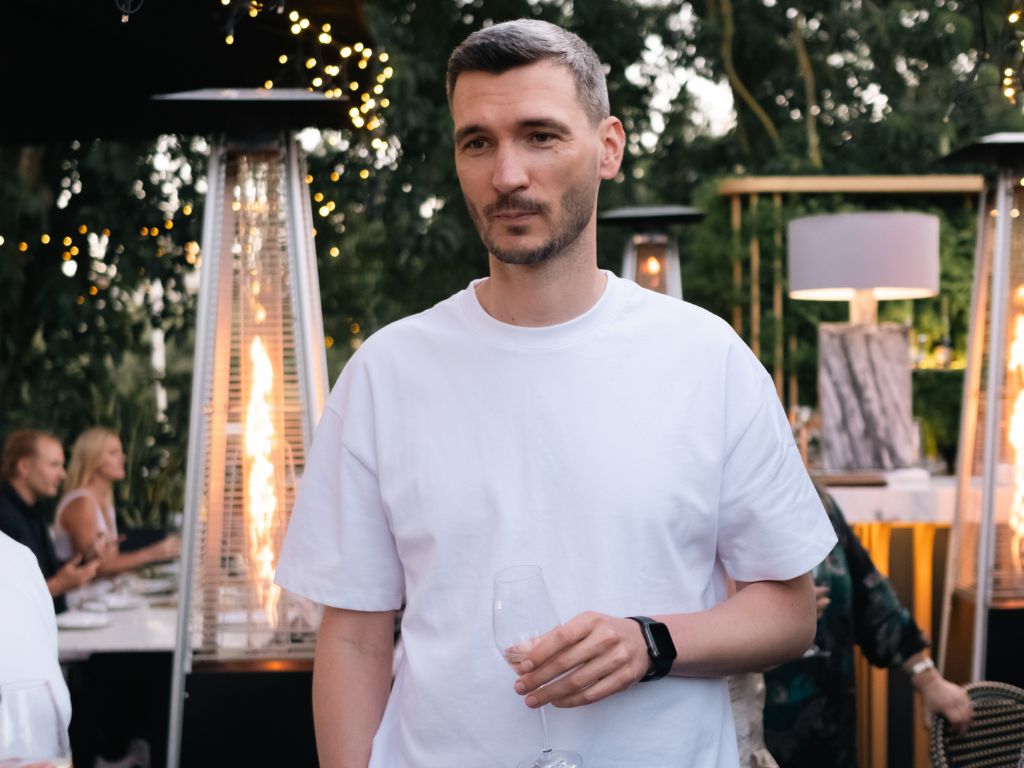
With over 10 years of experience in operational management and business systematization, Mykhailo Zimin explains why fractional leadership is not about temporary intervention, but about building systems that allow companies to grow sustainably beyond the founder.
Behind companies that manage to grow without chaos, scale without breaking, and move to the next level without constant crises, there is often invisible work. It is not the work on stage, nor the one in pitch decks or PR campaigns, but the work of structuring, discipline, and decision-making. Mykhailo Zimin is one of the professionals who operate precisely in this invisible yet essential space.
A fractional COO and CEO strategist, Mykhailo has over a decade of experience in operational management and business systematization. His professional journey began in project management and naturally evolved into the role of Chief Operating Officer within the international Business Constructor group, where for six years he simultaneously coordinated six businesses and over 120 employees. There, he learned in practice what it means to build processes, scale operations, and keep complex, fast-growing organizations functional.
Today, Mykhailo works as a fractional leader alongside entrepreneurs and CEOs, helping them design efficient business systems, balance strategy with operations, and create structures that can function without the founder’s constant presence. In parallel, he develops educational products for training the next generation of managers and is the founder of Play Padel Camp in Portugal, a project that blends entrepreneurship with community and an active lifestyle.
The transition to the fractional model was not an abrupt leap, but a natural continuation of his professional path. After more than five years in a full-time COO role within a group of companies spanning EdTech, consulting, events, recruitment, and business clubs, Mykhailo reached a point of professional burnout. Not because the work had lost its meaning, but because the impact was limited to a single organization.
At the same time, more and more CEOs and business owners began seeking his advice on management structuring, processes, and systems. It became clear that his expertise could help many more businesses if delivered in a different format. The fractional model offered exactly that framework: the ability to work with multiple companies in parallel and focus on strategic impact rather than daily “firefighting.”
Freedom, diversity, and a market that needs education
What attracted him most to fractional leadership was the combination of diversity and freedom. Working with multiple companies at different stages of maturity allows him to identify recurring patterns, avoid common mistakes, and quickly transfer best practices from one industry to another.
The freedom to choose his clients and level of involvement is another major advantage. Mykhailo accepts only projects where he knows his expertise will generate real value and where there is openness to change. At the same time, one of the biggest challenges has been explaining this model in Eastern European markets, where the idea of a fractional executive is still perceived as an exception rather than a mature solution.
Here, efficiency is not proven through theory, but through concrete results. Why hire a full-time COO with a high fixed cost when you can access the same level of experience strategically, exactly as much as you need?
What a truly strategic project looks like
Mykhailo does not enter projects out of inertia. He carefully looks at three things: the founder’s willingness to delegate and change, the existence of a clear point of impact, and his genuine interest in the industry and team. He avoids situations where a CEO is looking for quick fixes without being willing to do the difficult work behind the scenes.
A relevant example of impact came from a collaboration with an international IT company at a critical transition stage, from the “Go-Go” phase to “Adolescence,” according to the Adizes model. This is the moment when many businesses get stuck, because the founder must let go of operational control and build a real management system.
In this context, Mykhailo’s role as a fractional COO involved organizational redesign, implementation of management practices, documentation of key processes, recruitment optimization, and the development of a managerial reporting system. Perhaps most importantly, he trained an internal operations manager who gradually took over operational responsibilities. The result was not just growth, but growth without crises, based on clarity and predictability.
Why fractional does not mean “temporary”
The fundamental difference between a full-time executive and a fractional one is not time, but perspective. The internal executive is caught in operations, urgencies, and internal politics. The fractional leader comes from the outside, with objectivity, cross-industry experience, and the ability to see the bigger picture.
Mykhailo describes the fractional role as that of a systems architect. He does not just solve today’s problems, but builds structures that work tomorrow and a year from now. Another major advantage is the transfer of know-how: teams do not just execute, they learn to think differently, more maturely, more strategically.
Fractional leadership, however, only works in a context of real trust. That is why Mykhailo begins almost every collaboration with a business audit, which gives the CEO a clear roadmap for the next 6–12 months. If there is reluctance, excessive need for control, or lack of openness, he prefers not to continue. Impact appears only when change is genuinely desired, not merely simulated.
A future model for businesses in transition
Mykhailo sees fractional leadership as an inevitable model of evolution, especially for companies caught between the startup stage and that of a corporation. In the US and Western Europe, this format is already standard, and in Eastern Europe it is beginning to take shape as entrepreneurs look for more flexible and efficient solutions.
For him, this direction is more than a professional choice. It is a mission to demonstrate, through concrete examples, that a fractional leader is not a temporary consultant, but a strategic partner who can help businesses build the foundation needed for real, sustainable growth.
In a world where speed is often confused with progress, Mykhailo Zimin delivers a different message: true scaling begins when the business is built well enough that it no longer depends on a single person.
This material is an original editorial report, created based on an interview previously published in our niche publication, Fractional. The full interview is available here.

 UK
UK
 IT
IT
 ES
ES
 DE
DE
 FR
FR
 RO
RO
 PT
PT
 HU
HU


